QUESTION IMAGE
Question
name: emily h date 2/13/24 period 12 6.7 ol project
ol dragon genetics project
in this project, you will model how combinations of genes work together to create an organism.
part 1 procedure
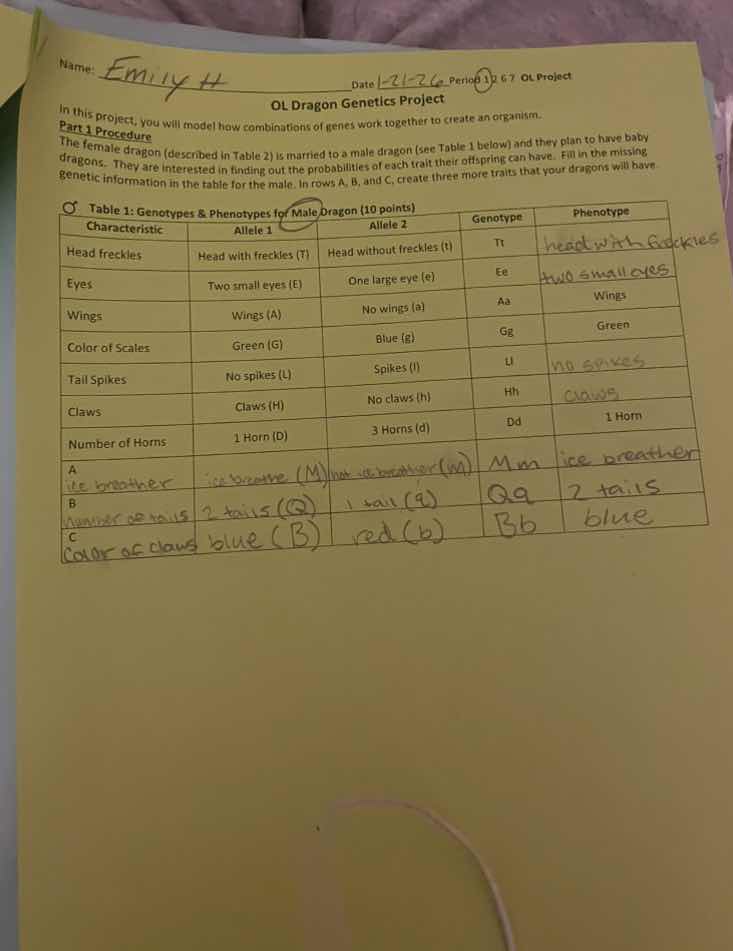
the female dragon (described in table 2) is married to a male dragon (see table 1 below) and they plan to have baby
dragons. they are interested in finding out the probabilities of each trait their offspring can have. fill in the missing
genetic information in the table for the male. in rows a, b, and c, create three more traits that your dragons will have
table 1: genotypes & phenotypes for male dragon (10 points)
characteristic allele 1 allele 2 genotype phenotype
head freckles head with freckles (t) head without freckles (t) tt
eyes two small eyes (e) one large eye (e) ee
wings wings (a) no wings (a) aa wings
color of scales green (g) blue (g) gg green
tail spikes no spikes (l) spikes (l) ll
claws claws (h) no claws (h) hh
number of horns 1 horn (d) 3 horns (d) dd 1 horn
a
b
c
To solve the missing phenotypes for the male dragon's traits, we use the principles of dominant and recessive alleles (Mendel's laws of inheritance). A dominant allele (uppercase letter) will express its phenotype even if paired with a recessive allele (lowercase letter), while a recessive phenotype is only expressed with two recessive alleles (homozygous recessive).
Head Freckles (Genotype: \( Tt \))
- Allele 1: \( T \) (Head with freckles, dominant)
- Allele 2: \( t \) (Head without freckles, recessive)
- Since \( T \) is dominant, the phenotype is Head with freckles.
Eyes (Genotype: \( Ee \))
- Allele 1: \( E \) (Two small eyes, dominant)
- Allele 2: \( e \) (One large eye, recessive)
- Since \( E \) is dominant, the phenotype is Two small eyes.
Tall Spikes (Genotype: \( Ll \))
- Allele 1: \( L \) (No spikes, dominant)
- Allele 2: \( l \) (Spikes, recessive)
- Since \( L \) is dominant, the phenotype is No spikes.
Claws (Genotype: \( Hh \))
- Allele 1: \( H \) (Claws, dominant)
- Allele 2: \( h \) (No claws, recessive)
- Since \( H \) is dominant, the phenotype is Claws.
Filling the Table (Summary)
| Characteristic | Allele 1 | Allele 2 | Genotype | Phenotype |
|---|---|---|---|---|
| Eyes | Two small eyes (\( E \)) | One large eye (\( e \)) | \( Ee \) | Two small eyes |
| Tall Spikes | No spikes (\( L \)) | Spikes (\( l \)) | \( Ll \) | No spikes |
| Claws | Claws (\( H \)) | No claws (\( h \)) | \( Hh \) | Claws |
For the custom traits (A, B, C), we follow the same logic:
- Trait A (Ice Breather, Genotype: \( Mm \)): \( M \) (Ice breather, dominant) + \( m \) (Fire breather, recessive) → Phenotype: Ice breather
- Trait B (Number of Tails, Genotype: \( Qq \)): \( Q \) (2 tails, dominant) + \( q \) (1 tail, recessive) → Phenotype: 2 tails
- Trait C (Color of Claws, Genotype: \( Bb \)): \( B \) (Blue, dominant) + \( b \) (Red, recessive) → Phenotype: Blue
Final Table (Completed)
| Characteristic | Allele 1 | Allele 2 | Genotype | Phenotype |
|---|---|---|---|---|
| Eyes | Two small eyes (\( E \)) | One large eye (\( e \)) | \( Ee \) | Two small eyes |
| Wings | Wings (\( A \)) | No wings (\( a \)) | \( Aa \) | Wings |
| Color of Scales | Green (\( G \)) | Blue (\( g \)) | \( Gg \) | Green |
| Tall Spikes | No spikes (\( L \)) | Spikes (\( l \)) | \( Ll \) | No spikes |
| Claws | Claws (\( H \)) | No claws (\( h \)) | \( Hh \) | Claws |
| Number of Horns | 1 Horn (\( D \)) | 3 Horns (\( d \)) | \( Dd \) | 1 Horn |
| Trait A (Ice Breather) | Ice breather (\( M \)) | Fire breather (\( m \)) | \( Mm \) | Ice breather |
| Trait B (Number of Tails) | 2 tai…

Snap & solve any problem in the app
Get step-by-step solutions on Sovi AI
Photo-based solutions with guided steps
Explore more problems and detailed explanations
To solve the missing phenotypes for the male dragon's traits, we use the principles of dominant and recessive alleles (Mendel's laws of inheritance). A dominant allele (uppercase letter) will express its phenotype even if paired with a recessive allele (lowercase letter), while a recessive phenotype is only expressed with two recessive alleles (homozygous recessive).
Head Freckles (Genotype: \( Tt \))
- Allele 1: \( T \) (Head with freckles, dominant)
- Allele 2: \( t \) (Head without freckles, recessive)
- Since \( T \) is dominant, the phenotype is Head with freckles.
Eyes (Genotype: \( Ee \))
- Allele 1: \( E \) (Two small eyes, dominant)
- Allele 2: \( e \) (One large eye, recessive)
- Since \( E \) is dominant, the phenotype is Two small eyes.
Tall Spikes (Genotype: \( Ll \))
- Allele 1: \( L \) (No spikes, dominant)
- Allele 2: \( l \) (Spikes, recessive)
- Since \( L \) is dominant, the phenotype is No spikes.
Claws (Genotype: \( Hh \))
- Allele 1: \( H \) (Claws, dominant)
- Allele 2: \( h \) (No claws, recessive)
- Since \( H \) is dominant, the phenotype is Claws.
Filling the Table (Summary)
| Characteristic | Allele 1 | Allele 2 | Genotype | Phenotype |
|---|---|---|---|---|
| Eyes | Two small eyes (\( E \)) | One large eye (\( e \)) | \( Ee \) | Two small eyes |
| Tall Spikes | No spikes (\( L \)) | Spikes (\( l \)) | \( Ll \) | No spikes |
| Claws | Claws (\( H \)) | No claws (\( h \)) | \( Hh \) | Claws |
For the custom traits (A, B, C), we follow the same logic:
- Trait A (Ice Breather, Genotype: \( Mm \)): \( M \) (Ice breather, dominant) + \( m \) (Fire breather, recessive) → Phenotype: Ice breather
- Trait B (Number of Tails, Genotype: \( Qq \)): \( Q \) (2 tails, dominant) + \( q \) (1 tail, recessive) → Phenotype: 2 tails
- Trait C (Color of Claws, Genotype: \( Bb \)): \( B \) (Blue, dominant) + \( b \) (Red, recessive) → Phenotype: Blue
Final Table (Completed)
| Characteristic | Allele 1 | Allele 2 | Genotype | Phenotype |
|---|---|---|---|---|
| Eyes | Two small eyes (\( E \)) | One large eye (\( e \)) | \( Ee \) | Two small eyes |
| Wings | Wings (\( A \)) | No wings (\( a \)) | \( Aa \) | Wings |
| Color of Scales | Green (\( G \)) | Blue (\( g \)) | \( Gg \) | Green |
| Tall Spikes | No spikes (\( L \)) | Spikes (\( l \)) | \( Ll \) | No spikes |
| Claws | Claws (\( H \)) | No claws (\( h \)) | \( Hh \) | Claws |
| Number of Horns | 1 Horn (\( D \)) | 3 Horns (\( d \)) | \( Dd \) | 1 Horn |
| Trait A (Ice Breather) | Ice breather (\( M \)) | Fire breather (\( m \)) | \( Mm \) | Ice breather |
| Trait B (Number of Tails) | 2 tails (\( Q \)) | 1 tail (\( q \)) | \( Qq \) | 2 tails |
| Trait C (Color of Claws) | Blue (\( B \)) | Red (\( b \)) | \( Bb \) | Blue |
This uses dominant/recessive inheritance to determine phenotypes from genotypes, ensuring consistency with Mendelian genetics.