QUESTION IMAGE
Question
name: jarrett. sanchez date: feb 05
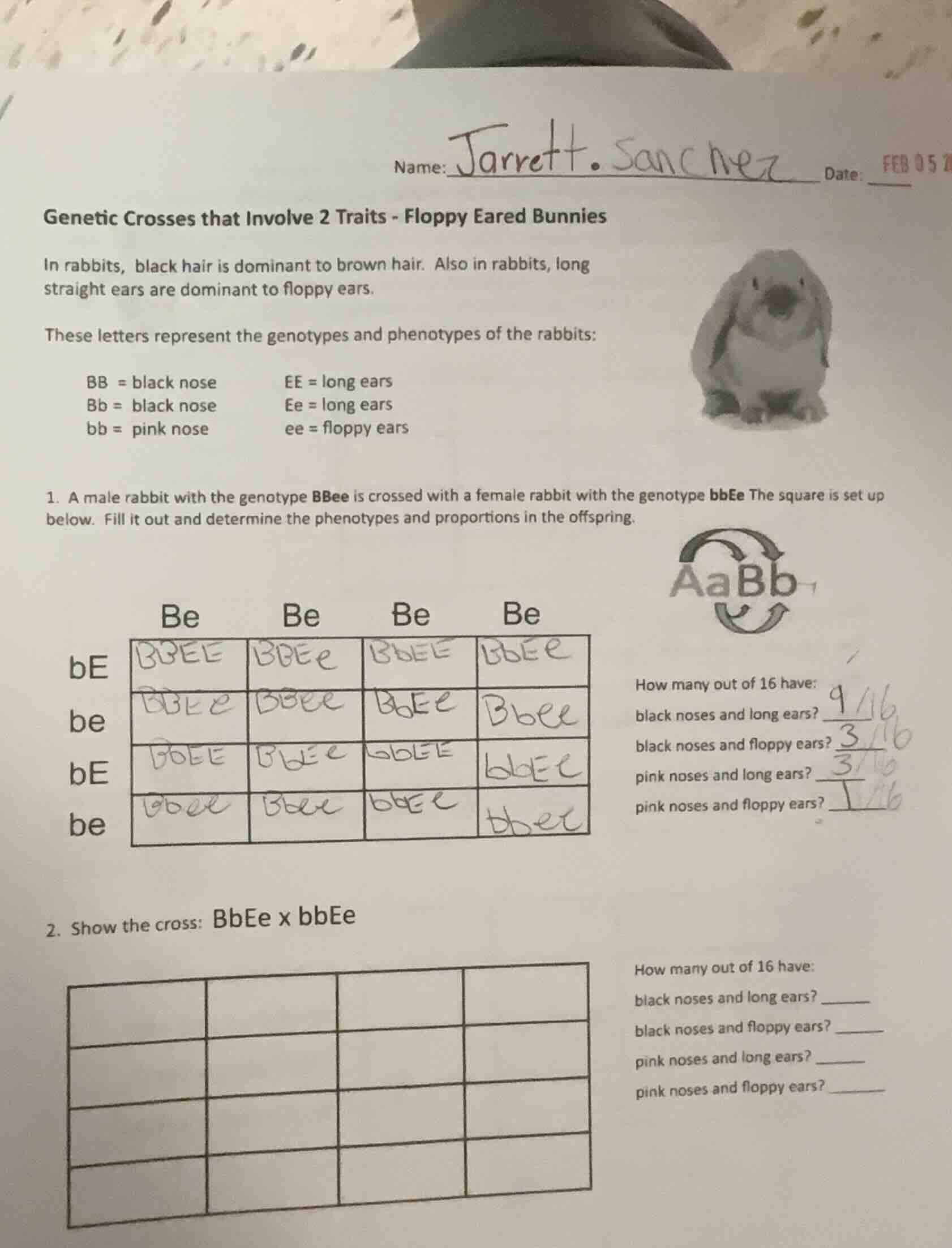
genetic crosses that involve 2 traits - floppy eared bunnies
in rabbits, black hair is dominant to brown hair. also in rabbits, long straight ears are dominant to floppy ears.
these letters represent the genotypes and phenotypes of the rabbits:
bb = black nose ee = long ears
bb = black nose ee = long ears
bb = pink nose ee = floppy ears
- a male rabbit with the genotype bbee is crossed with a female rabbit with the genotype bbee the square is set up below. fill it out and determine the phenotypes and proportions in the offspring.
how many out of 16 have:
black noses and long ears?
black noses and floppy ears?
pink noses and long ears?
pink noses and floppy ears?
- show the cross: bbee x bbee
how many out of 16 have:
black noses and long ears?
black noses and floppy ears?
pink noses and long ears?
pink noses and floppy ears?
Sub - question 2: Cross of \( BbEe\times bbEe \)
Step 1: Determine the gametes
- For the parent with genotype \( BbEe \), we use the principle of independent assortment. The alleles for the two traits (hair color and ear type) segregate independently. So the possible gametes are formed by combining the alleles for each trait. The alleles for the first trait (\( B \) and \( b \)) and the alleles for the second trait (\( E \) and \( e \)) can combine in the following ways: \( BE \), \( Be \), \( bE \), \( be \).
- For the parent with genotype \( bbEe \), the alleles for the first trait are both \( b \) (since it is \( bb \)), and for the second trait, the alleles are \( E \) and \( e \). So the possible gametes are \( bE \) and \( be \).
Step 2: Set up the Punnett square
We create a 4 (gametes from \( BbEe \)) by 2 (gametes from \( bbEe \)) Punnett square. But since we can also think of it as a 4x4 square if we consider the number of combinations (because when we cross, each gamete from one parent combines with each gamete from the other parent, and we can expand the 2 - gamete parent's gametes to match the number of columns/rows for clarity). The Punnett square will have the gametes of \( BbEe \) (\( BE \), \( Be \), \( bE \), \( be \)) along the top and the gametes of \( bbEe \) (\( bE \), \( be \), \( bE \), \( be \)) along the side (we repeat the gametes of \( bbEe \) to make it a 4x4 square).
| \( BE \) | \( Be \) | \( bE \) | \( be \) | |
|---|---|---|---|---|
| \( be \) | \( BbEe \) | \( Bbee \) | \( bbEe \) | \( bbee \) |
| \( bE \) | \( BbEE \) | \( BbEe \) | \( bbEE \) | \( bbEe \) |
| \( be \) | \( BbEe \) | \( Bbee \) | \( bbEe \) | \( bbee \) |
Step 3: Analyze the phenotypes
- Black noses ( \( B - \)) and long ears ( \( E - \)):
- Genotypes with \( B - \) ( \( Bb \)) and \( E - \) ( \( EE \) or \( Ee \)):
- \( BbEE \): Count the number of times this genotype appears. From the Punnett square, \( BbEE \) appears 2 times (first row, first column; third row, first column).
- \( BbEe \): Count the number of times this genotype appears. \( BbEe \) appears 4 times (first row, second column; second row, first column; third row, second column; fourth row, first column).
- Total for \( B - \) and \( E - \): \( 2 + 4=6 \) out of 16? Wait, no, wait. Wait, the total number of cells in the Punnett square is 16? Wait, no, when we have \( BbEe \) (4 gametes) and \( bbEe \) (2 gametes), the number of offspring is \( 4\times2 = 8 \)? No, no, I made a mistake. The correct way is: the number of gametes from \( BbEe \) is 4 (\( BE, Be, bE, be \)) and from \( bbEe \) is 2 (\( bE, be \)). So the number of possible offspring genotypes is \( 4\times2=8 \)? No, no, the Punnett square for a dihybrid cross when one parent is dihybrid (\( BbEe \)) and the other is \( bbEe \) (which is a monohybrid for the first trait and dihybrid for the second) can be analyzed by considering the two traits separately.
Let's analyze the two traits separately:
- Trait 1: Hair color ( \( B - \) vs \( bb \))
- Cross: \( Bb\times bb \)
- The Punnett square for this cross:
| \( B \) | \( b \) | |
|---|---|---|
| \( b \) | \( Bb \) | \( bb \) |
- The ratio of \( Bb \) (black nose) to \( bb \) (pink nose) is \( 2:2 = 1:1 \), so the probability of black nose (\( Bb \)) is \( \frac{1}{2} \), and pink nose (\( bb \)) is \( \frac{1}{2} \).
- Trait 2: Ear type ( \( E - \) vs \( ee \))
- Cross: \( Ee\…

Snap & solve any problem in the app
Get step-by-step solutions on Sovi AI
Photo-based solutions with guided steps
Explore more problems and detailed explanations
Sub - question 2: Cross of \( BbEe\times bbEe \)
Step 1: Determine the gametes
- For the parent with genotype \( BbEe \), we use the principle of independent assortment. The alleles for the two traits (hair color and ear type) segregate independently. So the possible gametes are formed by combining the alleles for each trait. The alleles for the first trait (\( B \) and \( b \)) and the alleles for the second trait (\( E \) and \( e \)) can combine in the following ways: \( BE \), \( Be \), \( bE \), \( be \).
- For the parent with genotype \( bbEe \), the alleles for the first trait are both \( b \) (since it is \( bb \)), and for the second trait, the alleles are \( E \) and \( e \). So the possible gametes are \( bE \) and \( be \).
Step 2: Set up the Punnett square
We create a 4 (gametes from \( BbEe \)) by 2 (gametes from \( bbEe \)) Punnett square. But since we can also think of it as a 4x4 square if we consider the number of combinations (because when we cross, each gamete from one parent combines with each gamete from the other parent, and we can expand the 2 - gamete parent's gametes to match the number of columns/rows for clarity). The Punnett square will have the gametes of \( BbEe \) (\( BE \), \( Be \), \( bE \), \( be \)) along the top and the gametes of \( bbEe \) (\( bE \), \( be \), \( bE \), \( be \)) along the side (we repeat the gametes of \( bbEe \) to make it a 4x4 square).
| \( BE \) | \( Be \) | \( bE \) | \( be \) | |
|---|---|---|---|---|
| \( be \) | \( BbEe \) | \( Bbee \) | \( bbEe \) | \( bbee \) |
| \( bE \) | \( BbEE \) | \( BbEe \) | \( bbEE \) | \( bbEe \) |
| \( be \) | \( BbEe \) | \( Bbee \) | \( bbEe \) | \( bbee \) |
Step 3: Analyze the phenotypes
- Black noses ( \( B - \)) and long ears ( \( E - \)):
- Genotypes with \( B - \) ( \( Bb \)) and \( E - \) ( \( EE \) or \( Ee \)):
- \( BbEE \): Count the number of times this genotype appears. From the Punnett square, \( BbEE \) appears 2 times (first row, first column; third row, first column).
- \( BbEe \): Count the number of times this genotype appears. \( BbEe \) appears 4 times (first row, second column; second row, first column; third row, second column; fourth row, first column).
- Total for \( B - \) and \( E - \): \( 2 + 4=6 \) out of 16? Wait, no, wait. Wait, the total number of cells in the Punnett square is 16? Wait, no, when we have \( BbEe \) (4 gametes) and \( bbEe \) (2 gametes), the number of offspring is \( 4\times2 = 8 \)? No, no, I made a mistake. The correct way is: the number of gametes from \( BbEe \) is 4 (\( BE, Be, bE, be \)) and from \( bbEe \) is 2 (\( bE, be \)). So the number of possible offspring genotypes is \( 4\times2=8 \)? No, no, the Punnett square for a dihybrid cross when one parent is dihybrid (\( BbEe \)) and the other is \( bbEe \) (which is a monohybrid for the first trait and dihybrid for the second) can be analyzed by considering the two traits separately.
Let's analyze the two traits separately:
- Trait 1: Hair color ( \( B - \) vs \( bb \))
- Cross: \( Bb\times bb \)
- The Punnett square for this cross:
| \( B \) | \( b \) | |
|---|---|---|
| \( b \) | \( Bb \) | \( bb \) |
- The ratio of \( Bb \) (black nose) to \( bb \) (pink nose) is \( 2:2 = 1:1 \), so the probability of black nose (\( Bb \)) is \( \frac{1}{2} \), and pink nose (\( bb \)) is \( \frac{1}{2} \).
- Trait 2: Ear type ( \( E - \) vs \( ee \))
- Cross: \( Ee\times Ee \)
- The Punnett square for this cross:
| \( E \) | \( e \) | |
|---|---|---|
| \( e \) | \( Ee \) | \( ee \) |
- The ratio of \( E - \) (long ears: \( EE \) or \( Ee \)) to \( ee \) (floppy ears) is \( 3:1 \), so the probability of long ears (\( E - \)) is \( \frac{3}{4} \), and floppy ears (\( ee \)) is \( \frac{1}{4} \).
Now, we use the multiplication rule for independent events (since the two traits are independent) to find the number of offspring with each phenotype:
- Black noses and long ears (\( B - \) and \( E - \)):
- Probability of \( B - \) is \( \frac{1}{2} \), probability of \( E - \) is \( \frac{3}{4} \).
- The number of offspring out of 16 (we can assume a total of 16 as a standard for dihybrid - like analysis, even though the actual number of offspring from the cross is \( 4\times2 = 8 \), but we can scale it to 16 for easier comparison with the first problem) is \( 16\times(\frac{1}{2}\times\frac{3}{4})=16\times\frac{3}{8} = 6 \). Wait, no, if we consider the actual number of offspring from the cross (8), and then scale to 16, we double the number. But let's do it by counting the genotypes in the Punnett square (correct 4x4 square where we have 4 gametes from each parent, by repeating the gametes of \( bbEe \) twice):
Looking at the correct 4x4 Punnett square (with gametes \( BE, Be, bE, be \) from \( BbEe \) and \( bE, be, bE, be \) from \( bbEe \)):
- Genotypes with \( B - \) ( \( Bb \)) and \( E - \) ( \( EE \) or \( Ee \)):
- \( BbEE \): 2
- \( BbEe \): 4
- Total: \( 2 + 4=6 \) out of 16 (if we consider the square as 16 cells, which is equivalent to two sets of the 8 - offspring cross)
- Black noses and floppy ears (\( B - \) and \( ee \)):
- Probability of \( B - \) is \( \frac{1}{2} \), probability of \( ee \) is \( \frac{1}{4} \).
- Number of offspring out of 16: \( 16\times(\frac{1}{2}\times\frac{1}{4}) = 16\times\frac{1}{8}=2 \). By counting the genotypes:
- \( Bbee \): 2 (second row, second column; fourth row, second column)
- Total: 2 out of 16
- Pink noses and long ears (\( bb \) and \( E - \)):
- Probability of \( bb \) is \( \frac{1}{2} \), probability of \( E - \) is \( \frac{3}{4} \).
- Number of offspring out of 16: \( 16\times(\frac{1}{2}\times\frac{3}{4})=6 \). By counting the genotypes:
- \( bbEE \): 2 (first row, third column; third row, third column)
- \( bbEe \): 4 (first row, fourth column; second row, fourth column; third row, fourth column; fourth row, fourth column)
- Total: \( 2 + 4 = 6 \) out of 16
- Pink noses and floppy ears (\( bb \) and \( ee \)):
- Probability of \( bb \) is \( \frac{1}{2} \), probability of \( ee \) is \( \frac{1}{4} \).
- Number of offspring out of 16: \( 16\times(\frac{1}{2}\times\frac{1}{4}) = 2 \). By counting the genotypes:
- \( bbee \): 2 (second row, fourth column; fourth row, fourth column) Wait, no, in the 4x4 square:
- \( bbee \) appears 2 times (second row, fourth column; fourth row, fourth column)
- Total: 2 out of 16
Final Answers for Sub - question 2:
- Black noses and long ears: \(\boldsymbol{6}\) out of 16
- Black noses and floppy ears: \(\boldsymbol{2}\) out of 16
- Pink noses and long ears: \(\boldsymbol{6}\) out of 16
- Pink noses and floppy ears: \(\boldsymbol{2}\) out of 16