QUESTION IMAGE
Question
name: jesus espinosa
hour: 3
score: ______/14
watch the following video and fill out the worksheet as you watch.
https://www.youtube.com/watch?v=65wjydez188 (the video is in schoology)
the principles of design
fill in the blank spaces with definitions/information about the term (2 points each)
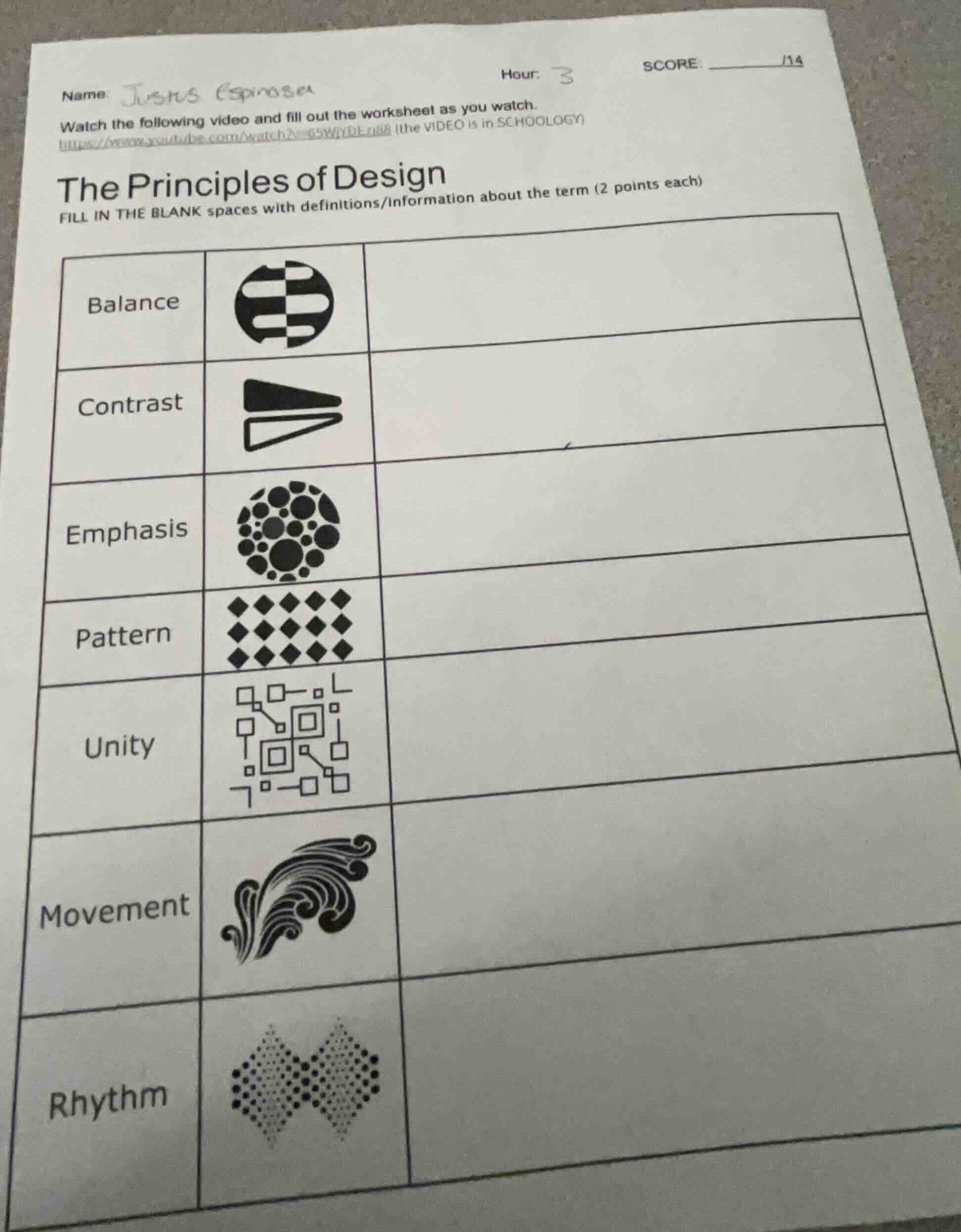
| term | image | definition/information |
|---|---|---|
| contrast | contrast image | |
| emphasis | emphasis image | |
| pattern | pattern image | |
| unity | unity image | |
| movement | movement image | |
| rhythm | rhythm image |
Brief Explanations
To answer this, we need to recall the definitions of the Principles of Design:
- Balance: The distribution of visual weight in a design. It can be symmetrical (equal on both sides) or asymmetrical (balanced through different elements). The image shows a symmetrical or balanced arrangement of black and white shapes.
- Contrast: The difference between elements (like color, size, shape) to create visual interest. The image has a black filled shape and an outlined shape, showing contrast.
- Emphasis: The area that draws attention, a focal point. The image with various - sized circles likely has a larger or more prominent circle as the focal point.
- Pattern: A repeated decorative design. The image with diamonds is a repeated pattern.
- Unity: The sense of harmony and coherence, where elements work together. The image with connected squares shows elements unified.
- Movement: Guides the viewer's eye through the design, often with lines or curves. The swirly image suggests movement.
- Rhythm: A repeated element to create a sense of movement or flow, like a pattern with variation. The dotted shapes in a repeated yet varying way show rhythm.

Snap & solve any problem in the app
Get step-by-step solutions on Sovi AI
Photo-based solutions with guided steps
Explore more problems and detailed explanations
s (Definitions for each):
- Balance: The distribution of visual weight in a composition, creating a sense of stability. It can be symmetrical (mirror - like) or asymmetrical (balanced with different elements).
- Contrast: The use of differing elements (e.g., color, shape, size) to create visual interest and make elements stand out from one another.
- Emphasis: The creation of a focal point in a design, drawing the viewer's attention to a particular area or element.
- Pattern: The repeated use of a decorative or structural element (e.g., shapes, lines) to create a cohesive design.
- Unity: The sense of harmony and wholeness in a design, where all elements work together to create a coherent visual experience.
- Movement: The technique that guides the viewer's eye through the design, often using lines, curves, or directional elements to create a sense of motion.
- Rhythm: The repeated use of elements (with possible variation) to create a sense of movement, flow, or visual beat in a design.