QUESTION IMAGE
Question
name:
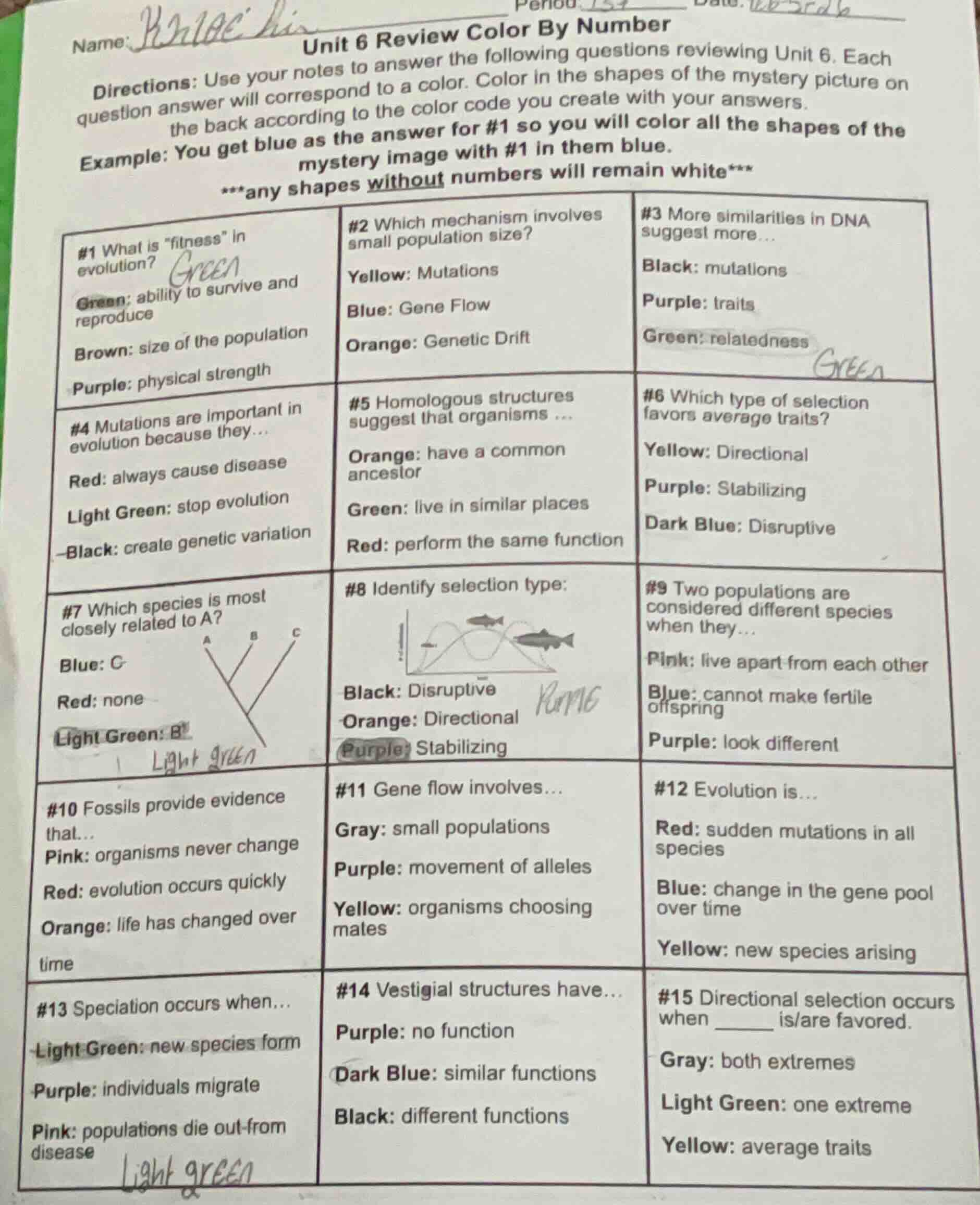
unit 6 review color by number
directions: use your notes to answer the following questions reviewing unit 6. each question answer will correspond to a color. color in the shapes of the mystery picture on the back according to the color code you create with your answers.
example: you get blue as the answer for #1 so you will color all the shapes of the mystery image with #1 in them blue.
any shapes without numbers will remain white
#1 what is \fitness\ in evolution?
green: ability to survive and reproduce
brown: size of the population
purple: physical strength
#2 which mechanism involves small population size?
yellow: mutations
blue: gene flow
orange: genetic drift
#3 more similarities in dna suggest more...
black: mutations
purple: traits
green: relatedness
#4 mutations are important in evolution because they...
red: always cause disease
light green: stop evolution
black: create genetic variation
#5 homologous structures suggest that organisms...
orange: have a common ancestor
green: live in similar places
red: perform the same function
#6 which type of selection favors average traits?
yellow: directional
purple: stabilizing
dark blue: disruptive
#7 which species is most closely related to a?
blue: c
red: none
light green: b
#8 identify selection type:
black: disruptive
orange: directional
purple: stabilizing
#9 two populations are considered different species when they...
pink: live apart from each other
blue: cannot make fertile offspring
purple: look different
#10 fossils provide evidence that...
pink: organisms never change
red: evolution occurs quickly
orange: life has changed over time
#11 gene flow involves...
gray: small populations
purple: movement of alleles
yellow: organisms choosing mates
#12 evolution is...
red: sudden mutations in all species
blue: change in the gene pool over time
yellow: new species arising
#13 speciation occurs when...
light green: new species form
purple: individuals migrate
pink: populations die out from disease
#14 vestigial structures have...
purple: no function
dark blue: similar functions
black: different functions
#15 directional selection occurs when ______ is/are favored.
gray: both extremes
light green: one extreme
yellow: average traits
To solve these biology - related evolution questions, we analyze each one based on evolutionary concepts:
Question #1
- Concept: In evolution, "fitness" is defined as the ability of an organism to survive and reproduce in its environment.
- Options Analysis:
- Brown (size of the population) is incorrect as fitness is not about population size.
- Purple (physical strength) is wrong because fitness isn't just about physical strength.
- Green (ability to survive and reproduce) matches the definition of evolutionary fitness.
- Answer: Green: ability to survive and reproduce
Question #2
- Concept: Genetic drift is the change in the frequency of an existing gene variant in a population due to random sampling of organisms, and it has a more significant effect in small populations.
- Options Analysis:
- Yellow (Mutations) are random changes in DNA and not directly related to population size.
- Blue (Gene Flow) is the transfer of genetic material between populations and not dependent on small population size.
- Orange (Genetic Drift) is the mechanism that involves small population size.
- Answer: Orange: Genetic Drift
Question #3
- Concept: The more similar the DNA of two organisms is, the more closely related they are (they share a more recent common ancestor).
- Options Analysis:
- Black (mutations) are changes in DNA and not related to the implication of DNA similarities.
- Purple (traits) - while related organisms may have similar traits, DNA similarity directly implies relatedness.
- Green (relatedness) - more DNA similarities suggest more relatedness.
- Answer: Green: relatedness
Question #4
- Concept: Mutations are the ultimate source of genetic variation in a population. This variation is essential for natural selection and evolution to occur.
- Options Analysis:
- Red (always cause disease) - most mutations are neutral or beneficial, not always disease - causing.
- Light Green (stop evolution) - mutations are a driving force of evolution, not a stop to it.
- Black (create genetic variation) - mutations create new alleles, thus genetic variation.
- Answer: Black: create genetic variation
Question #5
- Concept: Homologous structures are structures in different species that are similar because of common ancestry.
- Options Analysis:
- Green (live in similar places) - homologous structures are not about the habitat.
- Red (perform the same function) - analogous structures perform the same function, not homologous.
- Orange (have a common ancestor) - homologous structures suggest a common ancestor.
- Answer: Orange: have a common ancestor
Question #6
- Concept: Stabilizing selection is a type of natural selection in which the population mean stabilizes on a particular non - extreme trait value, favoring average traits.
- Options Analysis:
- Yellow (Directional) - directional selection favors one extreme phenotype.
- Dark Blue (Disruptive) - disruptive selection favors extreme values over intermediate values.
- Purple (Stabilizing) - stabilizing selection favors average traits.
- Answer: Purple: Stabilizing
Question #7
- Concept: In a phylogenetic tree, species that share a more recent common ancestor are more closely related. From the given tree, species B shares a more recent common ancestor with A.
- Options Analysis:
- Blue (C) - C is less closely related to A than B is.
- Red (none) - B is closely related to A.
- Light Green (B) - B is the…

Snap & solve any problem in the app
Get step-by-step solutions on Sovi AI
Photo-based solutions with guided steps
Explore more problems and detailed explanations
To solve these biology - related evolution questions, we analyze each one based on evolutionary concepts:
Question #1
- Concept: In evolution, "fitness" is defined as the ability of an organism to survive and reproduce in its environment.
- Options Analysis:
- Brown (size of the population) is incorrect as fitness is not about population size.
- Purple (physical strength) is wrong because fitness isn't just about physical strength.
- Green (ability to survive and reproduce) matches the definition of evolutionary fitness.
- Answer: Green: ability to survive and reproduce
Question #2
- Concept: Genetic drift is the change in the frequency of an existing gene variant in a population due to random sampling of organisms, and it has a more significant effect in small populations.
- Options Analysis:
- Yellow (Mutations) are random changes in DNA and not directly related to population size.
- Blue (Gene Flow) is the transfer of genetic material between populations and not dependent on small population size.
- Orange (Genetic Drift) is the mechanism that involves small population size.
- Answer: Orange: Genetic Drift
Question #3
- Concept: The more similar the DNA of two organisms is, the more closely related they are (they share a more recent common ancestor).
- Options Analysis:
- Black (mutations) are changes in DNA and not related to the implication of DNA similarities.
- Purple (traits) - while related organisms may have similar traits, DNA similarity directly implies relatedness.
- Green (relatedness) - more DNA similarities suggest more relatedness.
- Answer: Green: relatedness
Question #4
- Concept: Mutations are the ultimate source of genetic variation in a population. This variation is essential for natural selection and evolution to occur.
- Options Analysis:
- Red (always cause disease) - most mutations are neutral or beneficial, not always disease - causing.
- Light Green (stop evolution) - mutations are a driving force of evolution, not a stop to it.
- Black (create genetic variation) - mutations create new alleles, thus genetic variation.
- Answer: Black: create genetic variation
Question #5
- Concept: Homologous structures are structures in different species that are similar because of common ancestry.
- Options Analysis:
- Green (live in similar places) - homologous structures are not about the habitat.
- Red (perform the same function) - analogous structures perform the same function, not homologous.
- Orange (have a common ancestor) - homologous structures suggest a common ancestor.
- Answer: Orange: have a common ancestor
Question #6
- Concept: Stabilizing selection is a type of natural selection in which the population mean stabilizes on a particular non - extreme trait value, favoring average traits.
- Options Analysis:
- Yellow (Directional) - directional selection favors one extreme phenotype.
- Dark Blue (Disruptive) - disruptive selection favors extreme values over intermediate values.
- Purple (Stabilizing) - stabilizing selection favors average traits.
- Answer: Purple: Stabilizing
Question #7
- Concept: In a phylogenetic tree, species that share a more recent common ancestor are more closely related. From the given tree, species B shares a more recent common ancestor with A.
- Options Analysis:
- Blue (C) - C is less closely related to A than B is.
- Red (none) - B is closely related to A.
- Light Green (B) - B is the most closely related to A.
- Answer: Light Green: B
Question #8
- Concept: Stabilizing selection is characterized by the reduction of variation in a population, and the graph (implied by the question) likely shows a peak around the average trait (stabilizing selection).
- Options Analysis:
- Black (Disruptive) - disruptive selection has two peaks (favoring extremes).
- Orange (Directional) - directional selection has a shift in the peak towards one extreme.
- Purple (Stabilizing) - stabilizing selection has a single peak around the average.
- Answer: Purple: Stabilizing
Question #9
- Concept: The biological species concept defines a species as a group of organisms that can interbreed and produce fertile offspring. So, two populations are different species when they cannot make fertile offspring.
- Options Analysis:
- Pink (live apart from each other) - allopatric populations can still be the same species.
- Purple (look different) - phenotypic differences don't necessarily mean different species.
- Blue (cannot make fertile offspring) - this is the key in the biological species concept.
- Answer: Blue: cannot make fertile offspring
Question #10
- Concept: Fossils are the preserved remains or traces of ancient organisms. By studying fossils, we can see how life has changed over time (evolution).
- Options Analysis:
- Pink (organisms never change) - fossils show that organisms have changed over time.
- Red (evolution occurs quickly) - the fossil record shows that evolution can be slow (gradual) or fast (punctuated equilibrium), but the main evidence is change over time.
- Orange (life has changed over time) - fossils provide evidence of the change of life over time.
- Answer: Orange: life has changed over time
Question #11
- Concept: Gene flow is the transfer of genetic variation (alleles) from one population to another.
- Options Analysis:
- Gray (small populations) - gene flow is not about population size.
- Yellow (organisms choosing mates) - this is sexual selection, not gene flow.
- Purple (movement of alleles) - gene flow involves the movement of alleles between populations.
- Answer: Purple: movement of alleles
Question #12
- Concept: Evolution is defined as the change in the gene pool of a population over time.
- Options Analysis:
- Red (sudden mutations in all species) - evolution is a gradual (usually) change, not sudden mutations in all species.
- Yellow (new species arising) - speciation is a part of evolution, but evolution is a broader change in the gene pool.
- Blue (change in the gene pool over time) - this is the definition of evolution.
- Answer: Blue: change in the gene pool over time
Question #13
- Concept: Speciation is the process by which new species form from existing species.
- Options Analysis:
- Purple (individuals migrate) - migration is gene flow, not speciation.
- Pink (populations die out from disease) - this is extinction, not speciation.
- Light Green (new species form) - this is the definition of speciation.
- Answer: Light Green: new species form
Question #14
- Concept: Vestigial structures are anatomical features that no longer serve the same purpose as they did in the organism's ancestors (they have no function or a reduced function).
- Options Analysis:
- Dark Blue (similar functions) - vestigial structures don't have similar functions to their ancestral forms.
- Black (different functions) - they have no function (or a very reduced one), not different functions.
- Purple (no function) - vestigial structures have no function.
- Answer: Purple: no function
Question #15
- Concept: Directional selection is a type of natural selection in which one extreme phenotype is favored over other phenotypes, causing the allele frequency to shift over time in the direction of that phenotype.
- Options Analysis:
- Gray (both extremes) - this is disruptive selection.
- Yellow (average traits) - this is stabilizing selection.
- Light Green (one extreme) - directional selection favors one extreme.
- Answer: Light Green: one extreme