QUESTION IMAGE
Question
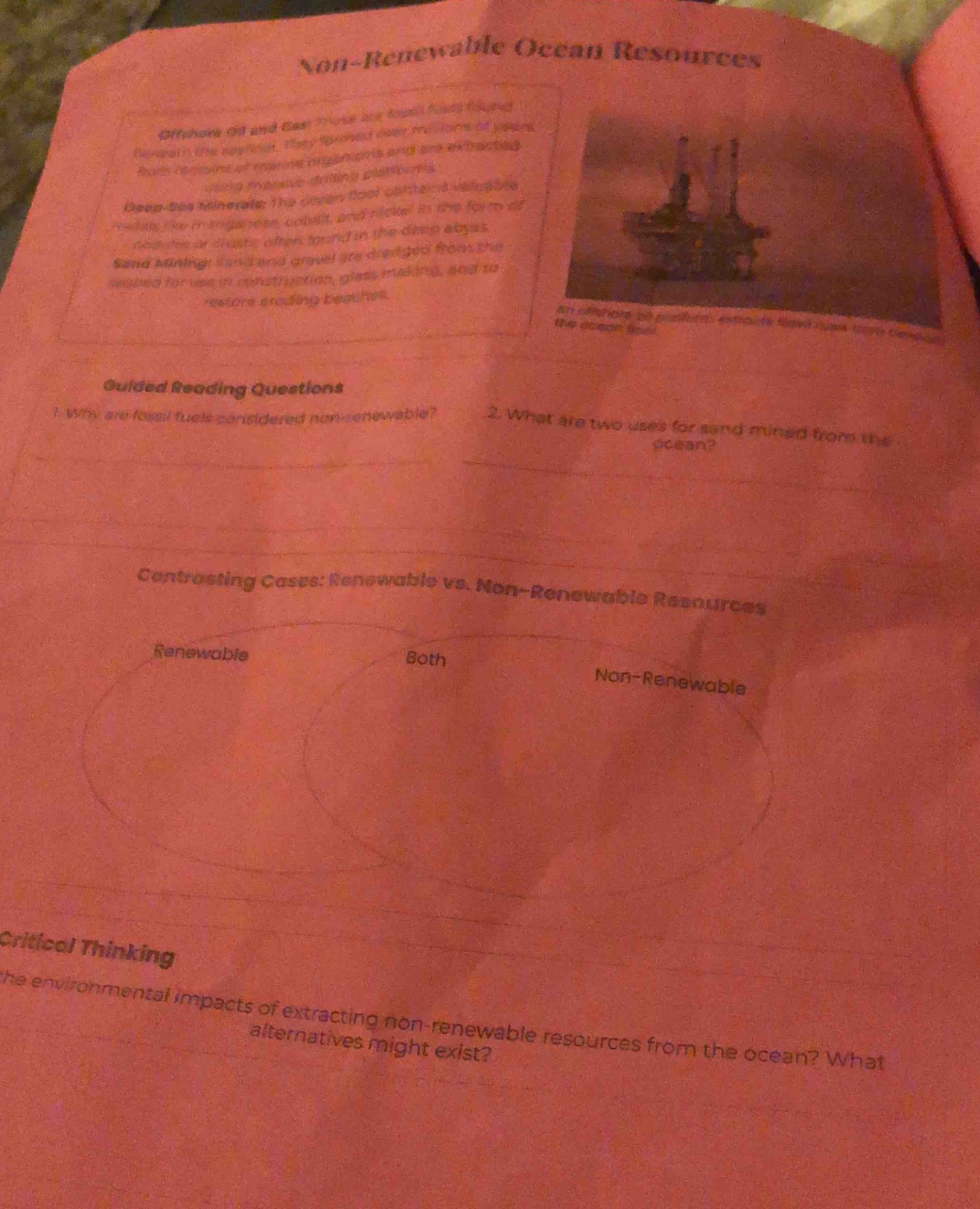
non - renewable ocean resources
offshore oil and gas: these are fossil fuels formed beneath the seafloor. they formed over millions of years from the remains of marine organisms and are extracted using massive offshore platforms.
deep - sea minerals: the ocean floor contains valuable metals, like manganese, cobalt, and nickel in the form of nodules or crusts, often found in the ocean abyss.
sand mining: sand and gravel are dredged from the seabed for use in construction, glass making, and to restore eroding beaches.
an offshore oil platform extracts fossil fuels from beneath the ocean floor.
guided reading questions
- why are fossil fuels considered non - renewable?
- what are two uses for sand mined from the ocean?
contrasting cases: renewable vs. non - renewable resources
renewable\tboth\tnon - renewable
critical thinking
the environmental impacts of extracting non - renewable resources from the ocean? what alternatives might exist?
For Guided Reading Questions:
- Fossil fuels form over millions of years from marine organisms, and their formation rate is far slower than human consumption, so they cannot be replenished in a human timescale.
- The text explicitly lists uses for ocean-mined sand, so two are selected from the given options.
For Contrasting Cases:
- Renewable ocean resources are naturally replenished quickly (e.g., wave energy, fish stocks).
- Both categories are resources taken from the ocean for human use.
- Non-renewable ocean resources form extremely slowly and are finite (e.g., offshore oil, deep-sea minerals).
For Critical Thinking:
Extracting non-renewable ocean resources harms marine ecosystems; alternatives rely on renewable resources.

Snap & solve any problem in the app
Get step-by-step solutions on Sovi AI
Photo-based solutions with guided steps
Explore more problems and detailed explanations
Guided Reading Questions
- They form over millions of years, far slower than human consumption, so they cannot be replaced in a human timescale.
- Two uses are:
- Construction
- Glass making
Contrasting Cases: Renewable vs. Non-Renewable Resources
- Renewable: Wave energy, sustainable fish stocks, tidal power
- Both: Ocean-derived resources used for human needs
- Non-Renewable: Offshore oil and gas, deep-sea minerals, ocean sand (when mined faster than replenished)
Critical Thinking
- Environmental impacts: Habitat destruction from drilling/mining platforms, ocean floor disruption, oil spills that poison marine life, and disruption of coastal ecosystems from sand mining.
- Alternatives: Using renewable ocean resources (wave, tidal, or offshore wind energy), switching to land-based renewable energy (solar, wind), and using recycled materials instead of mined ocean sand for construction.