QUESTION IMAGE
Question
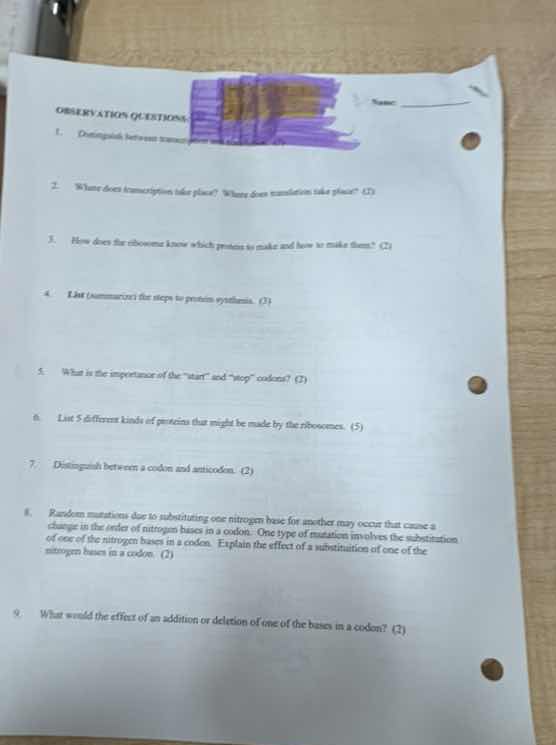
observation questions:
- distinguish between
- where does transcription take place? where does translation take place? (2)
- how does the ribosome know which proteins to make and how to make them? (2)
- list (number) the steps to protein synthesis. (1)
- what is the importance of the \start\ and \stop\ codons? (2)
- list 5 different kinds of proteins that might be made by the ribosomes. (5)
- distinguish between a codon and anticodon. (2)
- random mutations due to substituting one nitrogen base for another may occur that cause a change in the order of nitrogen bases in a codon. one type of mutation involves the substitution of one of the nitrogen bases in a codon. explain the effect of a substitution of one of the nitrogen bases in a codon. (2)
- what would the effect of an addition or deletion of one of the bases in a codon? (2)
To answer these questions, we'll address each one based on concepts from Biology (subfield of Natural Science), specifically related to molecular biology and protein synthesis:
Question 2: Where does transcription take place? Where does translation take place?
Transcription (DNA → mRNA) occurs in the nucleus (in eukaryotic cells) or in the cytoplasm (in prokaryotes, where DNA is not enclosed in a nucleus). Translation (mRNA → protein) occurs at ribosomes (either free in the cytoplasm or attached to the rough endoplasmic reticulum).
Ribosomes use mRNA (messenger RNA) as a template. mRNA carries the genetic code (from DNA) that specifies the sequence of amino acids. Transfer RNA (tRNA) brings the correct amino acids to the ribosome, matching their anticodons to mRNA codons.
- Transcription: DNA is transcribed into mRNA in the nucleus (eukaryotes) or cytoplasm (prokaryotes).
- mRNA Processing (eukaryotes only): Introns are removed, exons are spliced, and a 5’ cap + 3’ poly-A tail are added.
- mRNA Export (eukaryotes): Processed mRNA moves from the nucleus to the cytoplasm.
- Translation Initiation: Ribosome binds to mRNA, and the first tRNA (with methionine) attaches to the start codon (AUG).
- Translation Elongation: tRNAs deliver amino acids, ribosome forms peptide bonds between them, and the ribosome moves along mRNA.
- Translation Termination: Ribosome reaches a stop codon (UAA, UAG, UGA), releasing the completed protein.

Snap & solve any problem in the app
Get step-by-step solutions on Sovi AI
Photo-based solutions with guided steps
Explore more problems and detailed explanations
- Transcription: Nucleus (eukaryotes) / Cytoplasm (prokaryotes).
- Translation: Ribosomes (cytoplasm or rough ER).