QUESTION IMAGE
Question
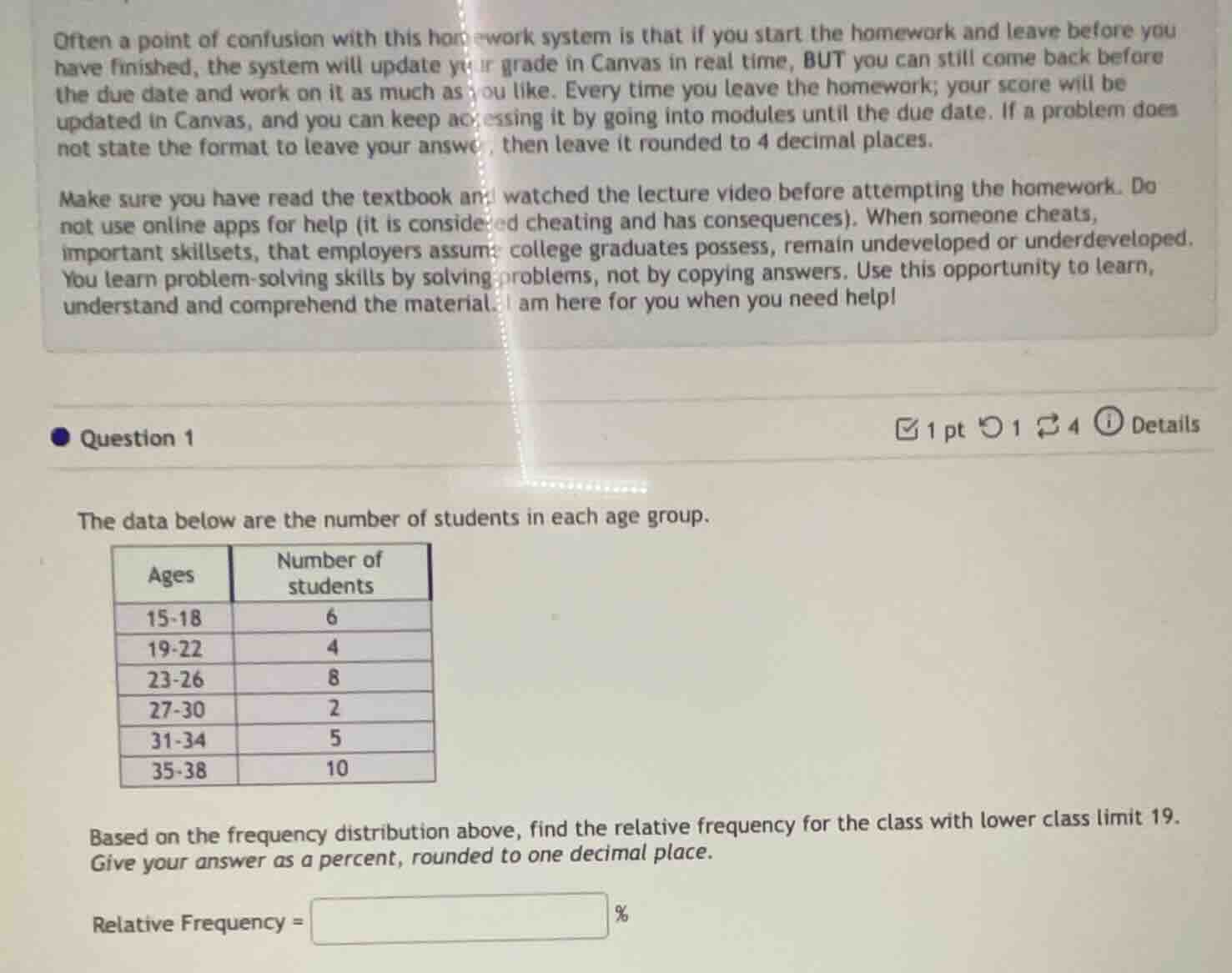
often a point of confusion with this homework system is that if you start the homework and leave before you have finished, the system will update your grade in canvas in real time, but you can still come back before the due date and work on it as much as you like. every time you leave the homework; your score will be updated in canvas, and you can keep accessing it by going into modules until the due date. if a problem does not state the format to leave your answer, then leave it rounded to 4 decimal places. make sure you have read the textbook and watched the lecture video before attempting the homework. do not use online apps for help (it is considered cheating and has consequences). when someone cheats, important skillsets, that employers assume college graduates possess, remain undeveloped or underdeveloped. you learn problem - solving skills by solving problems, not by copying answers. use this opportunity to learn, understand and comprehend the material. i am here for you when you need help! question 1 1 pt 1 4 details the data below are the number of students in each age group. a table with ages (15 - 18, 19 - 22, 23 - 26, 27 - 30, 31 - 34, 35 - 38) and number of students (6, 4, 8, 2, 5, 10) based on the frequency distribution above, find the relative frequency for the class with lower class limit 19. give your answer as a percent, rounded to one decimal place. relative frequency = %
Step1: Find total number of students
First, we sum up the number of students in all age groups. The number of students are 6, 4, 8, 2, 5, and 10. So total \( N = 6 + 4 + 8 + 2 + 5 + 10 \).
\( N = 6 + 4 + 8 + 2 + 5 + 10 = 35 \)
Step2: Identify the frequency for lower class limit 19
The class with lower class limit 19 is 19 - 22, and its frequency (number of students) is 4.
Step3: Calculate relative frequency
Relative frequency is calculated as \( \text{Relative Frequency} = \frac{\text{Frequency of the class}}{\text{Total number of observations}} \times 100 \) (to get percentage). So we have \( \frac{4}{35} \times 100 \).
\( \frac{4}{35} \times 100 \approx 11.42857 \)
Step4: Round to one decimal place
Rounding 11.42857 to one decimal place gives 11.4.

Snap & solve any problem in the app
Get step-by-step solutions on Sovi AI
Photo-based solutions with guided steps
Explore more problems and detailed explanations
11.4