QUESTION IMAGE
Question
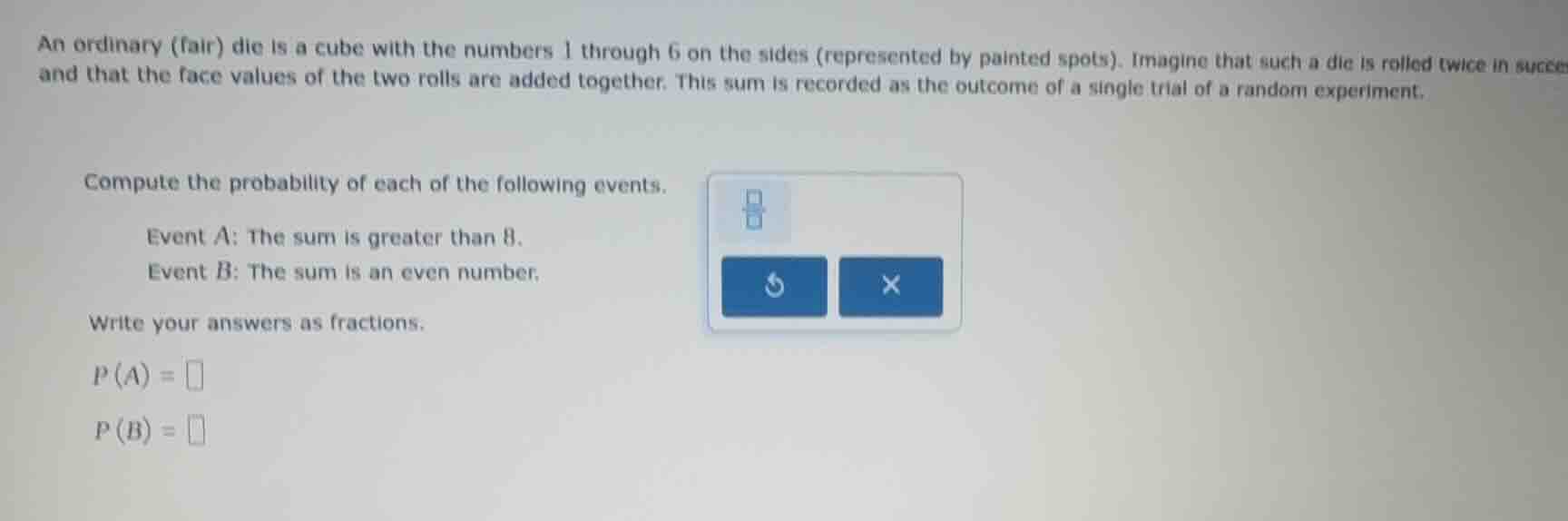
an ordinary (fair) die is a cube with the numbers 1 through 6 on the sides (represented by painted spots). imagine that such a die is rolled twice in succes and that the face values of the two rolls are added together. this sum is recorded as the outcome of a single trial of a random experiment. compute the probability of each of the following events. event a: the sum is greater than 8. event b: the sum is an even number. write your answers as fractions. p(a)=□ p(b)=□
Step1: Find total possible outcomes
When rolling a die twice, each roll has 6 outcomes. Total outcomes: $6 \times 6 = 36$
Step2: Identify favorable outcomes for Event A
Sum > 8 means sums of 9, 10, 11, 12.
- Sum 9: (3,6), (4,5), (5,4), (6,3) → 4 outcomes
- Sum 10: (4,6), (5,5), (6,4) → 3 outcomes
- Sum 11: (5,6), (6,5) → 2 outcomes
- Sum 12: (6,6) → 1 outcome
Total favorable for A: $4 + 3 + 2 + 1 = 10$
Step3: Calculate P(A)
Probability = $\frac{\text{Favorable Outcomes}}{\text{Total Outcomes}}$
$P(A) = \frac{10}{36} = \frac{5}{18}$
Step4: Identify favorable outcomes for Event B
Even sum occurs when both rolls are even or both are odd:
- Odd-odd pairs: (1,1),(1,3),(1,5),(3,1),(3,3),(3,5),(5,1),(5,3),(5,5) → 9 outcomes
- Even-even pairs: (2,2),(2,4),(2,6),(4,2),(4,4),(4,6),(6,2),(6,4),(6,6) → 9 outcomes
Total favorable for B: $9 + 9 = 18$
Step5: Calculate P(B)
$P(B) = \frac{18}{36} = \frac{1}{2}$

Snap & solve any problem in the app
Get step-by-step solutions on Sovi AI
Photo-based solutions with guided steps
Explore more problems and detailed explanations
$P(A) = \frac{5}{18}$
$P(B) = \frac{1}{2}$