QUESTION IMAGE
Question
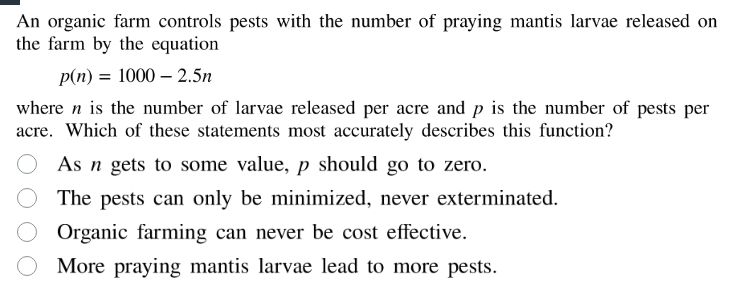
an organic farm controls pests with the number of praying mantis larvae released on the farm by the equation
$p(n) = 1000 - 2.5n$
where $n$ is the number of larvae released per acre and $p$ is the number of pests per acre. which of these statements most accurately describes this function?
\bigcirc as $n$ gets to some value, $p$ should go to zero.
\bigcirc the pests can only be minimized, never exterminated.
\bigcirc organic farming can never be cost effective.
\bigcirc more praying mantis larvae lead to more pests.
- Analyze the linear function $p(n) = 1000 - 2.5n$: as $n$ (number of larvae) increases, $p$ (number of pests) decreases.
- Set $p(n)=0$ and solve:
$$0 = 1000 - 2.5n$$
$$2.5n = 1000$$
$$n = 400$$
When 400 larvae per acre are released, the pest count reaches zero, matching the first statement. The other options are incorrect: the function shows pests can reach zero (so they can be exterminated), cost effectiveness is not addressed, and more larvae reduce pests, not increase them.

Snap & solve any problem in the app
Get step-by-step solutions on Sovi AI
Photo-based solutions with guided steps
Explore more problems and detailed explanations
As n gets to some value, p should go to zero.