QUESTION IMAGE
Question
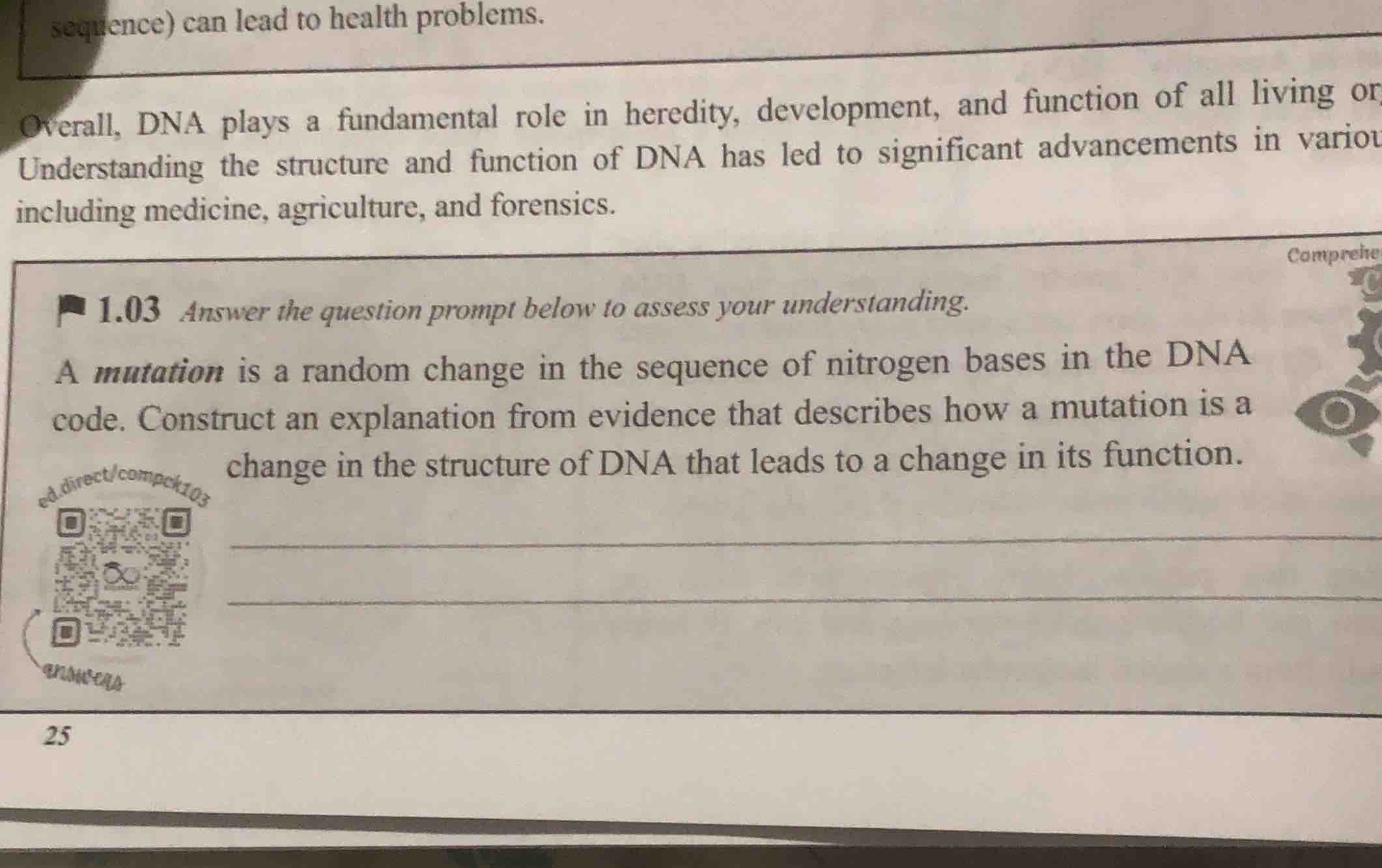
overall, dna plays a fundamental role in heredity, development, and function of all living or understanding the structure and function of dna has led to significant advancements in variou including medicine, agriculture, and forensics. 1.03 answer the question prompt below to assess your understanding. a mutation is a random change in the sequence of nitrogen bases in the dna code. construct an explanation from evidence that describes how a mutation is a change in the structure of dna that leads to a change in its function.
- Structure - Function Relationship in DNA: DNA's structure is a double helix with nitrogen bases (A, T, C, G) in a specific sequence. This sequence codes for proteins, which are responsible for the functions of cells (like enzymes for metabolism, structural proteins, etc.).
- Effect of Mutation on Structure: A mutation changes the sequence of these nitrogen bases. For example, a point mutation might substitute one base (e.g., A to T), or a frameshift mutation (insertion/deletion) can shift the entire reading frame of the DNA sequence. This alters the "blueprint" of the DNA at the structural level (the order of bases).
- Effect on Function: Since the DNA sequence codes for amino acid sequences in proteins (via transcription and translation), a changed base sequence can lead to a different amino acid sequence in the protein. If the protein's structure (like the active site of an enzyme) is altered, its function can be affected. For instance, in sickle - cell anemia, a single base mutation in the DNA coding for hemoglobin changes one amino acid in the hemoglobin protein. This causes the hemoglobin to form abnormal structures, leading to red blood cells becoming sickle - shaped. These abnormal cells don't carry oxygen as efficiently and can get stuck in blood vessels, leading to health problems. So, the structural change in DNA (base sequence) leads to a functional change in the protein it codes for, and ultimately in the cell/organism.

Snap & solve any problem in the app
Get step-by-step solutions on Sovi AI
Photo-based solutions with guided steps
Explore more problems and detailed explanations
A mutation alters the sequence of nitrogen bases in DNA (a structural change). Since DNA’s sequence codes for protein synthesis, a mutated sequence can lead to a different amino acid sequence in the resulting protein. For example, in sickle - cell anemia, a single base mutation changes a hemoglobin amino acid. This modifies the protein’s structure (e.g., hemoglobin’s shape), which impairs its function (oxygen - carrying ability), showing how a DNA structural change (mutation) causes a functional change.