QUESTION IMAGE
Question
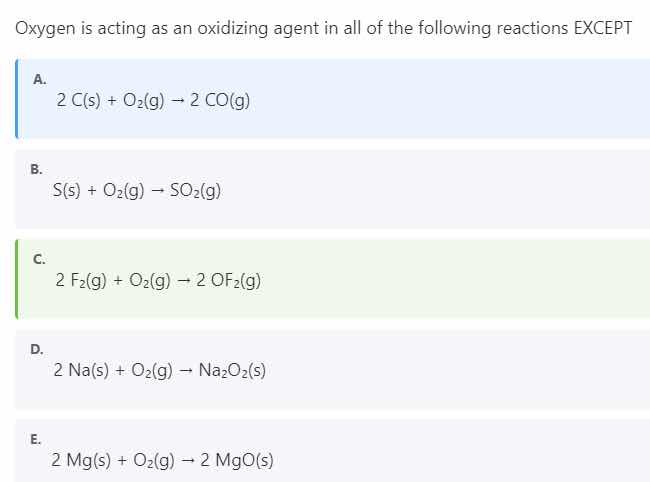
oxygen is acting as an oxidizing agent in all of the following reactions except
a.
2 c(s) + o₂(g) → 2 co(g)
b.
s(s) + o₂(g) → so₂(g)
c.
2 f₂(g) + o₂(g) → 2 of₂(g)
d.
2 na(s) + o₂(g) → na₂o₂(s)
e.
2 mg(s) + o₂(g) → 2 mgo(s)
Step1: Define oxidizing agent role
An oxidizing agent is reduced (gains electrons, oxidation number decreases).
Step2: Find O oxidation number in reactants
In $\text{O}_2$, oxidation number of O is $0$.
Step3: Calculate O oxidation number in products for each option
- Option A: In $\text{CO}$, O has oxidation number $-2$ (decreases from 0, O is reduced).
- Option B: In $\text{SO}_2$, O has oxidation number $-2$ (decreases from 0, O is reduced).
- Option C: In $\text{OF}_2$, F has oxidation number $-1$. Let O oxidation number = $x$.
$x + 2(-1) = 0 \implies x = +2$ (increases from 0, O is oxidized).
- Option D: In $\text{Na}_2\text{O}_2$, O has oxidation number $-1$ (decreases from 0, O is reduced).
- Option E: In $\text{MgO}$, O has oxidation number $-2$ (decreases from 0, O is reduced).
Step4: Identify non-oxidizing agent case
Only in Option C, O is oxidized, so it is not an oxidizing agent.

Snap & solve any problem in the app
Get step-by-step solutions on Sovi AI
Photo-based solutions with guided steps
Explore more problems and detailed explanations
C. $2\ \text{F}_2(\text{g}) + \text{O}_2(\text{g})
ightarrow 2\ \text{OF}_2(\text{g})$