QUESTION IMAGE
Question
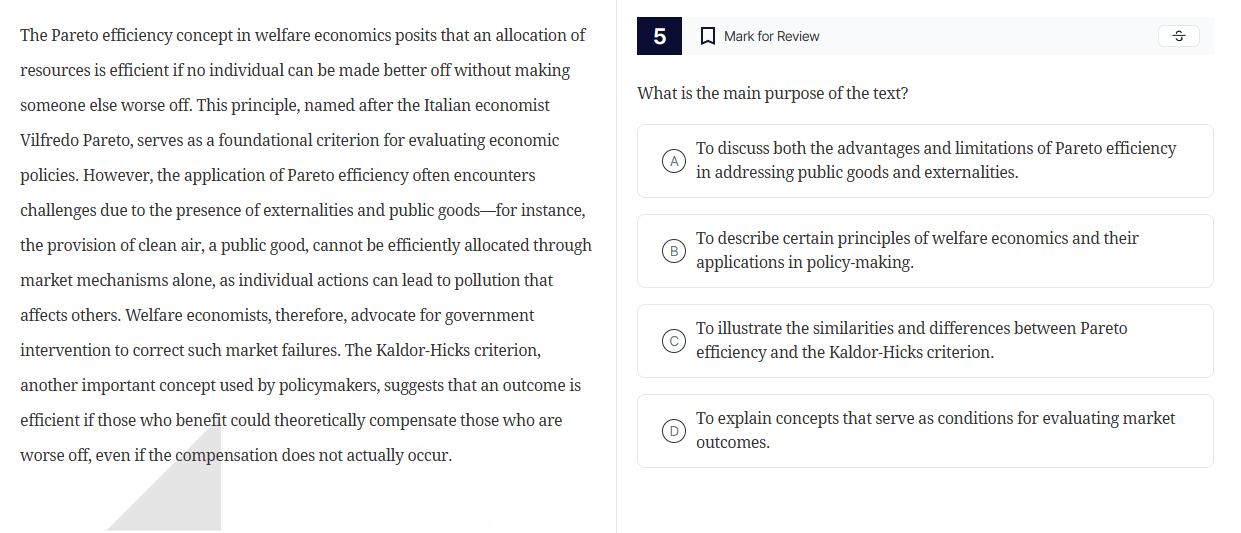
the pareto efficiency concept in welfare economics posits that an allocation of resources is efficient if no individual can be made better off without making someone else worse off. this principle, named after the italian economist vilfredo pareto, serves as a foundational criterion for evaluating economic policies. however, the application of pareto efficiency often encounters challenges due to the presence of externalities and public goods—for instance, the provision of clean air, a public good, cannot be efficiently allocated through market mechanisms alone, as individual actions can lead to pollution that affects others. welfare economists, therefore, advocate for government intervention to correct such market failures. the kaldor - hicks criterion, another important concept used by policymakers, suggests that an outcome is efficient if those who benefit could theoretically compensate those who are worse off, even if the compensation does not actually occur.
5
what is the main purpose of the text?
a to discuss both the advantages and limitations of pareto efficiency in addressing public goods and externalities.
b to describe certain principles of welfare economics and their applications in policy - making.
c to illustrate the similarities and differences between pareto efficiency and the kaldor - hicks criterion.
d to explain concepts that serve as conditions for evaluating market outcomes.
- Analyze Option A: The text doesn't discuss both advantages and limitations of Pareto efficiency in public goods and externalities; it mentions challenges in application and introduces Kaldor - Hicks, so A is incorrect.
- Analyze Option B: The text is not about describing principles of welfare economics in general and their policy - making applications. It focuses on specific concepts (Pareto efficiency, Kaldor - Hicks) for evaluating market outcomes, so B is incorrect.
- Analyze Option C: The text is not mainly about illustrating similarities and differences between Pareto efficiency and Kaldor - Hicks. It explains both as concepts for evaluating market outcomes, so C is incorrect.
- Analyze Option D: The text explains Pareto efficiency (a concept for evaluating resource allocation/market outcomes) and the Kaldor - Hicks criterion (another concept for evaluating market outcomes), so the main purpose is to explain concepts that serve as conditions for evaluating market outcomes.

Snap & solve any problem in the app
Get step-by-step solutions on Sovi AI
Photo-based solutions with guided steps
Explore more problems and detailed explanations
D. To explain concepts that serve as conditions for evaluating market outcomes.