QUESTION IMAGE
Question
part 1 of 2
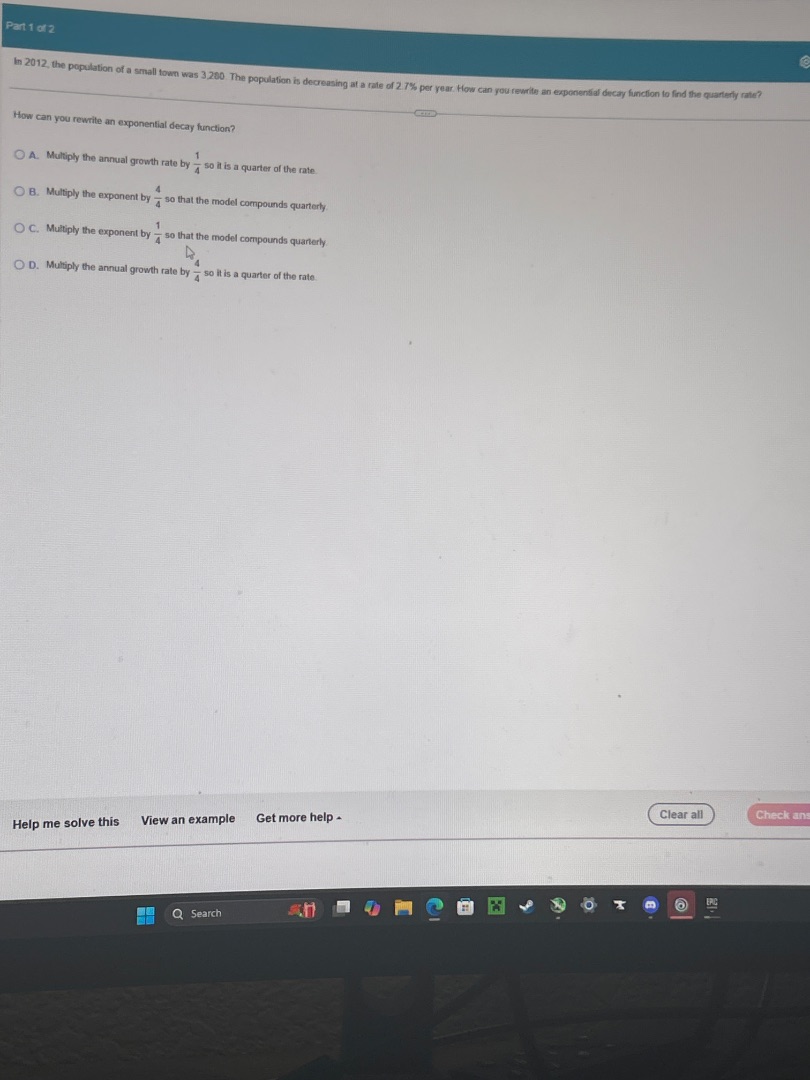
in 2012, the population of a small town was 3,280. the population is decreasing at a rate of 2.7% per year. how can you rewrite an exponential decay function to find the quarterly rate?
how can you rewrite an exponential decay function?
o a. multiply the annual growth rate by $\frac{1}{4}$ so it is a quarter of the rate.
o b. multiply the exponent by $\frac{4}{1}$ so that the model compounds quarterly.
o c. multiply the exponent by $\frac{1}{4}$ so that the model compounds quarterly.
o d. multiply the annual growth rate by $\frac{4}{1}$ so it is a quarter of the rate.
The standard annual exponential decay function is $P(t) = P_0(1 - r)^t$, where $t$ is in years. To convert to quarterly compounding, we adjust the exponent to represent quarterly time intervals: since there are 4 quarters in a year, the quarterly time variable is $\frac{t}{4}$, so the function becomes $P(t) = P_0(1 - r)^{\frac{t}{4}}$. This is equivalent to multiplying the original exponent $t$ by $\frac{1}{4}$, which correctly models the decay compounded quarterly without altering the annual decay rate itself.

Snap & solve any problem in the app
Get step-by-step solutions on Sovi AI
Photo-based solutions with guided steps
Explore more problems and detailed explanations
C. Multiply the exponent by $\frac{1}{4}$ so that the model compounds quarterly.