QUESTION IMAGE
Question
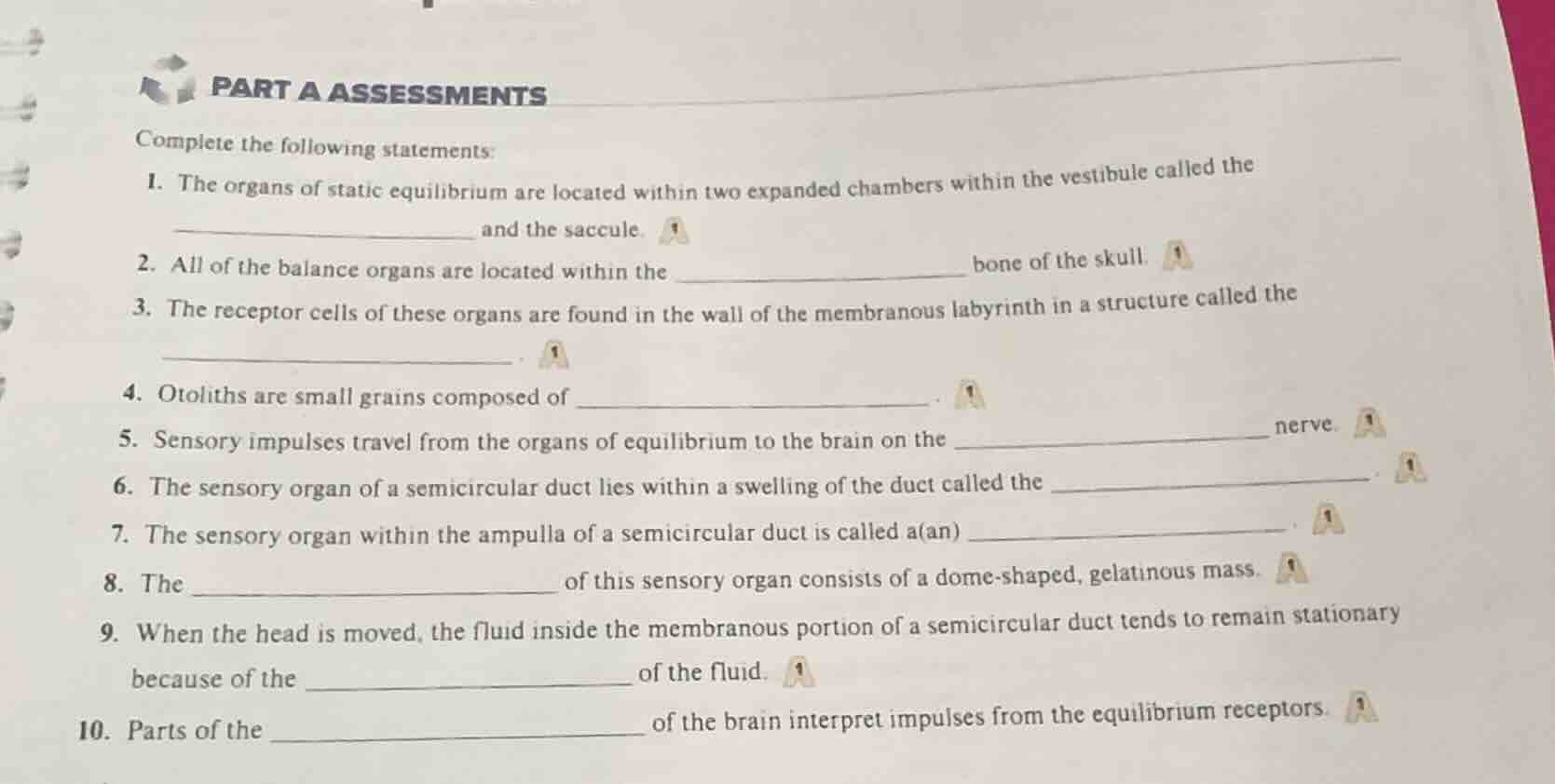
part a assessments
complete the following statements:
- the organs of static equilibrium are located within two expanded chambers within the vestibule called the
and the saccule.
- all of the balance organs are located within the
bone of the skull.
- the receptor cells of these organs are found in the wall of the membranous labyrinth in a structure called the
.
- otoliths are small grains composed of
.
- sensory impulses travel from the organs of equilibrium to the brain on the
nerve.
- the sensory organ of a semicircular duct lies within a swelling of the duct called the
.
- the sensory organ within the ampulla of a semicircular duct is called a(an)
.
- the
of this sensory organ consists of a dome - shaped, gelatinous mass.
- when the head is moved, the fluid inside the membranous portion of a semicircular duct tends to remain stationary
because of the
of the fluid.
- parts of the
of the brain interpret impulses from the equilibrium receptors.
Brief Explanations
- The vestibule of the inner ear has two chambers for static equilibrium: utricle and saccule.
- All inner ear balance organs are housed in the temporal bone of the skull.
- The receptor cells for equilibrium are in the macula, part of the membranous labyrinth wall.
- Otoliths are tiny grains made of calcium carbonate.
- Equilibrium sensory signals travel to the brain via the vestibular nerve.
- The sensory structure of the semicircular duct is contained within the ampulla, a swelling of the duct.
- The sensory organ inside the semicircular duct's ampulla is the crista ampullaris.
- The crista ampullaris has a dome-shaped gelatinous mass called the cupula.
- When the head moves, fluid in the semicircular duct stays still due to its inertia.
- The cerebellum (along with brainstem regions) processes equilibrium receptor impulses.

Snap & solve any problem in the app
Get step-by-step solutions on Sovi AI
Photo-based solutions with guided steps
Explore more problems and detailed explanations
- utricle
- temporal
- macula
- calcium carbonate
- vestibular
- ampulla
- crista ampullaris
- cupula
- inertia
- cerebellum