QUESTION IMAGE
Question
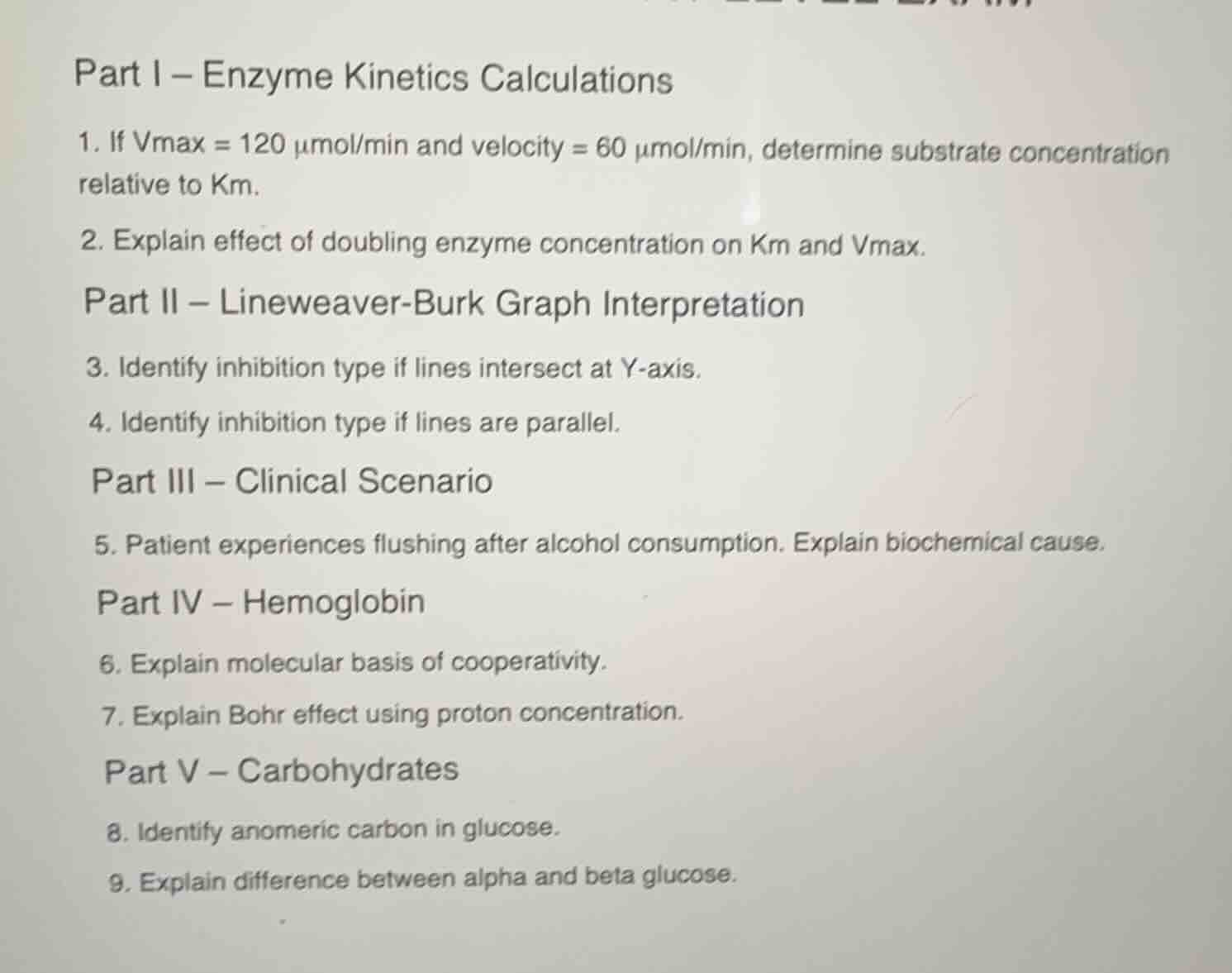
part i – enzyme kinetics calculations
- if vmax = 120 μmol/min and velocity = 60 μmol/min, determine substrate concentration relative to km.
- explain effect of doubling enzyme concentration on km and vmax.
part ii – lineweaver-burk graph interpretation
- identify inhibition type if lines intersect at y-axis.
- identify inhibition type if lines are parallel.
part iii – clinical scenario
- patient experiences flushing after alcohol consumption. explain biochemical cause.
part iv – hemoglobin
- explain molecular basis of cooperativity.
- explain bohr effect using proton concentration.
part v – carbohydrates
- identify anomeric carbon in glucose.
- explain difference between alpha and beta glucose.
Step1: Use Michaelis-Menten equation
The Michaelis-Menten equation is $v = \frac{V_{max}[S]}{K_m + [S]}$, where $v$ is reaction velocity, $V_{max}$ is maximum velocity, $[S]$ is substrate concentration, and $K_m$ is Michaelis constant.
Step2: Substitute given values
Substitute $v=60\ \mu\text{mol/min}$, $V_{max}=120\ \mu\text{mol/min}$:
$60 = \frac{120[S]}{K_m + [S]}$
Step3: Solve for $[S]$ relative to $K_m$
Multiply both sides by $K_m + [S]$:
$60(K_m + [S]) = 120[S]$
$60K_m + 60[S] = 120[S]$
$60K_m = 60[S]$
$[S] = K_m$
Brief Explanations
- $K_m$ is an enzyme-substrate affinity constant, independent of enzyme concentration. $V_{max}$ is directly proportional to enzyme concentration, so doubling enzyme concentration doubles $V_{max}$ while $K_m$ stays unchanged.
- In Lineweaver-Burk plots, lines intersecting at the Y-axis indicate competitive inhibition; this inhibition competes with substrate for the active site, leaving $V_{max}$ unchanged while increasing $K_m$.
- Parallel lines in Lineweaver-Burk plots indicate uncompetitive inhibition; this inhibition binds only to the enzyme-substrate complex, decreasing both $V_{max}$ and $K_m$ proportionally, resulting in parallel lines.
- This is due to aldehyde dehydrogenase (ALDH) deficiency. Alcohol is first converted to acetaldehyde by alcohol dehydrogenase; without functional ALDH, acetaldehyde accumulates, triggering vasodilation (flushing) and other symptoms.
- Hemoglobin has 4 subunits. Binding of one oxygen molecule to a subunit induces a conformational change (from T-state to R-state) that increases the affinity of the remaining subunits for oxygen, creating cooperative binding.
- The Bohr effect describes that high proton concentration (low pH, e.g., in tissues) stabilizes hemoglobin's low-affinity T-state. Protons bind to hemoglobin residues, reducing oxygen affinity, so hemoglobin releases more oxygen to oxygen-depleted tissues.
- In glucose (an aldohexose), the anomeric carbon is carbon 1 (C1), which is the carbonyl carbon in the open-chain form that becomes chiral when the molecule cyclizes.
- Alpha and beta glucose differ in the orientation of the hydroxyl group (-OH) on the anomeric carbon (C1). In alpha glucose, the -OH on C1 is oriented below the plane of the ring; in beta glucose, the -OH on C1 is oriented above the plane of the ring.

Snap & solve any problem in the app
Get step-by-step solutions on Sovi AI
Photo-based solutions with guided steps
Explore more problems and detailed explanations
- $[S] = K_m$
- $K_m$ remains unchanged; $V_{max}$ doubles.
- Competitive inhibition
- Uncompetitive inhibition
- Aldehyde dehydrogenase (ALDH) deficiency leads to acetaldehyde accumulation, causing vasodilation (flushing).
- Subunit conformational change (T→R state) after O₂ binding increases remaining subunits' O₂ affinity.
- High proton concentration stabilizes hemoglobin's low-affinity T-state, reducing O₂ affinity and promoting O₂ release.
- Carbon 1 (C1) of glucose
- Alpha glucose has C1 -OH below the ring plane; beta glucose has C1 -OH above the ring plane.