QUESTION IMAGE
Question
part a
an organisms adaptations are specific to its native
environment. an organism that lives in a coniferous forest
will have different adaptations compared to an animal that
lives in a tropical rain forest. the following graphs show the
temperature and precipitation throughout the year for two
different forests: a coniferous forest in canada, and a
tropical rain forest in belize.
evaluate the graphs, and then explain why plants from
these two ecosystems will have different adaptations. in
your answer, explain the survival challenges that plants face
in these two environments.
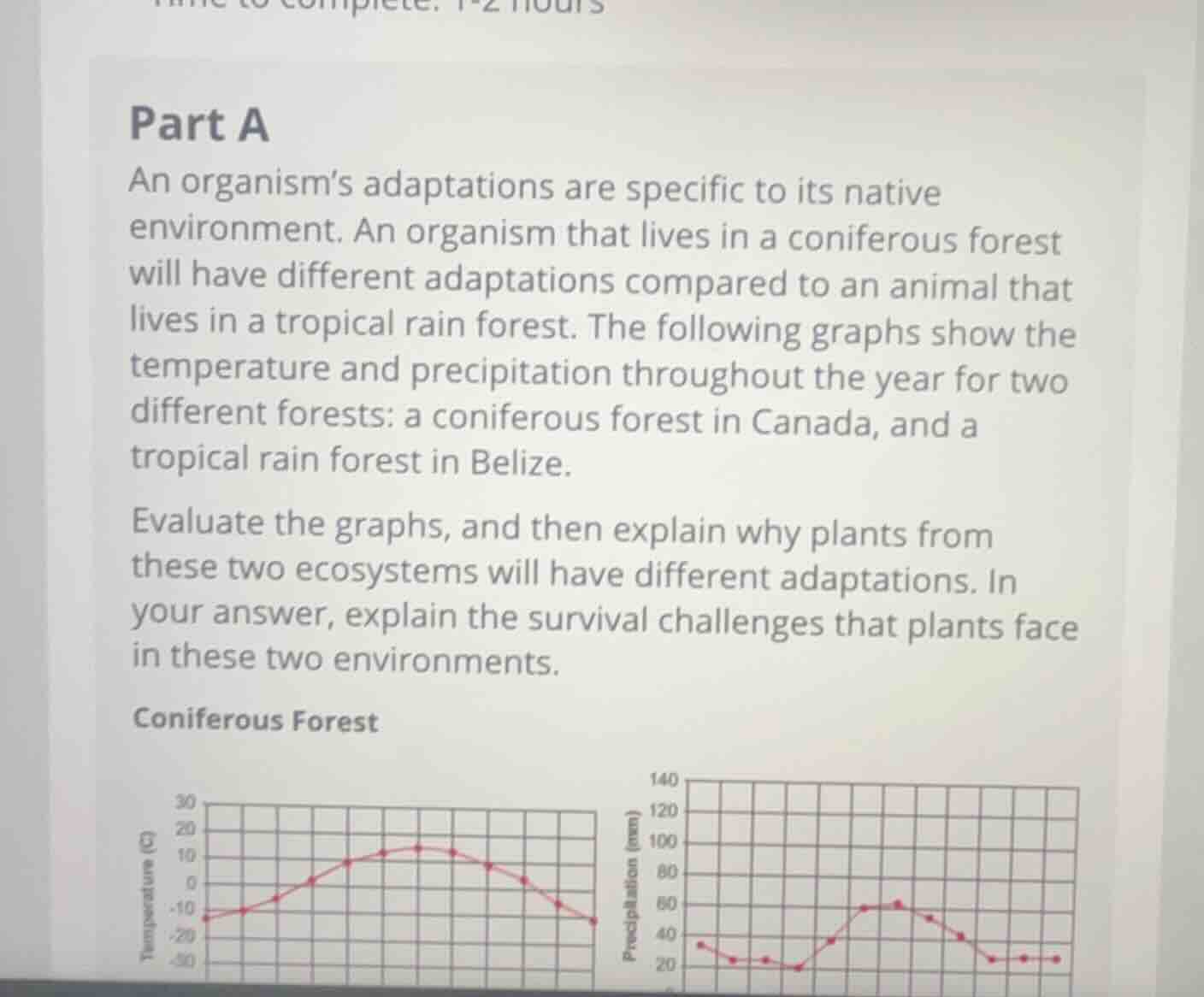
coniferous forest
- Coniferous Forest (Canada) Conditions & Challenges:
- The temperature graph shows cold winters (as low as ~-20°C) and mild summers (peaking at ~10-15°C), with a long, cold dormant period.
- Precipitation is low overall, with a small summer peak, and winter water is locked as ice, creating drought-like conditions for plants.
- Key challenges: Freezing temperatures, limited liquid water in winter, short growing season, and low light in winter.
- Tropical Rainforest (Belize) Conditions & Challenges:
- (Inferred from typical tropical rainforest data, as the graph is not fully shown, but paired with the coniferous forest context): Year-round warm temperatures (consistently 20-30°C), extremely high and consistent precipitation (often 200+ mm monthly), intense sunlight, and high competition for light and space.
- Key challenges: Constant high moisture (risk of fungal/bacterial growth), intense sunlight exposure, nutrient-poor soil (rapid nutrient cycling), and competition for resources.
- Link to Adaptations:
- Coniferous plants (e.g., pine trees) evolve needle-like leaves (reduce water loss, resist freezing), thick waxy cuticles, cold-tolerant cell structures, and evergreen foliage to maximize limited summer sunlight.
- Tropical rainforest plants (e.g., broadleaf trees) evolve large, thin leaves (maximize light capture), drip tips (shed excess water), shallow roots (access surface nutrients), and epiphytic growth (avoid ground competition) to survive their warm, wet, high-competition environment.

Snap & solve any problem in the app
Get step-by-step solutions on Sovi AI
Photo-based solutions with guided steps
Explore more problems and detailed explanations
Plants from the two ecosystems have different adaptations because they face drastically distinct environmental challenges:
- Coniferous Forest (Canada):
- The environment has long, cold winters (temperatures as low as ~-20°C) with water locked as ice, a short warm summer growing season, and low overall precipitation.
- Survival challenges include freezing temperatures, limited liquid water in winter, and a short window for photosynthesis.
- Adaptations (e.g., needle-like leaves with thick waxy cuticles, cold-tolerant cells, evergreen foliage) evolve to reduce water loss, resist freezing, and maximize use of the short growing season.
- Tropical Rainforest (Belize):
- The environment has year-round warm temperatures, extremely high and consistent rainfall, intense sunlight, and nutrient-poor soil due to rapid cycling.
- Survival challenges include excess moisture (risk of fungal growth), intense solar radiation, and high competition for light and nutrients.
- Adaptations (e.g., large thin leaves, drip tips, shallow roots, epiphytic growth) evolve to maximize light capture, shed excess water, access surface nutrients, and avoid ground-level competition.