QUESTION IMAGE
Question
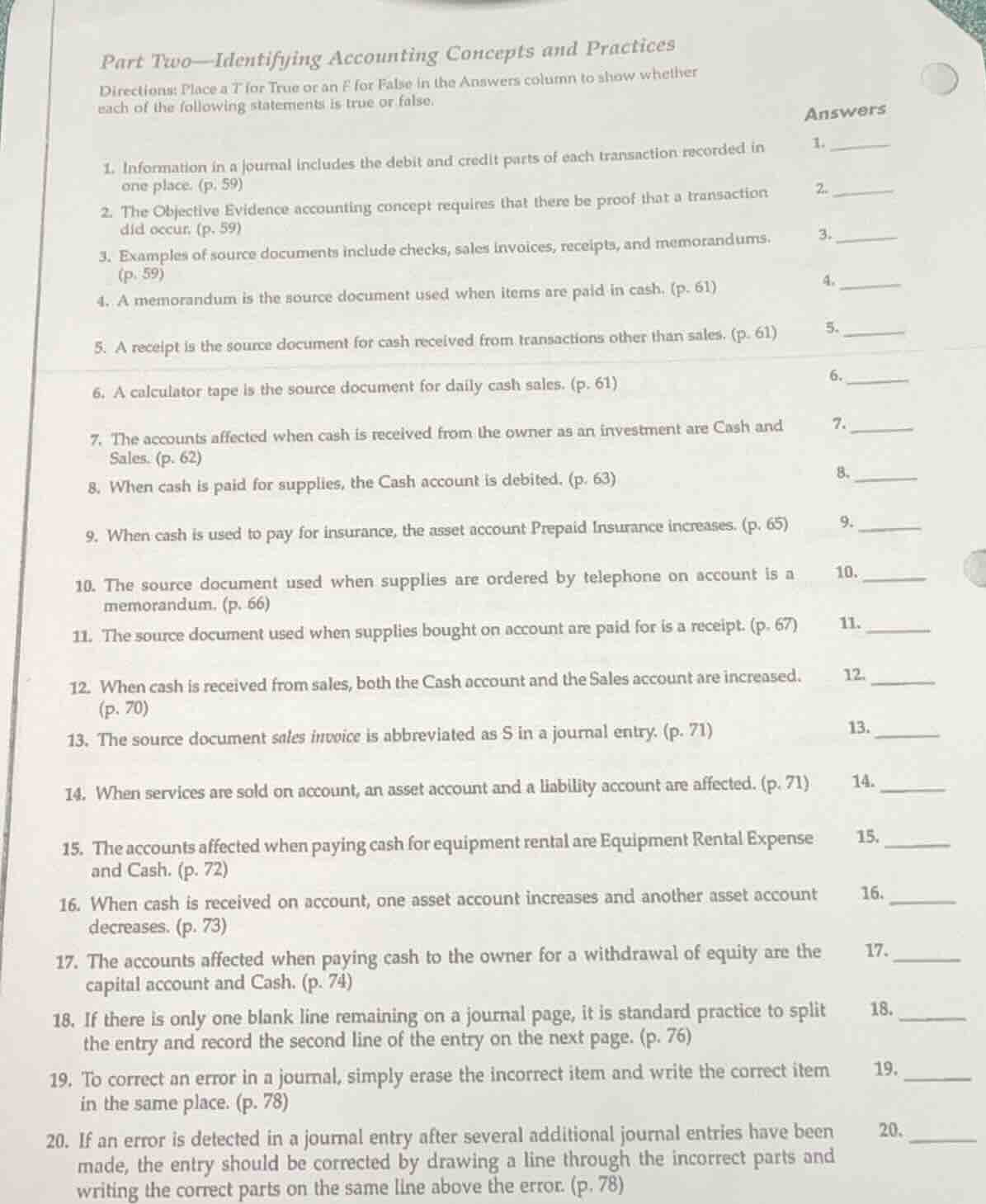
part two—identifying accounting concepts and practices
directions: place a t for true or an f for false in the answers column to show whether
each of the following statements is true or false.
- information in a journal includes the debit and credit parts of each transaction recorded in
one place. (p. 59)
- the objective evidence accounting concept requires that there be proof that a transaction
did occur. (p. 59)
- examples of source documents include checks, sales invoices, receipts, and memorandums.
(p. 59)
- a memorandum is the source document used when items are paid in cash. (p. 61)
- a receipt is the source document for cash received from transactions other than sales. (p. 61)
- a calculator tape is the source document for daily cash sales. (p. 61)
- the accounts affected when cash is received from the owner as an investment are cash and
sales. (p. 62)
- when cash is paid for supplies, the cash account is debited. (p. 63)
- when cash is used to pay for insurance, the asset account prepaid insurance increases. (p. 65)
- the source document used when supplies are ordered by telephone on account is a
memorandum. (p. 66)
- the source document used when supplies bought on account are paid for is a receipt. (p. 67)
- when cash is received from sales, both the cash account and the sales account are increased.
(p. 70)
- the source document sales invoice is abbreviated as s in a journal entry. (p. 71)
- when services are sold on account, an asset account and a liability account are affected. (p. 71)
- the accounts affected when paying cash for equipment rental are equipment rental expense
and cash. (p. 72)
- when cash is received on account, one asset account increases and another asset account
decreases. (p. 73)
- the accounts affected when paying cash to the owner for a withdrawal of equity are the
capital account and cash. (p. 74)
- if there is only one blank line remaining on a journal page, it is standard practice to split
the entry and record the second line of the entry on the next page. (p. 76)
- to correct an error in a journal, simply erase the incorrect item and write the correct item
in the same place. (p. 78)
- if an error is detected in a journal entry after several additional journal entries have been
made, the entry should be corrected by drawing a line through the incorrect parts and
writing the correct parts on the same line above the error. (p. 78)
To solve this, we analyze each statement based on accounting concepts:
1.
A journal records debit and credit of a transaction together.

Snap & solve any problem in the app
Get step-by-step solutions on Sovi AI
Photo-based solutions with guided steps
Explore more problems and detailed explanations
T
2.
Objective Evidence concept needs proof of transaction.