QUESTION IMAGE
Question
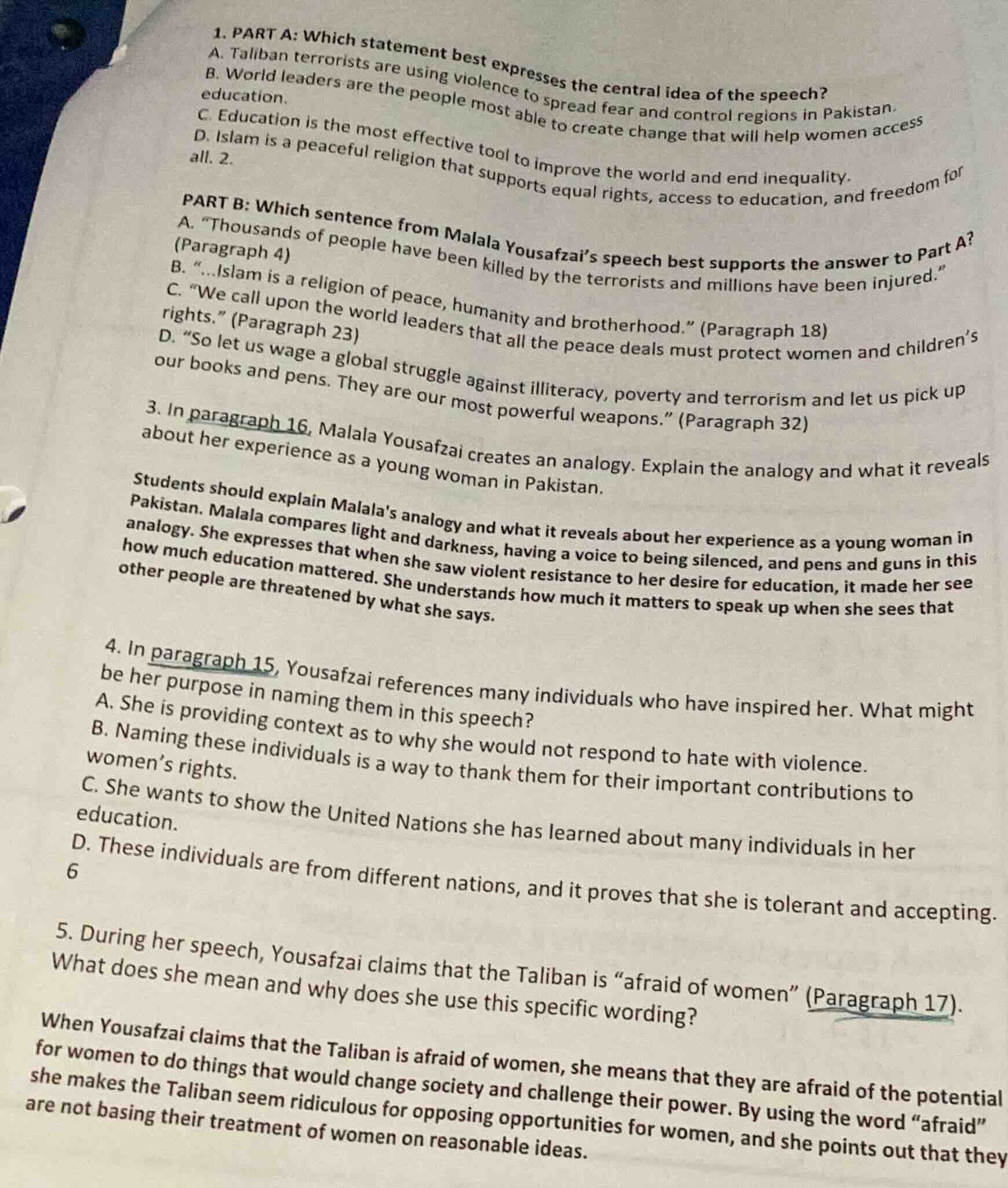
- part a: which statement best expresses the central idea of the speech?
a. taliban terrorists are using violence to spread fear and control regions in pakistan.
b. world leaders are the people most able to create change that will help women access education.
c. education is the most effective tool to improve the world and end inequality.
d. islam is a peaceful religion that supports equal rights, access to education, and freedom for all. 2.
part b: which sentence from malala yousafzai’s speech best supports the answer to part a?
a. “thousands of people have been killed by the terrorists and millions have been injured.” (paragraph 4)
b. “…islam is a religion of peace, humanity and brotherhood.” (paragraph 18)
c. “we call upon the world leaders that all the peace deals must protect women and children’s rights.” (paragraph 23)
d. “so let us wage a global struggle against illiteracy, poverty and terrorism and let us pick up our books and pens. they are our most powerful weapons.” (paragraph 32)
- in paragraph 16, malala yousafzai creates an analogy. explain the analogy and what it reveals about her experience as a young woman in pakistan.
students should explain malalas analogy and what it reveals about her experience as a young woman in pakistan. malala compares light and darkness, having a voice to being silenced, and pens and guns in this analogy. she expresses that when she saw violent resistance to her desire for education, it made her see how much education mattered. she understands how much it matters to speak up when she sees that other people are threatened by what she says.
- in paragraph 15, yousafzai references many individuals who have inspired her. what might be her purpose in naming them in this speech?
a. she is providing context as to why she would not respond to hate with violence.
b. naming these individuals is a way to thank them for their important contributions to women’s rights.
c. she wants to show the united nations she has learned about many individuals in her education.
d. these individuals are from different nations, and it proves that she is tolerant and accepting.
- during her speech, yousafzai claims that the taliban is “afraid of women” (paragraph 17). what does she mean and why does she use this specific wording?
when yousafzai claims that the taliban is afraid of women, she means that they are afraid of the potential for women to do things that would change society and challenge their power. by using the word “afraid” she makes the taliban seem ridiculous for opposing opportunities for women, and she points out that they are not basing their treatment of women on reasonable ideas.
- PART A: Malala's core message centers on education as a transformative force for equity and global good. PART B: The quote directly frames education (books and pens) as the most powerful weapon against the issues holding the world back, supporting the central idea of education's effectiveness.
- The analogies draw clear contrasts between Malala's values (education, voice) and the oppression she faced, emphasizing her perspective on education as a tool for justice.
- Malala references figures who fought for women's rights, so naming them honors their work in the same cause she champions.
- The wording reframes the Taliban's oppressive actions as a response to fear, undermining their legitimacy and centering the idea that women's empowerment is a threat to their control.

Snap & solve any problem in the app
Get step-by-step solutions on Sovi AI
Photo-based solutions with guided steps
Explore more problems and detailed explanations
- PART A: C. Education is the most effective tool to improve the world and end inequality.
PART B: D. "So let us wage a global struggle against illiteracy, poverty and terrorism and let us pick up our books and pens. They are our most powerful weapons." (Paragraph 32)
- Malala uses analogies of light/darkness (education as light, oppression as darkness), voice/silencing (her right to speak vs. being silenced), and pens/guns (education as a non-violent weapon more powerful than violence). These reveal that her pursuit of education faced violent resistance, and she views education as a critical force to fight injustice, while understanding the urgency of speaking up for those threatened by oppression.
- B. Naming these individuals is a way to thank them for their important contributions to women’s rights.
- Malala means the Taliban fears women's potential to gain education, empowerment, and agency, which would challenge their authoritarian control and the patriarchal, restrictive social order they enforce. She uses the word "afraid" to frame the Taliban's oppression as rooted in weakness rather than legitimate authority, highlighting that their opposition to women's rights is not based on reason, but on fear of societal change that would undermine their power.