QUESTION IMAGE
Question
passage 1
enigmas
adapted from folklore of the santal parganas
long ago, a man and his son went to visit the sons future father - in - law. they were joyfully welcomed, but the father - in - law, who had been busy, had nothing prepared for his guests. he said to his daughter,
ow, fill the little river and the big river, and polish the big axe and the little axe, and bar them into the cow house. i will be back with a pot full of water of dry land, then we will finish off these friends.\
the two visitors heard this strange talk, and they began to wonder if their host meant to toss them into the river bed; rich men had been known to do such things. with this thought in their minds, they made haste to leave, but the young woman called them back.
they reluctantly stopped, and when she came up they reproached her for not having warned them of their fate. she laughed at their folly and explained that what her father meant was she should give them a seat in the cow house, and then make some coffee, and they would all have a drink. he would bring back pots of tea in the big and little pitchers after she polished them. he heartily and returned to the house.
passage 2
enigmas
adapted from folklore of the santal parganas
stage set: long ago, in a house
a man and his son are arriving at the house of the sons future father - in - law for a visit. the father - in - law is angry because he is not prepared. he asks his daughter to quickly help ready things.
father - in - law: now, fill the little river and the big river while i am away, and polish the big axe and the little axe, and bar them into the cow house. i will come back, and then we will finish off these friends.
daughter: i will see to it, sir.
the man and son are standing outside the door of the father - in - laws house and overhear the conversation.
son: fearful did you hear what he said?
man: yes. hes going to throw us in the river. lets run!
daughter: chasing after the two men come back!
man: angry why werent you candid about our fate?
1
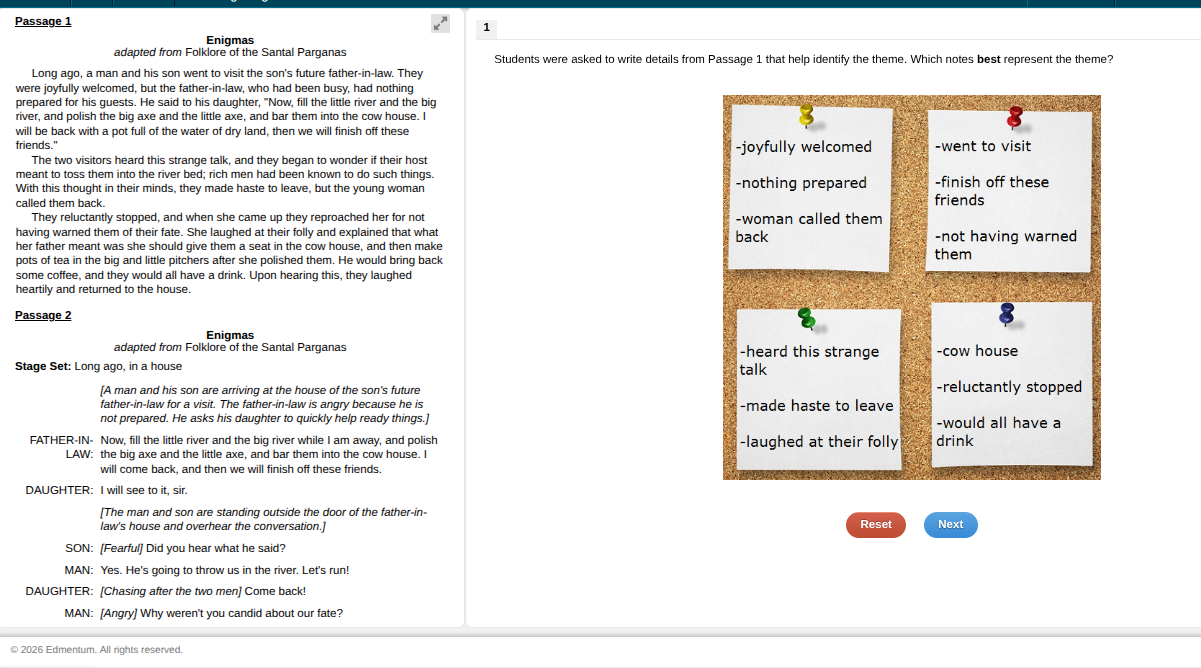
students were asked to write details from passage 1 that help identify the theme. which notes best represent the theme?
the image shows four notes with different details:
-joyfully welcomed
-nothing prepared
-woman called them back
-finish off these friends
-not having warned them
-heard this strange talk
-cow house
-made haste to leave
-laughed at their folly
-reluctantly stopped
-would all have a drink
To determine the notes that best represent the theme, we analyze the passage's key elements: misinterpretation, fear, and then realization. Let's evaluate each note:
- “joyfully welcomed”: This is the initial action, but not central to the theme (misunderstanding). Eliminate.
- “went to visit”: Just the setup, not thematic. Eliminate.
- “nothing prepared”: Context about the host, not the core theme. Eliminate.
- “finish off these friends”: The phrase that sparks fear (misinterpreted as harm). Relevant.
- “not having warned them”: The visitors’ complaint (due to misinterpretation). Relevant.
- “woman called them back”: The daughter’s action to clarify. Relevant.
- “heard this strange talk”: The trigger for misinterpretation. Relevant.
- “made haste to leave”: The visitors’ reaction to fear. Relevant.
- “laughed at their folly”: The resolution (realizing the misinterpretation). Relevant.
- “cow house”: A detail, not thematic. Eliminate.
- “reluctantly stopped”: The visitors’ pause, not core. Eliminate.
- “would all have a drink”: The actual plan, part of the resolution. Relevant.
The notes that capture the theme (misinterpretation, fear, then relief) are: “finish off these friends” (misinterpreted threat), “not having warned them” (visitors’ complaint), “woman called them back” (clarification), “heard this strange talk” (trigger), “made haste to leave” (fearful reaction), “laughed at their folly” (realization), and “would all have a drink” (actual plan). Among the options, the notes that best represent the theme are those tied to the misinterpretation and its resolution. The most cohesive set includes:
- “finish off these friends” (threat misinterpreted)
- “not having warned them” (visitors’ frustration)
- “heard this strange talk” (trigger)
- “made haste to leave” (fearful action)
- “laughed at their folly” (resolution)
- “woman called them back” (clarification)
However, if we must choose the “best” set (likely the one with “finish off these friends”, “not having warned them”, “heard this strange talk”, “made haste to leave”, “laughed at their folly”, and “woman called them back”), these collectively show the arc of misinterpretation → fear → resolution.

Snap & solve any problem in the app
Get step-by-step solutions on Sovi AI
Photo-based solutions with guided steps
Explore more problems and detailed explanations
The notes that best represent the theme are: “finish off these friends”, “not having warned them”, “heard this strange talk”, “made haste to leave”, “laughed at their folly”, and “woman called them back” (or the set including these key thematic elements).