QUESTION IMAGE
Question
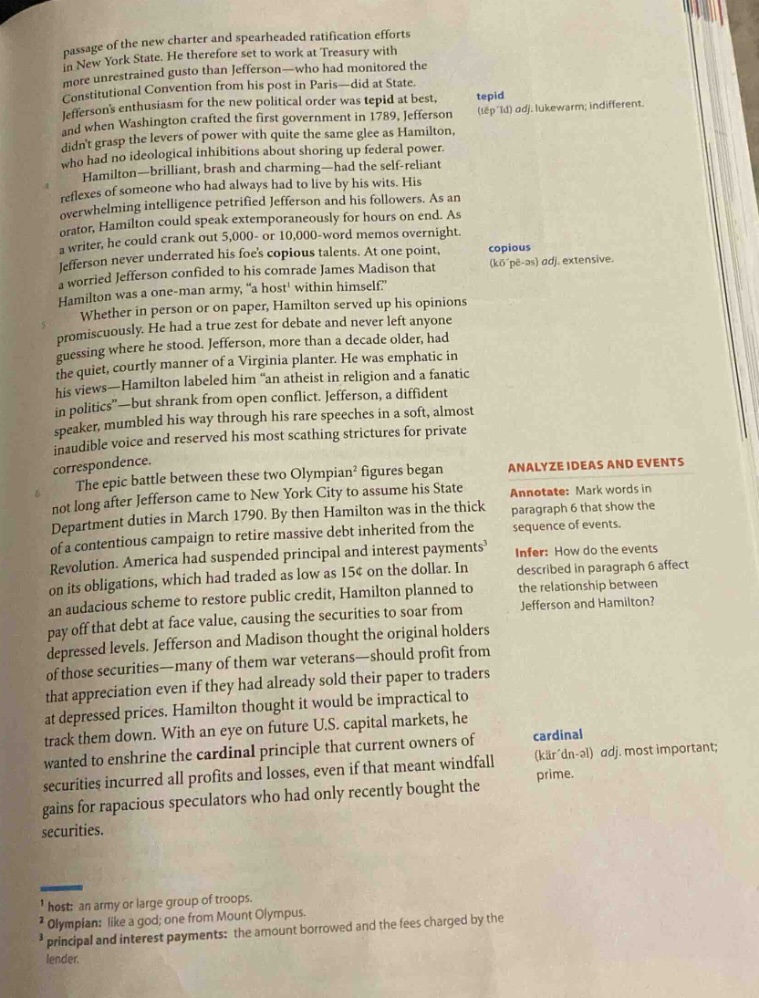
passage of the new charter and spearheaded ratification efforts in new york state. he therefore set to work at treasury with more unrestrained gusto than jefferson—who had monitored the constitutional convention from his post in paris—did at state. jefferson’s enthusiasm for the new political order was tepid at best, and when washington crafted the first government in 1789, jefferson didn’t grasp the levers of power with quite the same glee as hamilton, who had no ideological inhibitions about shoring up federal power.
hamilton—brilliant, brash and charming—had the self - reliant reflexes of someone who had always had to live by his wits. his overwhelming intelligence petrified jefferson and his followers. as an orator, hamilton could speak extemporaneously for hours on end. as a writer, he could crank out 5,000 - or 10,000 - word memos overnight. jefferson never underrated his foe’s copious talents. at one point, a worried jefferson confided to his cousin james madison that hamilton was a one - man army, “a host¹ within himself.”
whether in person or on paper, hamilton served up his opinions promiscuously. he had a true zest for debate and never left anyone guessing where he stood. jefferson, more than a decade older, had the quiet, courtly manner of a virginia planter. he was emphatic in his views—hamilton labeled him “an atheist in religion and a fanatic in politics”—but shrank from open conflict. jefferson, a diffident speaker, mumbled his way through his rare speeches in a soft, almost inaudible voice and reserved his most scathing strictures for private correspondence.
the epic battle between these two olympian² figures began not long after jefferson came to new york city to assume his state department duties in march 1790. by then hamilton was in the thick of a contentious campaign to retire massive debt inherited from the revolution. america had suspended principal and interest payments³ on its obligations, which had traded as low as 15¢ on the dollar. in an audacious scheme to restore public credit, hamilton planned to pay off that debt at face value, causing the securities to soar from depressed levels. jefferson and madison thought the original holders of those securities—many of them war veterans—should profit from that appreciation even if they had already sold their paper to traders at depressed prices. hamilton thought it would be impractical to track them down. with an eye on future u.s. capital markets, he wanted to enshrine the cardinal principle that current owners of securities incurred all profits and losses, even if that meant windfall gains for rapacious speculators who had only recently bought the securities.
1 host: an army or large group of troops.
2 olympian: like a god; one from mount olympus.
3 principal and interest payments: the amount borrowed and the fees charged by the lender.
tepid
(tep id) adj. lukewarm; indifferent.
copious
(ko - pe - as) adj. extensive.
analyze ideas and events
annotate: mark words in paragraph 6 that show the sequence of events.
infer: how do the events described in paragraph 6 affect the relationship between jefferson and hamilton?
cardinal
(kär dn - al) adj. most important; prime.
- The phrases began not long after and By then explicitly signal the order of when Jefferson's arrival and Hamilton's debt campaign took place, marking the sequence of events.
- Hamilton's debt plan favored speculators, which directly clashed with Jefferson and Madison's belief that original war bond holders should benefit. This policy disagreement amplified their existing personal and political tensions, pushing their relationship further into conflict.

Snap & solve any problem in the app
Get step-by-step solutions on Sovi AI
Photo-based solutions with guided steps
Explore more problems and detailed explanations
- Words showing sequence of events: began not long after, By then
- The events deepen their ideological conflict and worsen their already strained relationship.