QUESTION IMAGE
Question
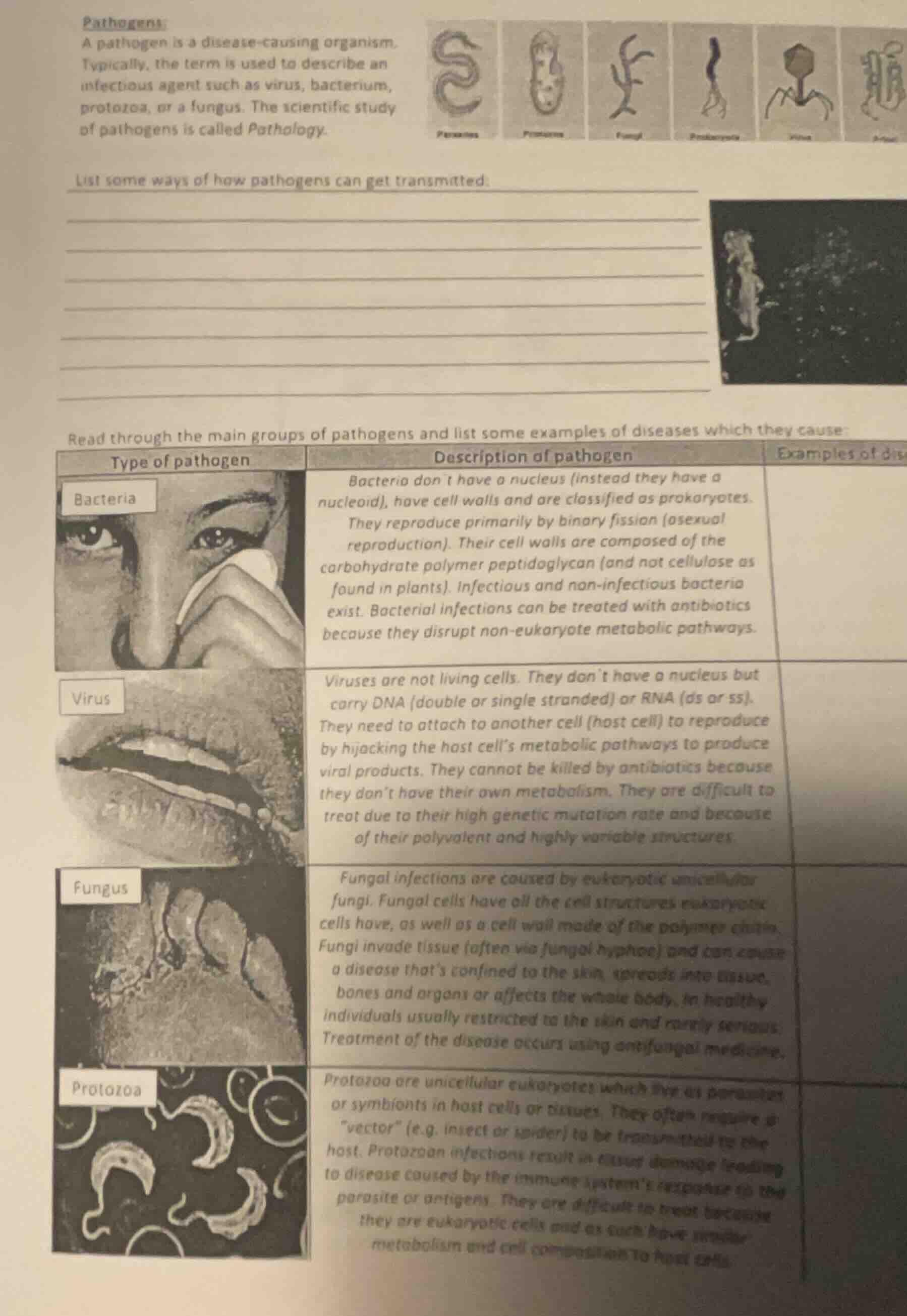
pathogens:a pathogen is a disease-causing organism.typically, the term is used to describe aninfectious agent such as virus, bacterium,protozoa, or a fungus. the scientific studyof pathogens is called pathology.list some ways of how pathogens can get transmitted.read through the main groups of pathogens and list some examples of diseases which they cause:| type of pathogen | description of pathogen | examples of dis || ---- | ---- | ---- || bacteria | bacteria dont have a nucleus (instead they have a nucleoid), have cell walls and are classified as prokaryotes. they reproduce primarily by binary fission (asexual reproduction). their cell walls are composed of the carbohydrate polymer peptidoglycan (and not cellulose as found in plants). infectious and non-infectious bacteria exist. bacterial infections can be treated with antibiotics because they disrupt non-eukaryote metabolic pathways. | || virus | viruses are not living cells. they dont have a nucleus but carry dna (double or single stranded) or rna (ds or ss). they need to attach to another cell (host cell) to reproduce by hijacking the host cells metabolic pathways to produce viral products. they cannot be killed by antibiotics because they dont have their own metabolism. they are difficult to treat due to their high genetic mutation rate and because of their polyvalent and highly variable structures. | || fungus | fungal infections are caused by eukaryotic unicellular fungi. fungal cells have all the cell structures eukaryotic cells have, as well as a cell wall made of the polymer chitin. fungi invade tissue (often via fungal hyphae) and can cause a disease thats confined to the skin, spreads into tissue, bones and organs or affects the whole body. in healthy individuals usually restricted to the skin and rarely serious. treatment of the disease occurs using antifungal medicine. | || protozoa | protozoa are unicellular eukaryotes which live as parasites or symbionts in host cells or tissues. they often require a \vector\ (e.g. insect or spider) to be transmitted to the host. protozoan infections result in tissue damage leading to disease caused by the immune systems response to the parasite or antigens. they are difficult to treat because they are eukaryotic cells and as such have similar metabolism and cell composition to host cells. | |
First, for pathogen transmission, common routes are based on how infectious agents move between hosts. For the disease examples, each pathogen type has well-documented associated illnesses aligned with their biological traits.
- Transmission methods: These are standard, evidence-based ways pathogens spread between organisms.
- Disease examples: Each example matches the pathogen's classification and infection mechanisms (e.g., antibiotics work on bacterial diseases, viruses use host cells, fungi target skin/body tissues, protozoa often rely on vectors).

Snap & solve any problem in the app
Get step-by-step solutions on Sovi AI
Photo-based solutions with guided steps
Explore more problems and detailed explanations
Ways pathogens are transmitted:
- Direct physical contact (e.g., touching an infected person)
- Inhalation of airborne droplets (e.g., coughing/sneezing)
- Ingestion of contaminated food or water
- Transmission via vector organisms (e.g., mosquitoes, ticks)
- Contact with contaminated surfaces or objects
Diseases caused by each pathogen type:
| Type of pathogen | Examples of diseases |
|---|---|
| Virus | Influenza, COVID-19, Herpes simplex |
| Fungus | Athlete's foot, Ringworm, Candidiasis (thrush) |
| Protozoa | Malaria (transmitted by mosquitoes), Giardiasis, African trypanosomiasis (sleeping sickness) |