QUESTION IMAGE
Question
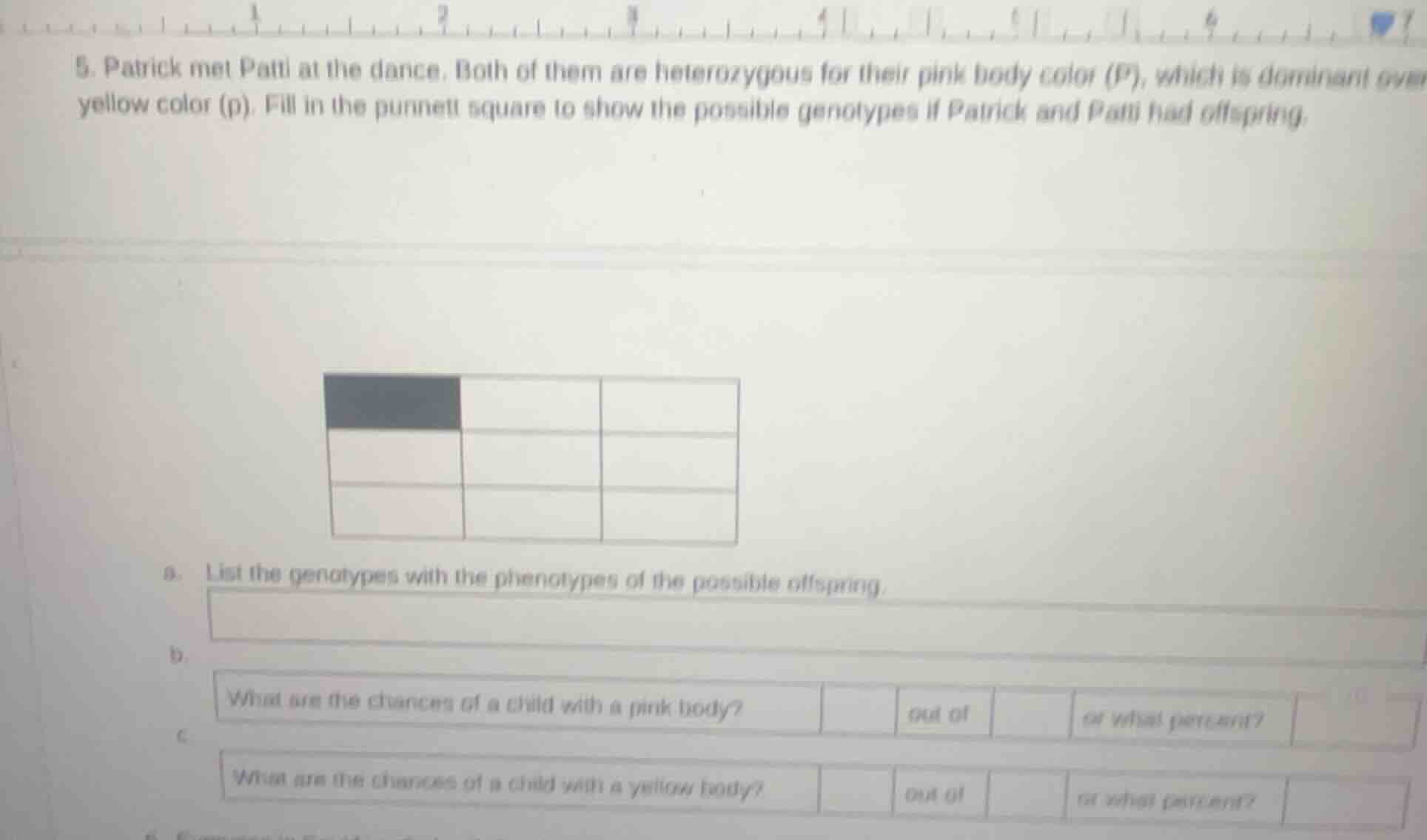
- patrick met patti at the dance. both of them are heterozygous for their pink body color (p), which is dominant over yellow color (p). fill in the punnett square to show the possible genotypes if patrick and patti had offspring.
a. list the genotypes with the phenotypes of the possible offspring.
b.
what are the chances of a child with a pink body?
out of
or what percent?
c.
what are the chances of a child with a yellow body?
out of
or what percent?
Part 1: Filling the Punnett Square
Since both Patrick and Patti are heterozygous (\(Pp\)), their gametes can be \(P\) or \(p\). The Punnett square is a 2x2 grid (wait, the given grid looks 3x3? Wait, no—heterozygous parents (\(Pp \times Pp\)) have a 2x2 Punnett square, but maybe the diagram is misdrawn. Correctly, the Punnett square for \(Pp \times Pp\) is:
| \(P\) | \(p\) | |
|---|---|---|
| \(p\) | \(Pp\) | \(pp\) |
Part a: Genotypes and Phenotypes
- \(PP\): Phenotype = Pink (homozygous dominant)
- \(Pp\): Phenotype = Pink (heterozygous, dominant allele expressed)
- \(pp\): Phenotype = Yellow (homozygous recessive)
Part b: Chances of Pink Body
From the Punnett square, 3 out of 4 offspring have pink body (\(PP\), \(Pp\), \(Pp\)).
- Fraction: \(\frac{3}{4}\)
- Percentage: \(75\%\)
Part c: Chances of Yellow Body
From the Punnett square, 1 out of 4 offspring have yellow body (\(pp\)).
- Fraction: \(\frac{1}{4}\)
- Percentage: \(25\%\)
Final Answers
a. Genotypes: \(PP\) (pink), \(Pp\) (pink), \(Pp\) (pink), \(pp\) (yellow)
b. Chances of pink body: \(3\) out of \(4\) or \(75\%\)
c. Chances of yellow body: \(1\) out of \(4\) or \(25\%\)

Snap & solve any problem in the app
Get step-by-step solutions on Sovi AI
Photo-based solutions with guided steps
Explore more problems and detailed explanations
Part 1: Filling the Punnett Square
Since both Patrick and Patti are heterozygous (\(Pp\)), their gametes can be \(P\) or \(p\). The Punnett square is a 2x2 grid (wait, the given grid looks 3x3? Wait, no—heterozygous parents (\(Pp \times Pp\)) have a 2x2 Punnett square, but maybe the diagram is misdrawn. Correctly, the Punnett square for \(Pp \times Pp\) is:
| \(P\) | \(p\) | |
|---|---|---|
| \(p\) | \(Pp\) | \(pp\) |
Part a: Genotypes and Phenotypes
- \(PP\): Phenotype = Pink (homozygous dominant)
- \(Pp\): Phenotype = Pink (heterozygous, dominant allele expressed)
- \(pp\): Phenotype = Yellow (homozygous recessive)
Part b: Chances of Pink Body
From the Punnett square, 3 out of 4 offspring have pink body (\(PP\), \(Pp\), \(Pp\)).
- Fraction: \(\frac{3}{4}\)
- Percentage: \(75\%\)
Part c: Chances of Yellow Body
From the Punnett square, 1 out of 4 offspring have yellow body (\(pp\)).
- Fraction: \(\frac{1}{4}\)
- Percentage: \(25\%\)
Final Answers
a. Genotypes: \(PP\) (pink), \(Pp\) (pink), \(Pp\) (pink), \(pp\) (yellow)
b. Chances of pink body: \(3\) out of \(4\) or \(75\%\)
c. Chances of yellow body: \(1\) out of \(4\) or \(25\%\)