QUESTION IMAGE
Question
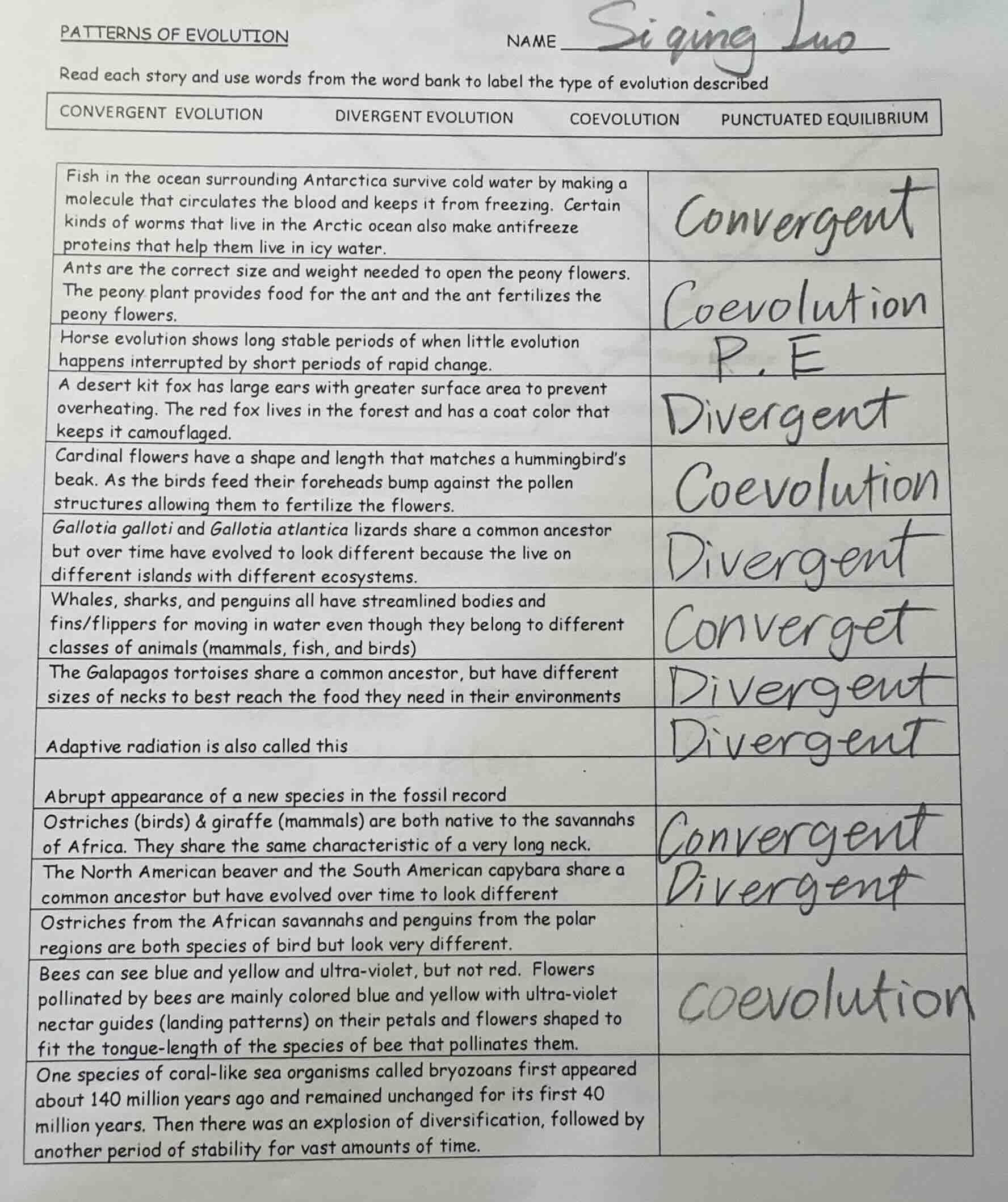
patterns of evolution
name
read each story and use words from the word bank to label the type of evolution described
convergent evolution divergent evolution coevolution punctuated equilibrium
fish in the ocean surrounding antarctica survive cold water by making a molecule that circulates the blood and keeps it from freezing. certain kinds of worms that live in the arctic ocean also make antifreeze proteins that help them live in icy water.
ants are the correct size and weight needed to open the peony flowers. the peony plant provides food for the ant and the ant fertilizes the peony flowers.
horse evolution shows long stable periods of when little evolution happens interrupted by short periods of rapid change.
a desert kit fox has large ears with greater surface area to prevent overheating. the red fox lives in the forest and has a coat color that keeps it camouflaged.
cardinal flowers have a shape and length that matches a hummingbird’s beak. as the birds feed their foreheads bump against the pollen structures allowing them to fertilize the flowers.
gallotia galloti and gallotia atlantica lizards share a common ancestor but over time have evolved to look different because the live on different islands with different ecosystems.
whales, sharks, and penguins all have streamlined bodies and fins/flippers for moving in water even though they belong to different classes of animals (mammals, fish, and birds)
the galapagos tortoises share a common ancestor, but have different sizes of necks to best reach the food they need in their environments
adaptive radiation is also called this
abrupt appearance of a new species in the fossil record
ostriches (birds) & giraffe (mammals) are both native to the savannahs of africa. they share the same characteristic of a very long neck.
the north american beaver and the south american capybara share a common ancestor but have evolved over time to look different
ostriches from the african savannahs and penguins from the polar regions are both species of bird but look very different.
bees can see blue and yellow and ultra - violet, but not red. flowers pollinated by bees are mainly colored blue and yellow with ultra - violet nectar guides (landing patterns) on their petals and flowers shaped to fit the tongue - length of the species of bee that pollinates them.
one species of coral - like sea organisms called bryozoans first appeared about 140 million years ago and remained unchanged for its first 40 million years. then there was an explosion of diversification, followed by another period of stability for vast amounts of time.
To solve these problems, we analyze each scenario based on the definitions of the four evolution types:
1. Abrupt appearance of a new species in the fossil record
- Definition of Punctuated Equilibrium: Evolution with long stable periods interrupted by short bursts of rapid change, often appearing as "abrupt" new species in fossils (since slow, gradual change wouldn’t create such sudden appearances).
- Answer: PUNCTUATED EQUILIBRIUM
2. Ostriches from the African savannahs and penguins from the polar regions are both species of bird but look very different.
- Definition of Divergent Evolution: Closely related species (same bird group here) evolve different traits due to different environments (savannah vs. polar).
- Answer: DIVERGENT EVOLUTION
3. One species of coral - like sea organisms called bryozoans first appeared about 140 million years ago and remained unchanged for its first 40 million years. Then there was an explosion of diversification, followed by another period of stability for vast amounts of time.
- Definition of Punctuated Equilibrium: Long periods of stability (no change) interrupted by short periods of rapid change (diversification “explosion” here).
- Answer: PUNCTUATED EQUILIBRIUM
Final Answers (for the three unlabeled rows):
- Abrupt appearance of a new species in the fossil record: $\boldsymbol{\text{PUNCTUATED EQUILIBRIUM}}$
- Ostriches (savannah) & penguins (polar) (both birds, look different): $\boldsymbol{\text{DIVERGENT EVOLUTION}}$
- Bryozoans (stable → diversification → stable): $\boldsymbol{\text{PUNCTUATED EQUILIBRIUM}}$

Snap & solve any problem in the app
Get step-by-step solutions on Sovi AI
Photo-based solutions with guided steps
Explore more problems and detailed explanations
To solve these problems, we analyze each scenario based on the definitions of the four evolution types:
1. Abrupt appearance of a new species in the fossil record
- Definition of Punctuated Equilibrium: Evolution with long stable periods interrupted by short bursts of rapid change, often appearing as "abrupt" new species in fossils (since slow, gradual change wouldn’t create such sudden appearances).
- Answer: PUNCTUATED EQUILIBRIUM
2. Ostriches from the African savannahs and penguins from the polar regions are both species of bird but look very different.
- Definition of Divergent Evolution: Closely related species (same bird group here) evolve different traits due to different environments (savannah vs. polar).
- Answer: DIVERGENT EVOLUTION
3. One species of coral - like sea organisms called bryozoans first appeared about 140 million years ago and remained unchanged for its first 40 million years. Then there was an explosion of diversification, followed by another period of stability for vast amounts of time.
- Definition of Punctuated Equilibrium: Long periods of stability (no change) interrupted by short periods of rapid change (diversification “explosion” here).
- Answer: PUNCTUATED EQUILIBRIUM
Final Answers (for the three unlabeled rows):
- Abrupt appearance of a new species in the fossil record: $\boldsymbol{\text{PUNCTUATED EQUILIBRIUM}}$
- Ostriches (savannah) & penguins (polar) (both birds, look different): $\boldsymbol{\text{DIVERGENT EVOLUTION}}$
- Bryozoans (stable → diversification → stable): $\boldsymbol{\text{PUNCTUATED EQUILIBRIUM}}$