QUESTION IMAGE
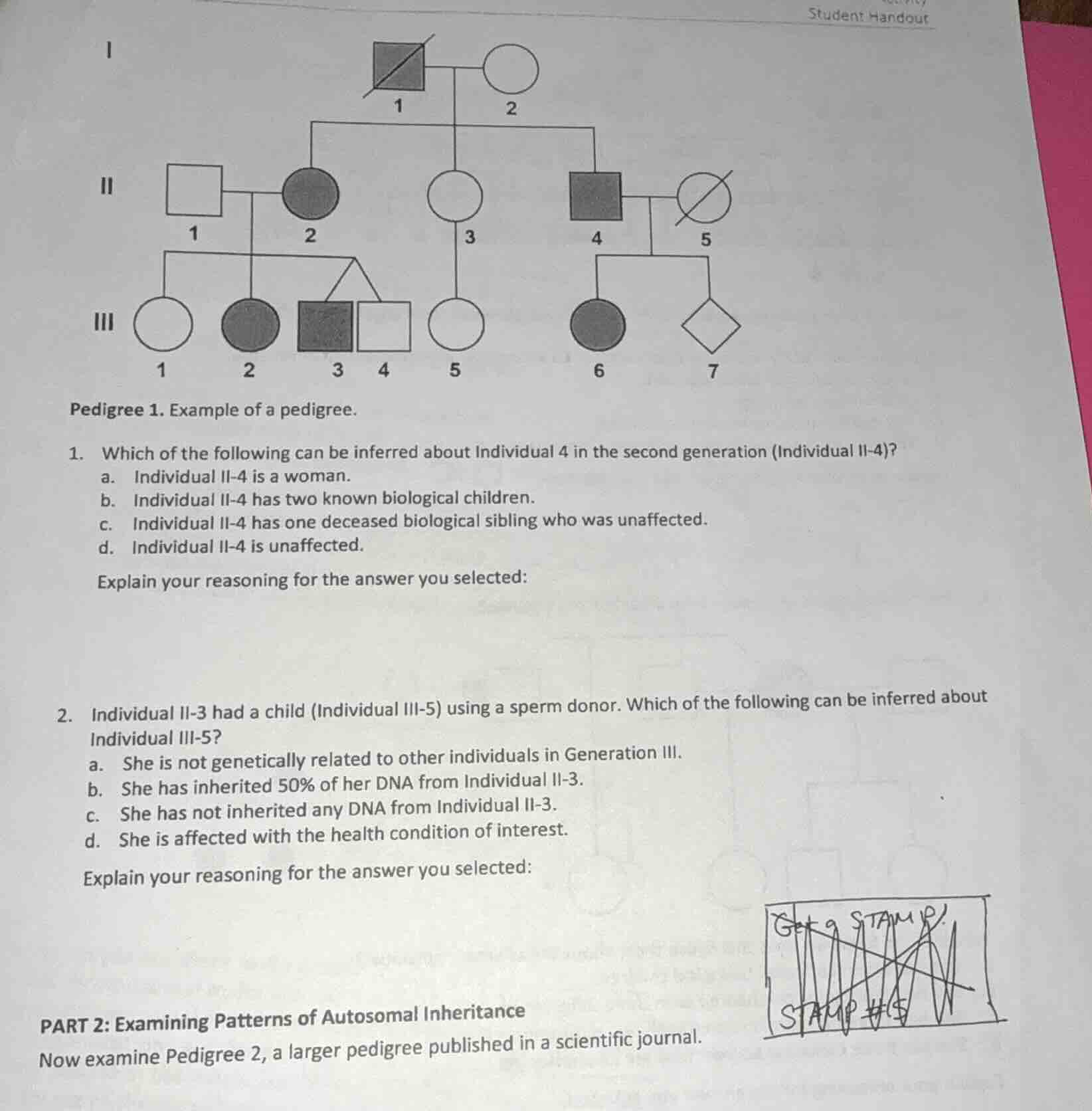
Question
pedigree 1. example of a pedigree.
- which of the following can be inferred about individual 4 in the second generation (individual ii - 4)?
a. individual ii - 4 is a woman.
b. individual ii - 4 has two known biological children.
c. individual ii - 4 has one deceased biological sibling who was unaffected.
d. individual ii - 4 is unaffected.
explain your reasoning for the answer you selected:
- individual ii - 3 had a child (individual iii - 5) using a sperm donor. which of the following can be inferred about individual iii - 5?
a. she is not genetically related to other individuals in generation iii.
b. she has inherited 50% of her dna from individual ii - 3.
c. she has not inherited any dna from individual ii - 3.
d. she is affected with the health condition of interest.
explain your reasoning for the answer you selected:
part 2: examining patterns of autosomal inheritance
now examine pedigree 2, a larger pedigree published in a scientific journal.
Question 1
- Option a: In pedigree notation, squares represent males and circles represent females. II - 4 is a square, so it's a male, so a is wrong.
- Option b: II - 4 has children III - 6 and III - 7 (the diamond can represent a child, and III - 6 is a circle, III - 7 is a diamond), so two known biological children, this is correct.
- Option c: II - 4's siblings are II - 2, II - 3. II - 1 is a spouse of II - 2. The deceased sibling would be I - 1 (deceased, but I - 1 is a parent, not a sibling of II - 4). II - 4's siblings: II - 2 (affected, circle filled), II - 3 (unaffected, circle empty). No deceased sibling who was unaffected, so c is wrong.
- Option d: II - 4 is a filled square, so affected, so d is wrong.
- Option a: III - 5's mother is II - 3. Other individuals in Generation III like III - 1, III - 2, III - 3, III - 4 are children of II - 2 and II - 1. III - 6 and III - 7 are children of II - 4. III - 5 is related to II - 3, but not genetically related to the children of II - 2 (III - 1, III - 2, III - 3, III - 4) or II - 4 (III - 6, III - 7) except through the family tree but not genetically? Wait, no: III - 5's mother is II - 3. II - 3's parents are I - 1 and I - 2. The other Generation III individuals: III - 1,2,3,4 have mother II - 2 (sister of II - 3), so III - 5 and III - 1,2,3,4 are cousins (genetically related as cousins, since their mothers are sisters). So a is wrong.
- Option b: A child inherits 50% of DNA from the mother (II - 3 is the mother here, using a sperm donor, so the mother contributes half the DNA). So III - 5 inherits 50% of DNA from II - 3, this is correct.
- Option c: She inherits from the mother (II - 3), so c is wrong.
- Option d: II - 3 is unaffected (circle empty), so if the condition is autosomal (assuming), and the mother is unaffected, and the sperm donor's status is unknown, but since II - 3 is unaffected, and if the condition is recessive or dominant, but II - 3 is unaffected, so III - 5 may not be affected. The filled circles/squares are affected. III - 5 is an empty circle, so unaffected, so d is wrong.

Snap & solve any problem in the app
Get step-by-step solutions on Sovi AI
Photo-based solutions with guided steps
Explore more problems and detailed explanations
b. Individual II - 4 has two known biological children.