QUESTION IMAGE
Question
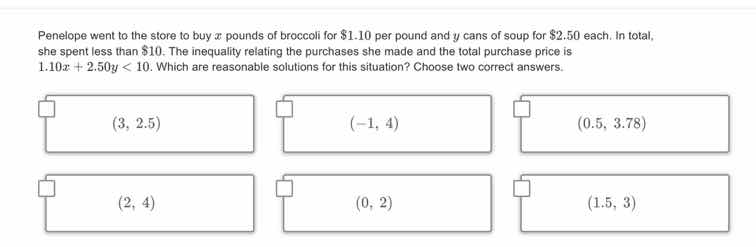
penelope went to the store to buy ( x ) pounds of broccoli for $1.10 per pound and ( y ) cans of soup for $2.50 each. in total, she spent less than $10. the inequality relating the purchases she made and the total purchase price is ( 1.10x + 2.50y < 10 ). which are reasonable solutions for this situation? choose two correct answers.
(3, 2.5)
(-1, 4)
(0.5, 3.78)
(2, 4)
(0, 2)
(1.5, 3)
Step1: Analyze the domain of variables
Since \(x\) represents pounds of broccoli and \(y\) represents cans of soup, \(x\geq0\) and \(y\geq0\) (and \(y\) should be a non - negative integer as you can't buy a fraction of a can in a reasonable real - world context for soup cans, \(x\) can be a non - negative real number as you can buy a fraction of a pound of broccoli). So we can eliminate the option \((- 1,4)\) because \(x=-1<0\) and \((3,2.5)\) because \(y = 2.5\) (non - integer number of cans) and \((0.5,3.78)\) because \(y=3.78\) (non - integer number of cans).
Step2: Check the inequality \(1.10x + 2.50y<10\) for each remaining option
- For \((2,4)\):
Calculate \(1.10\times2+2.50\times4=2.2 + 10=12.2\). Since \(12.2
ot<10\), this option is not valid.
- For \((0,2)\):
Calculate \(1.10\times0 + 2.50\times2=0 + 5 = 5\). Since \(5<10\), this option is valid.
- For \((1.5,3)\):
Calculate \(1.10\times1.5+2.50\times3 = 1.65+7.5=9.15\). Since \(9.15<10\), this option is valid.

Snap & solve any problem in the app
Get step-by-step solutions on Sovi AI
Photo-based solutions with guided steps
Explore more problems and detailed explanations
\((0,2)\), \((1.5,3)\)