QUESTION IMAGE
Question
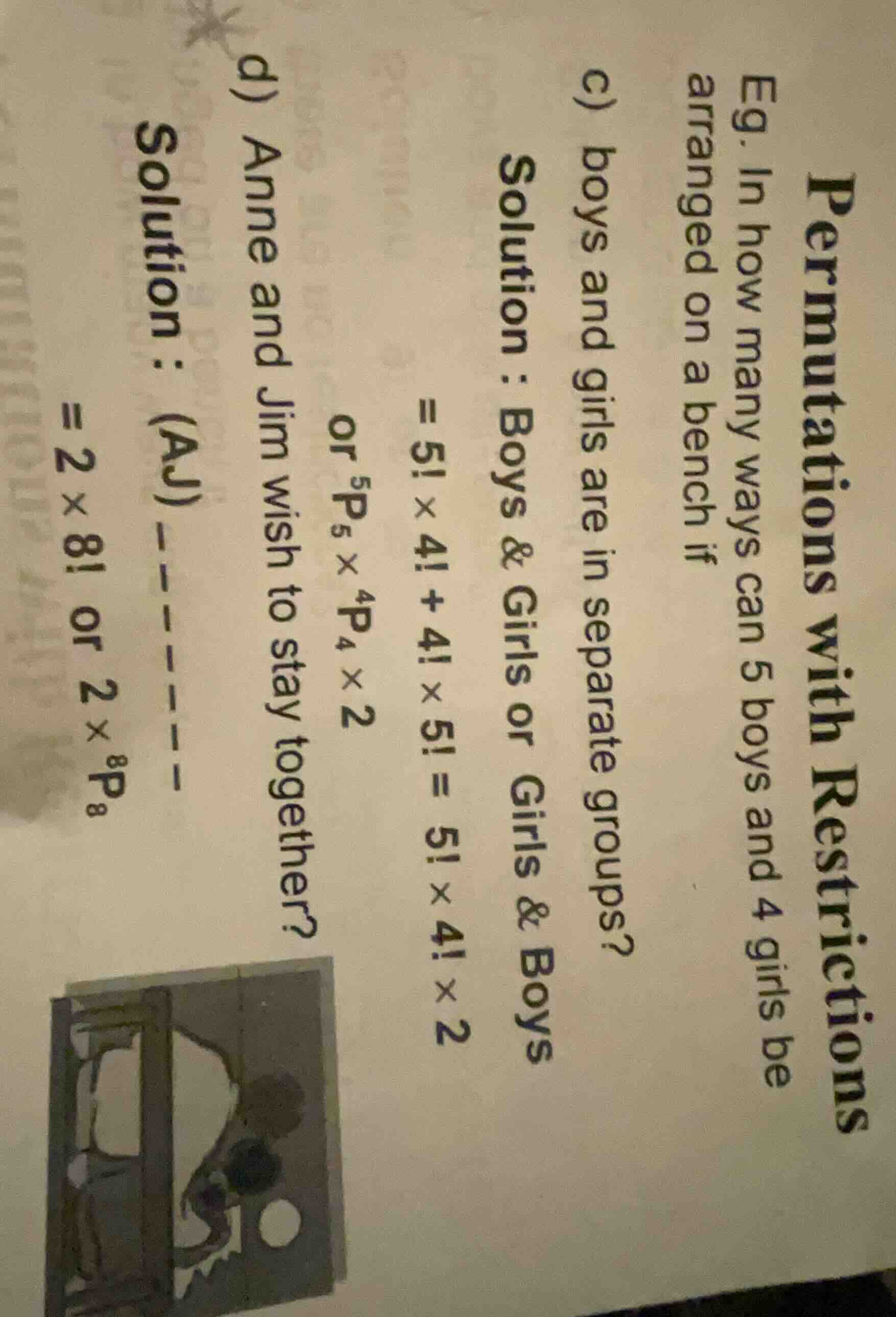
permutations with restrictions
eg. in how many ways can 5 boys and 4 girls be arranged on a bench if
c) boys and girls are in separate groups?
solution : boys & girls or girls & boys
= 5! × 4! + 4! × 5! = 5! × 4! × 2
or ( _5p_5 \times _4p_4 \times 2 )
d) anne and jim wish to stay together?
solution : (aj) -----
= 2 × 8! or ( 2 \times _8p_8 )
Part (c)
Step1: Analyze the two cases (Boys first then Girls, or Girls first then Boys)
For the case of Boys first then Girls: The number of ways to arrange 5 boys is \( _5P_5 = 5!\) (since permutation of \( n \) distinct objects is \( n!\)), and the number of ways to arrange 4 girls is \( _4P_4 = 4!\). So the number of arrangements for this case is \( 5! \times 4!\).
Step2: Analyze the second case (Girls first then Boys)
Similarly, the number of ways to arrange 4 girls is \( 4! \) and the number of ways to arrange 5 boys is \( 5! \). So the number of arrangements for this case is \( 4! \times 5! \).
Step3: Sum the two cases
The total number of arrangements is \( 5! \times 4! + 4! \times 5! \). We can factor out \( 5! \times 4! \) to get \( 2\times5! \times 4! \) (since \( 5! \times 4! + 4! \times 5! = 2\times5! \times 4! \)).
We know that \( n! = n\times(n - 1)\times\cdots\times1 \), so \( 5! = 5\times4\times3\times2\times1 = 120 \) and \( 4! = 4\times3\times2\times1 = 24 \).
Then \( 2\times120\times24 = 2\times2880 = 5760 \).
Step1: Treat Anne and Jim as a single entity (AJ)
When we treat Anne and Jim as one unit, we now have to arrange this unit along with the remaining \( 8 - 2=8 \) people? Wait, actually, if we consider Anne and Jim as a single entity, the total number of entities to arrange is \( 8 \) (since originally there are, let's assume, 10 people? Wait, no, the solution shows \( 2\times8! \) or \( 2\times_8P_8 \). Wait, the idea is: if Anne and Jim must stay together, we consider them as a single "block". So we have \( n - 1 \) entities to arrange where \( n \) is the total number of people. Wait, the solution suggests that when we group Anne and Jim, we have 8 entities (maybe total people are 9? Wait, the solution has \( 2\times8! \). Let's think: the number of ways to arrange \( k \) distinct objects is \( k! \). If we treat Anne and Jim as one object, we have \( 8 \) objects (since \( 9 - 1=8 \)? Wait, the solution says \( 2\times8! \) or \( 2\times_8P_8 \). The factor of 2 comes from the fact that Anne and Jim can be in two orders within their block: AJ or JA. Then, the number of ways to arrange the 8 entities (the AJ block and the other 7 people? Wait, no, maybe total people are 9? Wait, the solution's \( 8! \) implies that after grouping Anne and Jim, we have 8 entities. So the number of ways to arrange the 8 entities is \( 8! \) (or \( _8P_8 \)), and then multiply by 2 (for the two arrangements of Anne and Jim within the block). So total number of arrangements is \( 2\times8! \).
Calculating \( 8! = 8\times7\times6\times5\times4\times3\times2\times1 = 40320 \), then \( 2\times40320 = 80640 \).
Step2: Calculate the result
So the number of ways is \( 2\times8! = 80640 \).

Snap & solve any problem in the app
Get step-by-step solutions on Sovi AI
Photo-based solutions with guided steps
Explore more problems and detailed explanations
The number of ways is \( \boldsymbol{2\times5!\times4! = 5760} \) (or using permutation notation \( _5P_5\times_4P_4+_4P_4\times_5P_5 = 5760 \))