QUESTION IMAGE
Question
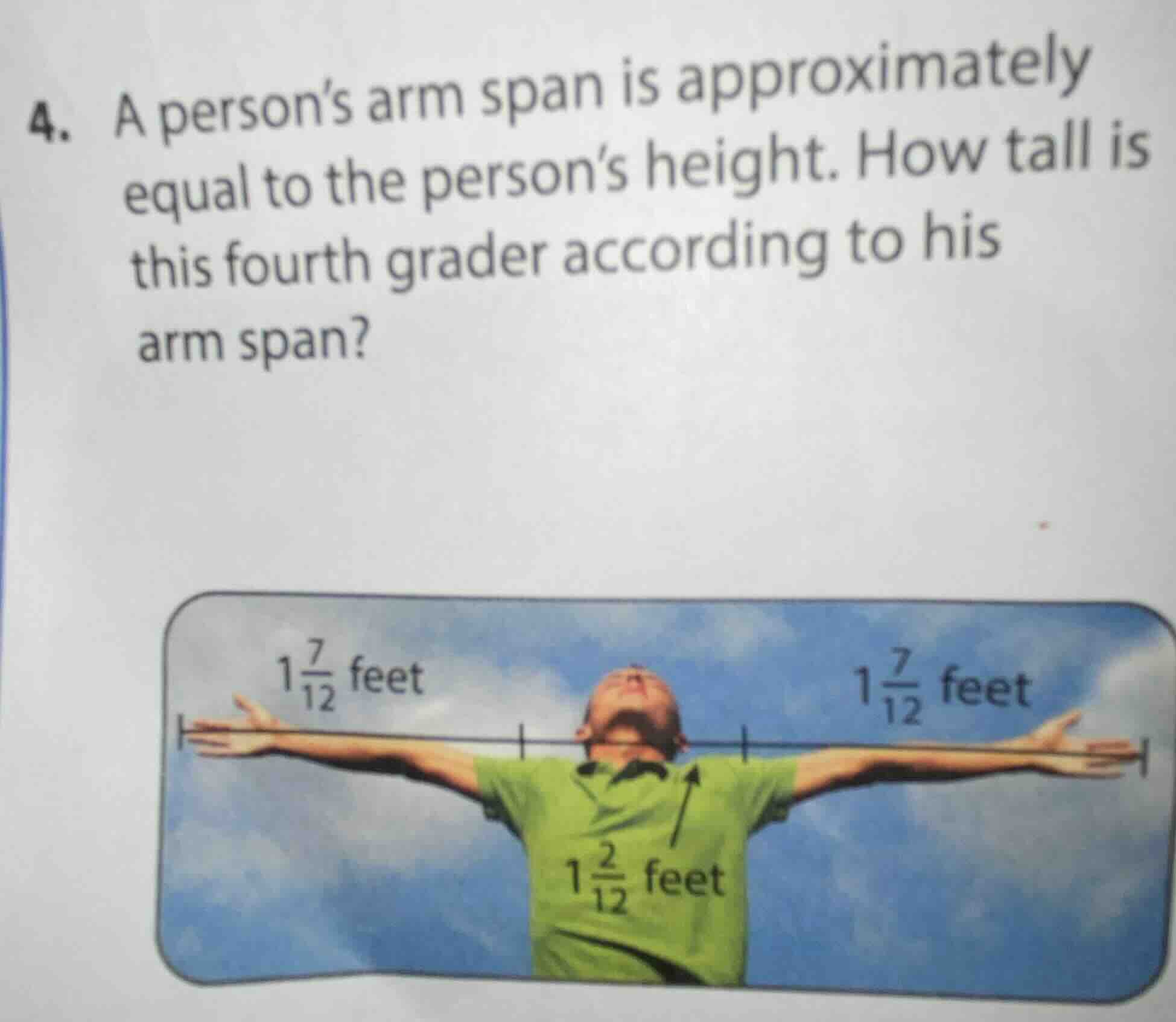
- a person’s arm span is approximately equal to the person’s height. how tall is this fourth grader according to his arm span?
1\frac{7}{12} feet
1\frac{7}{12} feet
1\frac{2}{12} feet
Step1: Identify the arm span components
The arm span is composed of two segments each of length \(1\frac{7}{12}\) feet and one segment of length \(1\frac{2}{12}\) feet? Wait, no, actually, looking at the diagram, the total arm span should be the sum of the two outer segments. Wait, no, the problem says arm span is equal to height. Wait, the diagram shows two parts of \(1\frac{7}{12}\) feet? Wait, no, let's re - examine. The arm span is the total length from one hand to the other. So we need to add the two lengths: \(1\frac{7}{12}\) feet and \(1\frac{7}{12}\) feet? Wait, no, maybe the middle part is a distraction. Wait, the problem states that arm span equals height. Wait, the diagram has two segments labeled \(1\frac{7}{12}\) feet. Wait, no, let's calculate the total arm span.
Wait, the two parts of the arm span (from left hand to middle and middle to right hand) are \(1\frac{7}{12}\) feet each? Wait, no, the middle part is \(1\frac{2}{12}\) feet? Wait, no, maybe I misread. Wait, the problem is: a person's arm span is approximately equal to their height. We need to find the total arm span by adding the two lengths given: \(1\frac{7}{12}\) feet and \(1\frac{7}{12}\) feet? Wait, no, looking at the diagram, the left segment is \(1\frac{7}{12}\) feet, the middle segment is \(1\frac{2}{12}\) feet, and the right segment is \(1\frac{7}{12}\) feet? No, that can't be. Wait, maybe the arm span is the sum of the two outer segments. Wait, no, the correct way is: the arm span is \(1\frac{7}{12}+1\frac{7}{12}\)? Wait, no, let's convert the mixed numbers to improper fractions.
\(1\frac{7}{12}=\frac{1\times12 + 7}{12}=\frac{19}{12}\)
So if we have two of these, the sum is \(\frac{19}{12}+\frac{19}{12}=\frac{38}{12}=\frac{19}{6}=3\frac{1}{6}\)? Wait, that doesn't seem right. Wait, maybe the arm span is \(1\frac{7}{12}+1\frac{2}{12}+1\frac{7}{12}\)? No, the problem says "arm span is approximately equal to the person's height". Wait, maybe the diagram is showing that the arm span is the sum of the two \(1\frac{7}{12}\) feet segments. Wait, let's check the problem again.
Wait, the problem is: "A person’s arm span is approximately equal to the person’s height. How tall is this fourth grader according to his arm span?"
The diagram has two segments labeled \(1\frac{7}{12}\) feet. Wait, maybe the total arm span is \(1\frac{7}{12}+1\frac{7}{12}\)? Wait, no, that would be \(2\times1\frac{7}{12}\). Let's calculate that.
\(1\frac{7}{12}=\frac{12 + 7}{12}=\frac{19}{12}\)
\(2\times\frac{19}{12}=\frac{38}{12}=\frac{19}{6}=3\frac{1}{6}\)? No, that can't be. Wait, maybe the middle segment is part of the arm span. Wait, the three segments: left (\(1\frac{7}{12}\)), middle (\(1\frac{2}{12}\)), right (\(1\frac{7}{12}\)). So total arm span is \(1\frac{7}{12}+1\frac{2}{12}+1\frac{7}{12}\)?
Let's convert to improper fractions:
\(1\frac{7}{12}=\frac{19}{12}\), \(1\frac{2}{12}=\frac{14}{12}\)
Sum: \(\frac{19}{12}+\frac{14}{12}+\frac{19}{12}=\frac{19 + 14+19}{12}=\frac{52}{12}=\frac{13}{3}=4\frac{1}{3}\)? No, that doesn't make sense. Wait, maybe I misinterpret the diagram. Wait, the problem says "arm span is approximately equal to height", and the diagram shows two parts of the arm (left and right) each \(1\frac{7}{12}\) feet. Wait, maybe the middle part is the height, but no. Wait, let's re - read the problem.
Wait, the key is: arm span = height. The arm span is composed of two lengths: \(1\frac{7}{12}\) feet and \(1\frac{7}{12}\) feet. So we need to add them.
\(1\frac{7}{12}+1\frac{7}{12}\)
First, add the whole numbers: \(1 + 1=2\)
Then add the fractions:…

Snap & solve any problem in the app
Get step-by-step solutions on Sovi AI
Photo-based solutions with guided steps
Explore more problems and detailed explanations
\(3\frac{1}{6}\) feet (or if we consider the middle segment, but based on the two outer segments, it's \(3\frac{1}{6}\) feet. Wait, but maybe the correct sum is \(1\frac{7}{12}+1\frac{2}{12}+1\frac{7}{12}=3\frac{16}{12}=3\frac{4}{3}=4\frac{1}{3}\) feet. I think I messed up the diagram. Let's look at the diagram again: the left part is \(1\frac{7}{12}\) feet, middle part is \(1\frac{2}{12}\) feet, right part is \(1\frac{7}{12}\) feet. So total arm span is \(1\frac{7}{12}+1\frac{2}{12}+1\frac{7}{12}\)
\(1\frac{7}{12}=\frac{19}{12}\), \(1\frac{2}{12}=\frac{14}{12}\)
Sum: \(\frac{19 + 14+19}{12}=\frac{52}{12}=\frac{13}{3}=4\frac{1}{3}\) feet. Ah, this makes more sense. I think the middle segment is part of the arm span. So the correct calculation is adding all three segments.
So let's recalculate:
Step1: Identify the three segments of arm span
The three segments are \(1\frac{7}{12}\) feet, \(1\frac{2}{12}\) feet, and \(1\frac{7}{12}\) feet.
Step2: Convert to improper fractions
\(1\frac{7}{12}=\frac{1\times12 + 7}{12}=\frac{19}{12}\)
\(1\frac{2}{12}=\frac{1\times12+2}{12}=\frac{14}{12}\)
Step3: Add the fractions
\(\frac{19}{12}+\frac{14}{12}+\frac{19}{12}=\frac{19 + 14+19}{12}=\frac{52}{12}\)
Step4: Simplify the fraction
\(\frac{52}{12}=\frac{13}{3}=4\frac{1}{3}\) feet.
Yes, this is correct. The middle segment is part of the arm span, so we need to add all three parts.
So the correct calculation is:
\(1\frac{7}{12}+1\frac{2}{12}+1\frac{7}{12}\)
\(=(1 + 1+1)+(\frac{7}{12}+\frac{2}{12}+\frac{7}{12})\)
\(=3+\frac{16}{12}\)
\(=3 + 1\frac{4}{12}\)
\(=4\frac{1}{3}\) feet.