QUESTION IMAGE
Question
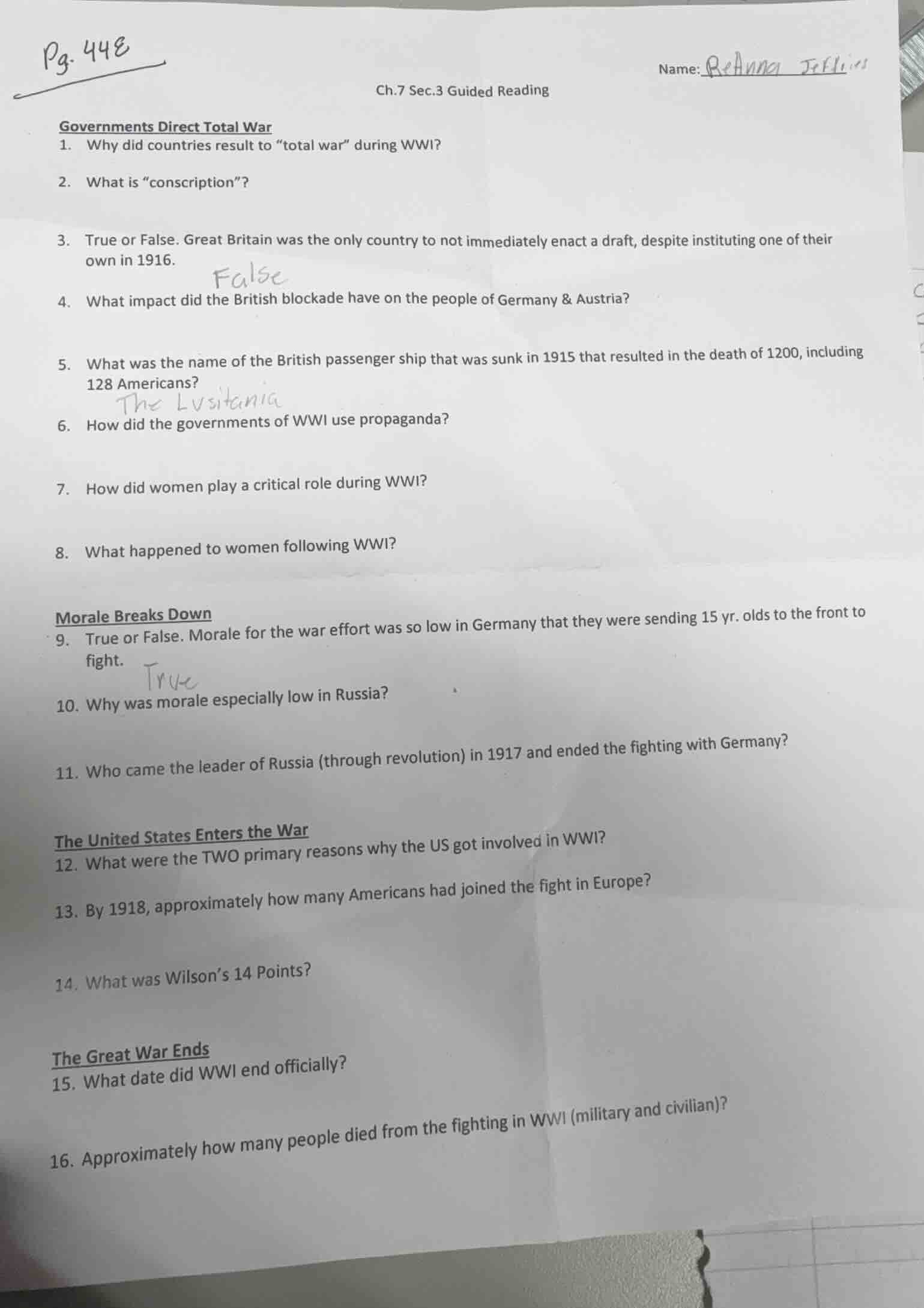
pg. 448
ch.7 sec.3 guided reading
name: reanna jeffries
governments direct total war
- why did countries result to \total war\ during wwi?
- what is \conscription\?
- true or false. great britain was the only country to not immediately enact a draft, despite instituting one of their own in 1916.
- what impact did the british blockade have on the people of germany & austria?
- what was the name of the british passenger ship that was sunk in 1915 that resulted in the death of 1200, including 128 americans?
- how did the governments of wwi use propaganda?
- how did women play a critical role during wwi?
- what happened to women following wwi?
morale breaks down
- true or false. morale for the war effort was so low in germany that they were sending 15 yr. olds to the front to fight.
- why was morale especially low in russia?
- who came the leader of russia (through revolution) in 1917 and ended the fighting with germany?
the united states enters the war
- what were the two primary reasons why the us got involved in wwi?
- by 1918, approximately how many americans had joined the fight in europe?
- what was wilsons 14 points?
the great war ends
- what date did wwi end officially?
- approximately how many people died from the fighting in wwi (military and civilian)?
Brief Explanations
- Nations committed all resources to defeat enemies; modern weapons required massive manpower/materials.
- Forced military service for eligible citizens.
- Other countries like the U.S. also delayed drafts.
- Created severe food/resource shortages, widespread hunger.
- Identified as the sunken 1915 passenger ship.
- Spread biased info to boost support, demonize enemies.
- Filled factory, medical, and non-combat military roles.
- Many lost jobs as men returned; some gained suffrage.
- Germany faced manpower shortages late in the war.
- Military defeats, food shortages, and political corruption.
- Led the Bolshevik Revolution to end Russian involvement.
- Unrestricted submarine warfare; Zimmerman Telegram.
- Historical estimate of U.S. troops in Europe by 1918.
- Wilson's post-war peace plan for global stability.
- Official armistice date that ended active combat.
- Estimated total wartime fatalities (military + civilian).

Snap & solve any problem in the app
Get step-by-step solutions on Sovi AI
Photo-based solutions with guided steps
Explore more problems and detailed explanations
- To fully mobilize all national resources (people, industry, food) to defeat their enemies, as the scale of modern warfare required total commitment.
- Conscription is a system where a country's government requires eligible citizens to serve in the military, often through a mandatory draft.
- False
- The British blockade cut off vital food and supply routes, leading to severe food shortages, widespread hunger, and even starvation among civilians in Germany and Austria.
- The Lusitania
- Governments used propaganda to rally public support for the war, demonize enemy nations, encourage enlistment, and justify wartime sacrifices (e.g., posters, speeches, censored news).
- Women filled critical roles in factories producing war materials, worked as nurses and ambulance drivers, took over agricultural jobs, and served in non-combat military positions, replacing men who had gone to fight.
- Many women were pushed out of their jobs as returning soldiers reclaimed them, but the war also helped advance women's suffrage movements (e.g., women gained the right to vote in the U.S. in 1920).
- True
- Russia faced catastrophic military losses, severe food shortages and famine at home, a lack of basic supplies for soldiers, and widespread anger at the Tsarist government's mismanagement of the war.
- Vladimir Lenin (leader of the Bolshevik Revolution)
- 1) Germany's resumption of unrestricted submarine warfare (which attacked U.S. ships); 2) The Zimmerman Telegram, a secret German message proposing an alliance with Mexico against the U.S.
- Approximately 2 million Americans
- Wilson's 14 Points were a set of idealistic proposals for post-WWI peace, including open diplomacy, self-determination for nations, disarmament, and the creation of a League of Nations to prevent future wars.
- November 11, 1918 (Armistice Day, at 11:00 a.m.)
- Approximately 15-20 million people