QUESTION IMAGE
Question
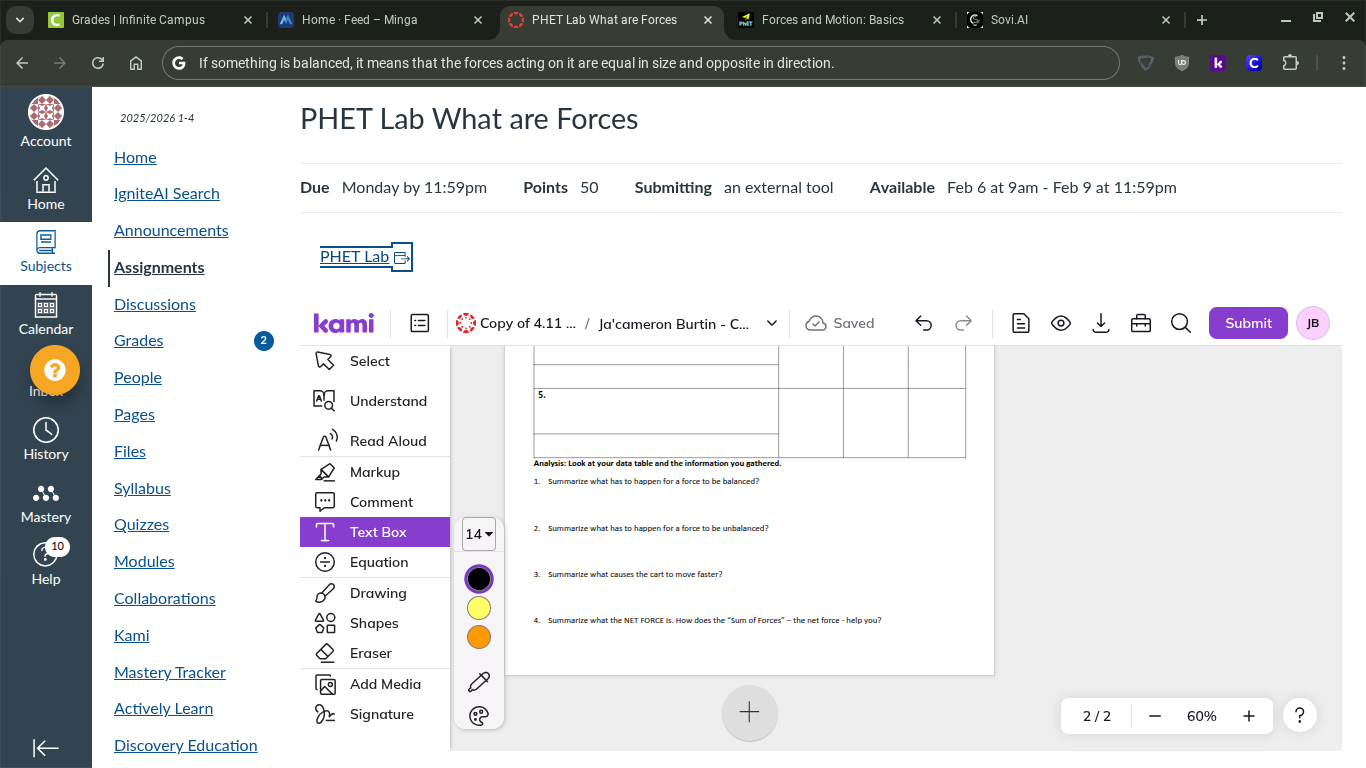
phet lab what are forces due monday by 11:59pm points 50 submitting an external tool available feb 6 at 9am - feb 9 at 11:59pm phet lab kami copy of 4.11... / jacameron burtin - c... saved select understand read aloud markup comment text box 14 equation drawing shapes eraser add media signature 5. analysis: look at your data table and the information you gathered. 1. summarize what has to happen for a force to be balanced? 2. summarize what has to happen for a force to be unbalanced? 3. summarize what causes the cart to move faster? 4. summarize what the net force is. how does the “sum of forces” - the net force - help you? submit jb
To answer the questions related to the PHET Lab on forces, we analyze each one:
1. Summarize what has to happen for a force to be balanced?
Forces are balanced when the magnitude (size) of the forces acting on an object in opposite directions is equal. Mathematically, if we have forces \( F_1 \) and \( F_2 \) acting in opposite directions, \( F_1 = F_2 \), so the net force (\( F_{\text{net}} \)) is \( F_{\text{net}} = F_1 - F_2 = 0 \). When forces are balanced, the object’s motion (speed and direction) remains constant (Newton’s First Law—if at rest, it stays at rest; if moving, it moves at a constant velocity).
2. Summarize what has to happen for a force to be unbalanced?
Forces are unbalanced when the magnitude of forces in opposite directions is not equal (or when forces act in the same direction, their sum creates a net force). If \( F_1 \) and \( F_2 \) act in opposite directions, \( F_1
eq F_2 \), so \( F_{\text{net}} = |F_1 - F_2| \) (if opposite) or \( F_{\text{net}} = F_1 + F_2 \) (if same direction). Unbalanced forces cause a change in motion: the object accelerates (speeds up, slows down, or changes direction) (Newton’s Second Law: \( F_{\text{net}} = ma \), where \( m \) is mass and \( a \) is acceleration).
3. Summarize what causes the cart to move faster?
To make the cart move faster (increase its acceleration or velocity), we need a larger unbalanced (net) force acting on it (Newton’s Second Law: \( a = \frac{F_{\text{net}}}{m} \)). This can happen by:
- Increasing the magnitude of the “push” or “pull” force (e.g., using a stronger fan, adding more weights to a pulley system).
- Reducing opposing forces (e.g., less friction, lighter cart to decrease mass, so the same force creates more acceleration: \( a \propto \frac{1}{m} \) for a fixed \( F_{\text{net}} \)).
4. Summarize what the NET FORCE is. How does the “Sum of Forces” – the net force – help you?
The net force (\( F_{\text{net}} \)) is the vector sum of all forces acting on an object. If forces act in the same direction, we add their magnitudes; if opposite, we subtract. For example, if \( F_1 = 5\,\text{N} \) right and \( F_2 = 3\,\text{N} \) left, \( F_{\text{net}} = 5 - 3 = 2\,\text{N} \) right.
The net force tells us:
- If \( F_{\text{net}} = 0 \): Forces are balanced (no acceleration—motion is constant).
- If \( F_{\text{net}}
eq 0 \): Forces are unbalanced (object accelerates, so motion changes).
- It also lets us calculate acceleration (\( a = \frac{F_{\text{net}}}{m} \)) or predict how motion will change (speed up, slow down, turn).
5. (Assuming a data table from the lab, e.g., with forces applied and cart motion)
If the lab involved testing forces (e.g., fan speed, weights) and measuring cart speed/direction, the analysis would connect:
- Balanced forces: Cart moves at constant speed (or stops) (net force = 0).
- Unbalanced forces: Cart speeds up/slows down/turns (net force ≠ 0).
- Factors affecting speed: Larger net force (more fan power, more weights) or less mass (lighter cart) increases acceleration (and thus final speed over time).
If you need help with specific data from your table, share the table’s columns (e.g., “Force Applied (N), Cart Mass (kg), Cart Speed (m/s)”) and we can refine the analysis!

Snap & solve any problem in the app
Get step-by-step solutions on Sovi AI
Photo-based solutions with guided steps
Explore more problems and detailed explanations
To answer the questions related to the PHET Lab on forces, we analyze each one:
1. Summarize what has to happen for a force to be balanced?
Forces are balanced when the magnitude (size) of the forces acting on an object in opposite directions is equal. Mathematically, if we have forces \( F_1 \) and \( F_2 \) acting in opposite directions, \( F_1 = F_2 \), so the net force (\( F_{\text{net}} \)) is \( F_{\text{net}} = F_1 - F_2 = 0 \). When forces are balanced, the object’s motion (speed and direction) remains constant (Newton’s First Law—if at rest, it stays at rest; if moving, it moves at a constant velocity).
2. Summarize what has to happen for a force to be unbalanced?
Forces are unbalanced when the magnitude of forces in opposite directions is not equal (or when forces act in the same direction, their sum creates a net force). If \( F_1 \) and \( F_2 \) act in opposite directions, \( F_1
eq F_2 \), so \( F_{\text{net}} = |F_1 - F_2| \) (if opposite) or \( F_{\text{net}} = F_1 + F_2 \) (if same direction). Unbalanced forces cause a change in motion: the object accelerates (speeds up, slows down, or changes direction) (Newton’s Second Law: \( F_{\text{net}} = ma \), where \( m \) is mass and \( a \) is acceleration).
3. Summarize what causes the cart to move faster?
To make the cart move faster (increase its acceleration or velocity), we need a larger unbalanced (net) force acting on it (Newton’s Second Law: \( a = \frac{F_{\text{net}}}{m} \)). This can happen by:
- Increasing the magnitude of the “push” or “pull” force (e.g., using a stronger fan, adding more weights to a pulley system).
- Reducing opposing forces (e.g., less friction, lighter cart to decrease mass, so the same force creates more acceleration: \( a \propto \frac{1}{m} \) for a fixed \( F_{\text{net}} \)).
4. Summarize what the NET FORCE is. How does the “Sum of Forces” – the net force – help you?
The net force (\( F_{\text{net}} \)) is the vector sum of all forces acting on an object. If forces act in the same direction, we add their magnitudes; if opposite, we subtract. For example, if \( F_1 = 5\,\text{N} \) right and \( F_2 = 3\,\text{N} \) left, \( F_{\text{net}} = 5 - 3 = 2\,\text{N} \) right.
The net force tells us:
- If \( F_{\text{net}} = 0 \): Forces are balanced (no acceleration—motion is constant).
- If \( F_{\text{net}}
eq 0 \): Forces are unbalanced (object accelerates, so motion changes).
- It also lets us calculate acceleration (\( a = \frac{F_{\text{net}}}{m} \)) or predict how motion will change (speed up, slow down, turn).
5. (Assuming a data table from the lab, e.g., with forces applied and cart motion)
If the lab involved testing forces (e.g., fan speed, weights) and measuring cart speed/direction, the analysis would connect:
- Balanced forces: Cart moves at constant speed (or stops) (net force = 0).
- Unbalanced forces: Cart speeds up/slows down/turns (net force ≠ 0).
- Factors affecting speed: Larger net force (more fan power, more weights) or less mass (lighter cart) increases acceleration (and thus final speed over time).
If you need help with specific data from your table, share the table’s columns (e.g., “Force Applied (N), Cart Mass (kg), Cart Speed (m/s)”) and we can refine the analysis!