QUESTION IMAGE
Question
photosynthesis
- (reaction name)
2.
3.
4.
5.
6.
7.
8.
9.
10.
- (location of reaction)
- (location of reaction)
- (reaction name)
- location (organelle)
copyright © pearson education, inc., publishing as benjamin cummings
Brief Explanations
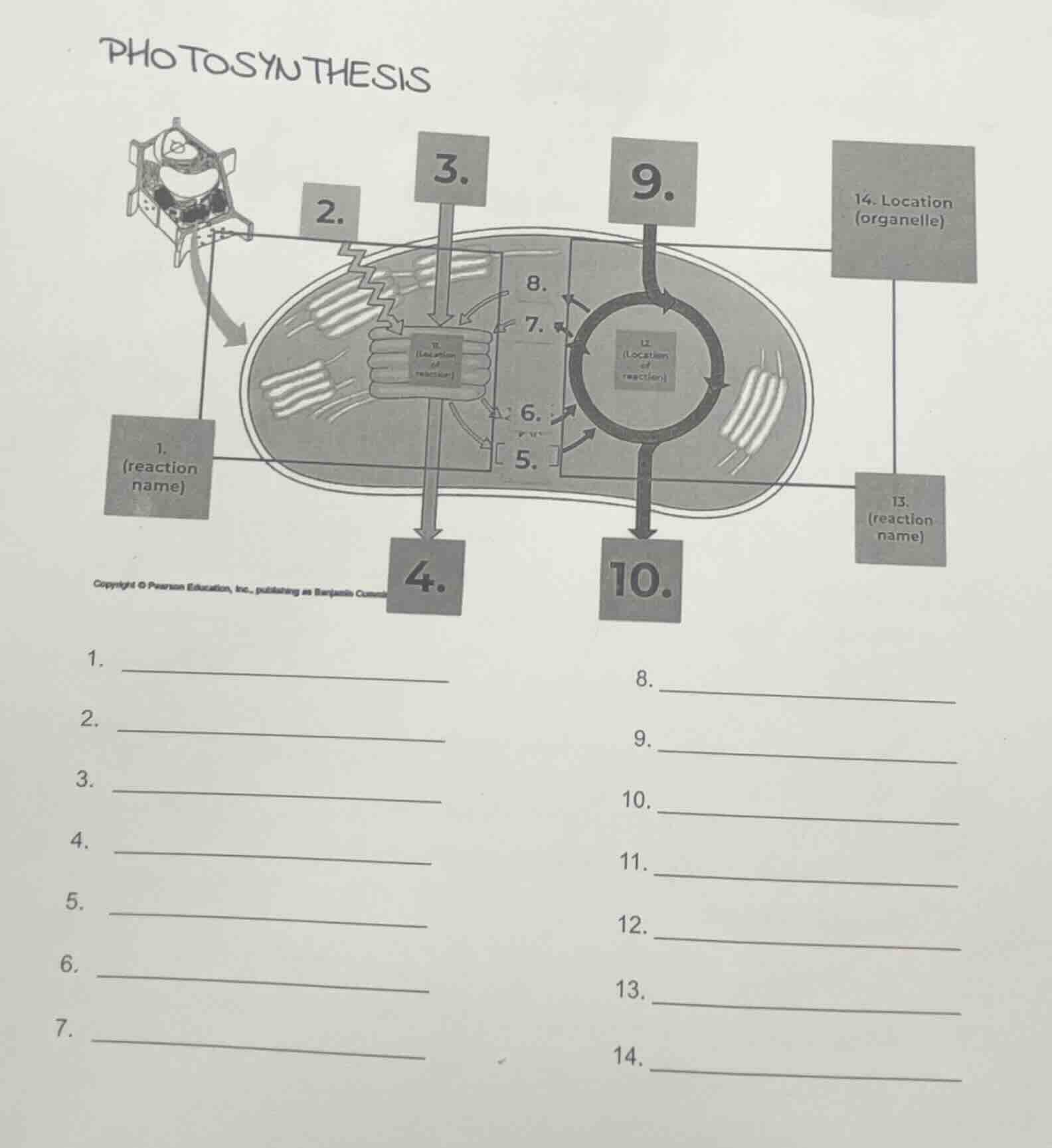
This diagram outlines the two stages of photosynthesis, the light-dependent reactions and Calvin cycle, along with their inputs, outputs, locations, and the overall organelle involved.
- The first reaction is the light-dependent reaction, which captures light energy.
- Water ($H_2O$) is taken into the thylakoid as an input for light reactions.
- Light energy (photons) is absorbed by chlorophyll in the thylakoid.
- Oxygen ($O_2$) is a waste product released from light reactions.
- Adenosine diphosphate (ADP) is converted to ATP in light reactions.
- Nicotinamide adenine dinucleotide phosphate ($NADP^+$) is converted to NADPH.
- ATP is an energy carrier sent to the Calvin cycle.
- NADPH is an electron carrier sent to the Calvin cycle.
- Carbon dioxide ($CO_2$) is the key input for the Calvin cycle.
- Glucose (a sugar, $C_6H_{12}O_6$) is the final product of the Calvin cycle.
- The light-dependent reactions occur in the thylakoid membrane.
- The Calvin cycle occurs in the stroma of the chloroplast.
- The second reaction is the Calvin cycle (light-independent reaction), which builds sugar.
- The entire process of photosynthesis takes place in the chloroplast.

Snap & solve any problem in the app
Get step-by-step solutions on Sovi AI
Photo-based solutions with guided steps
Explore more problems and detailed explanations
- Light-dependent reactions
- Water ($H_2O$)
- Light energy (photons)
- Oxygen ($O_2$)
- ADP (Adenosine diphosphate)
- $NADP^+$ (Nicotinamide adenine dinucleotide phosphate)
- ATP (Adenosine triphosphate)
- NADPH (Nicotinamide adenine dinucleotide phosphate hydrogen)
- Carbon dioxide ($CO_2$)
- Glucose ($C_6H_{12}O_6$)
- Thylakoid membrane
- Stroma
- Calvin cycle (Light-independent reactions)
- Chloroplast