QUESTION IMAGE
Question
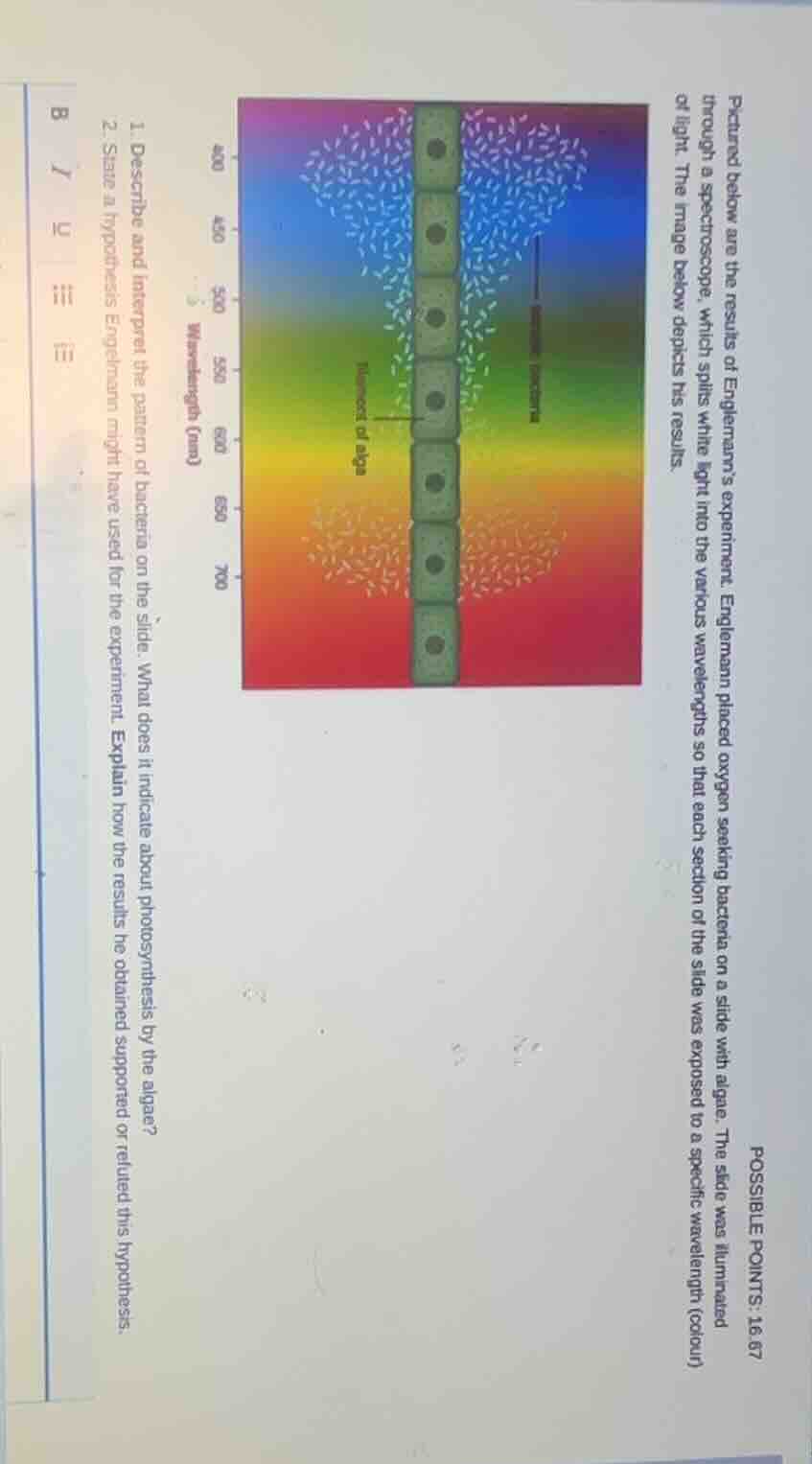
pictured below are the results of englemann’s experiment. englemann placed oxygen seeking bacteria on a slide with algae. the slide was illuminated through a spectroscope, which splits white light into the various wavelengths so that each section of the slide was exposed to a specific wavelength (color) of light. the image below depicts his results.
- describe and interpret the pattern of bacteria on the slide. what does it indicate about photosynthesis by the algae?
- state a hypothesis engelmann might have used for the experiment. explain how the results he obtained supported or refuted this hypothesis.
1. Describe and Interpret the Pattern of Bacteria on the Slide
The bacteria (oxygen - seeking) cluster more densely in regions corresponding to blue - violet (≈400 - 500 nm), red (≈650 - 700 nm), and less in green - yellow (≈500 - 650 nm) wavelengths. Oxygen - seeking bacteria gather where oxygen is produced, so this pattern indicates that the algae perform photosynthesis more efficiently (produce more O₂) in blue - violet and red light, and less in green - yellow light. This is because chlorophyll (the main photosynthetic pigment) absorbs strongly in blue - violet and red regions, and poorly in green - yellow (reflects green, making algae look green).
Hypothesis: Different wavelengths of light vary in their ability to drive photosynthesis (and thus oxygen production) in algae, with blue - violet and red light being more effective than green - yellow light.
Support from Results: The clustering of oxygen - seeking bacteria in blue - violet and red wavelength regions (where more O₂ is produced) and their scarcity in green - yellow regions matches the prediction. More bacteria in blue - violet/red imply more photosynthesis (O₂ production) there, and fewer in green - yellow imply less photosynthesis, supporting the hypothesis that these wavelengths differ in photosynthetic efficiency.

Snap & solve any problem in the app
Get step-by-step solutions on Sovi AI
Photo-based solutions with guided steps
Explore more problems and detailed explanations
The bacteria (oxygen - seeking) are more concentrated in the blue - violet (≈400 - 500 nm) and red (≈650 - 700 nm) wavelength regions, and less concentrated in the green - yellow (≈500 - 650 nm) region. This indicates that the algae produce more oxygen (via photosynthesis) in blue - violet and red light, as these wavelengths are more effectively absorbed for photosynthesis, while green - yellow light is less effective for photosynthesis.