QUESTION IMAGE
Question
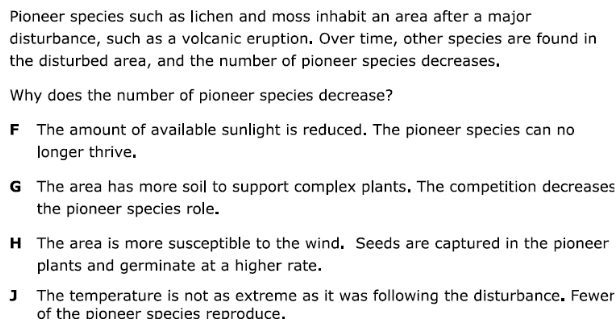
pioneer species such as lichen and moss inhabit an area after a major disturbance, such as a volcanic eruption. over time, other species are found in the disturbed area, and the number of pioneer species decreases. why does the number of pioneer species decrease? f the amount of available sunlight is reduced. the pioneer species can no longer thrive. g the area has more soil to support complex plants. the competition decreases the pioneer species role. h the area is more susceptible to the wind. seeds are captured in the pioneer plants and germinate at a higher rate. j the temperature is not as extreme as it was following the disturbance. fewer of the pioneer species reproduce.
To determine why pioneer species (like lichen, moss) decrease after a disturbance (e.g., volcanic eruption), we analyze each option:
- Option F: Pioneer species (e.g., lichen on bare rock) often rely on direct sunlight. As other plants grow, they shade the area, reducing available sunlight. Lichen/moss, adapted to full sun in barren environments, can’t thrive with less sun. This matches ecological succession logic.
- Option G: Pioneer species help create soil (e.g., lichen breaks down rock). As soil forms, complex plants grow, but competition for resources (not “decreasing the pioneer role” in this way) drives change. The wording about “competition decreasing the role” is inaccurate; it’s resource limitation (not competition’s “role - reduction”) that affects pioneers.
- Option H: Wind susceptibility and seed capture/germination don’t explain pioneer decline. Pioneer species (e.g., moss) reproduce via spores, and wind - related seed capture of other species doesn’t target pioneer decline.
- Option J: Pioneer species (e.g., lichen) are adapted to extreme post - disturbance temps. As temp moderates, they should reproduce more (not fewer). Moderate temps favor complex plants, but pioneers’ reproduction isn’t limited by less extreme temps.

Snap & solve any problem in the app
Get step-by-step solutions on Sovi AI
Photo-based solutions with guided steps
Explore more problems and detailed explanations
F. The amount of available sunlight is reduced. The pioneer species can no longer thrive.