QUESTION IMAGE
Question
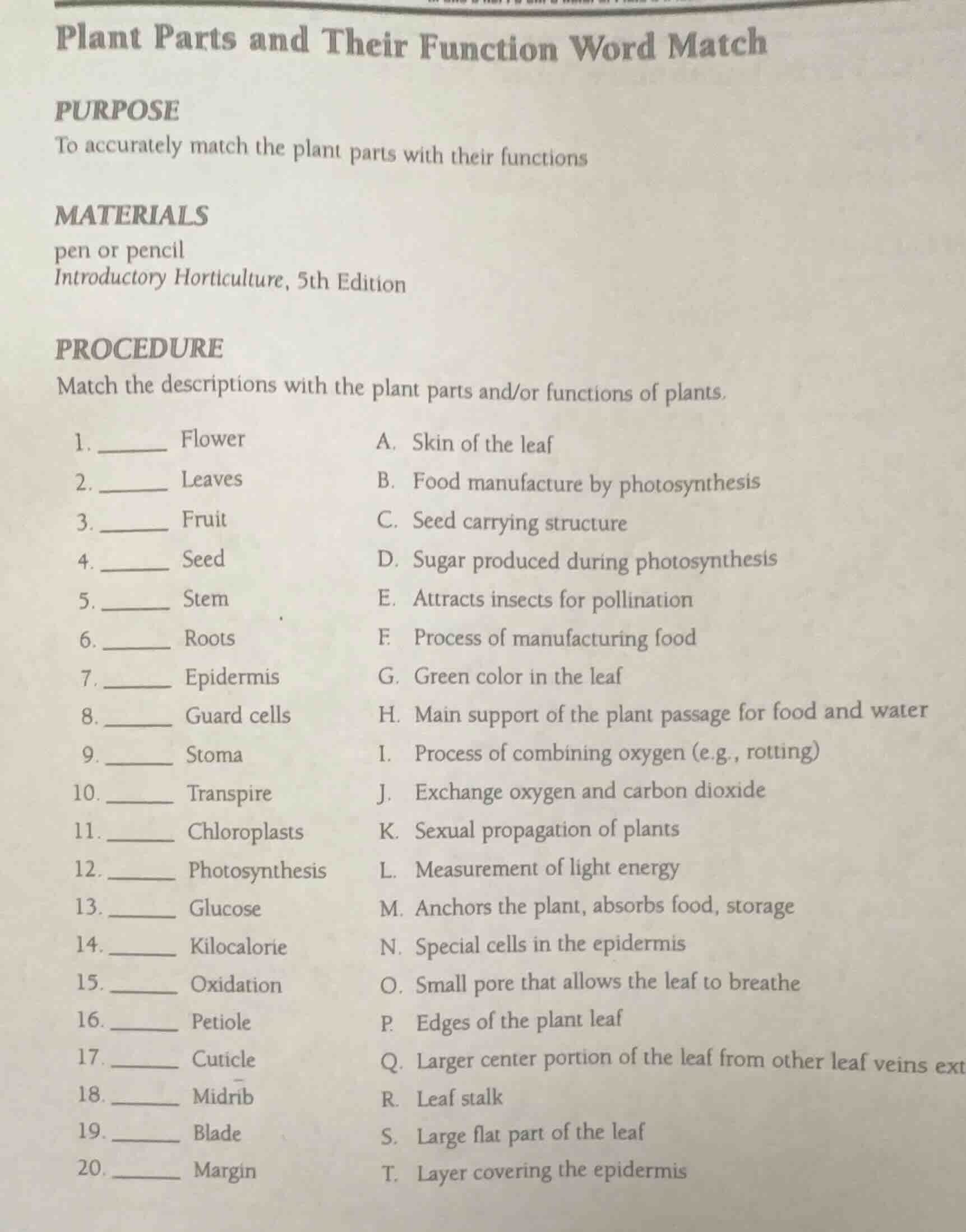
plant parts and their function word match
purpose
to accurately match the plant parts with their functions
materials
pen or pencil
introductory horticulture, 5th edition
procedure
match the descriptions with the plant parts and/or functions of plants.
- ______ flower a. skin of the leaf
- ______ leaves b. food manufacture by photosynthesis
- ______ fruit c. seed carrying structure
- ______ seed d. sugar produced during photosynthesis
- ______ stem e. attracts insects for pollination
- ______ roots f. process of manufacturing food
- ______ epidermis g. green color in the leaf
- ______ guard cells h. main support of the plant passage for food and water
- ______ stoma i. process of combining oxygen (e.g., rotting)
- ______ transpire j. exchange oxygen and carbon dioxide
- ______ chloroplasts k. sexual propagation of plants
- ______ photosynthesis l. measurement of light energy
- ______ glucose m. anchors the plant, absorbs food, storage
- ______ kilocalorie n. special cells in the epidermis
- ______ oxidation o. small pore that allows the leaf to breathe
- ______ petiole p. edges of the plant leaf
- ______ cuticle q. larger center portion of the leaf from other leaf veins ext
- ______ midrib r. leaf stalk
- ______ blade s. large flat part of the leaf
- ______ margin t. layer covering the epidermis
Brief Explanations
- Flower: Attracts insects for pollination (E) as flowers are for sexual reproduction and attract pollinators.
- Leaves: Food manufacture by photosynthesis (B) since leaves are the main site of photosynthesis.
- Fruit: Seed carrying structure (C) as fruits protect and disperse seeds.
- Seed: Sexual propagation of plants (K) as seeds are used in sexual reproduction of plants.
- Stem: Main support of the plant passage for food and water (H) as stems support and transport.
- Roots: Anchors the plant, absorbs food, storage (M) as roots anchor, absorb, and store.
- Epidermis: Skin of the leaf (A) as epidermis is the outer layer (skin) of the leaf.
- Guard cells: Special cells in the epidermis (N) as guard cells are specialized epidermal cells.
- Stoma: Small pore that allows the leaf to breathe (O) as stomata are pores for gas exchange.
- Transpire: Exchange oxygen and carbon dioxide (J) (Note: Transpiration is mainly water vapor loss, but gas exchange also occurs; or maybe a typo, but based on options, J fits for gas exchange related).
- Chloroplasts: Green color in the leaf (G) as chloroplasts contain chlorophyll which is green.
- Photosynthesis: Process of manufacturing food (F) as photosynthesis makes food.
- Glucose: Sugar produced during photosynthesis (D) as glucose is the sugar made in photosynthesis.
- Kilocalorie: Measurement of light energy (L) (Kilocalorie is a unit of energy, here related to energy in food/light? Maybe a bit stretched, but L is the option for measurement).
- Oxidation: Process of combining oxygen (e.g., rotting) (I) as oxidation involves combining with oxygen (like in decomposition).
- Petiole: Leaf stalk (R) as petiole is the stalk of the leaf.
- Cuticle: Layer covering the epidermis (T) as cuticle is a waxy layer over epidermis.
- Midrib: Larger center portion of the leaf from other leaf veins (Q) (Midrib is the central vein of the leaf).
- Blade: Large flat part of the leaf (S) as blade is the flat part of the leaf.
- Margin: Edges of the plant leaf (P) as margin is the edge of the leaf.

Snap & solve any problem in the app
Get step-by-step solutions on Sovi AI
Photo-based solutions with guided steps
Explore more problems and detailed explanations
- E. Attracts insects for pollination
- B. Food manufacture by photosynthesis
- C. Seed carrying structure
- K. Sexual propagation of plants
- H. Main support of the plant passage for food and water
- M. Anchors the plant, absorbs food, storage
- A. Skin of the leaf
- N. Special cells in the epidermis
- O. Small pore that allows the leaf to breathe
- J. Exchange oxygen and carbon dioxide
- G. Green color in the leaf
- F. Process of manufacturing food
- D. Sugar produced during photosynthesis
- L. Measurement of light energy
- I. Process of combining oxygen (e.g., rotting)
- R. Leaf stalk
- T. Layer covering the epidermis
- Q. Larger center portion of the leaf from other leaf veins
- S. Large flat part of the leaf
- P. Edges of the plant leaf