QUESTION IMAGE
Question
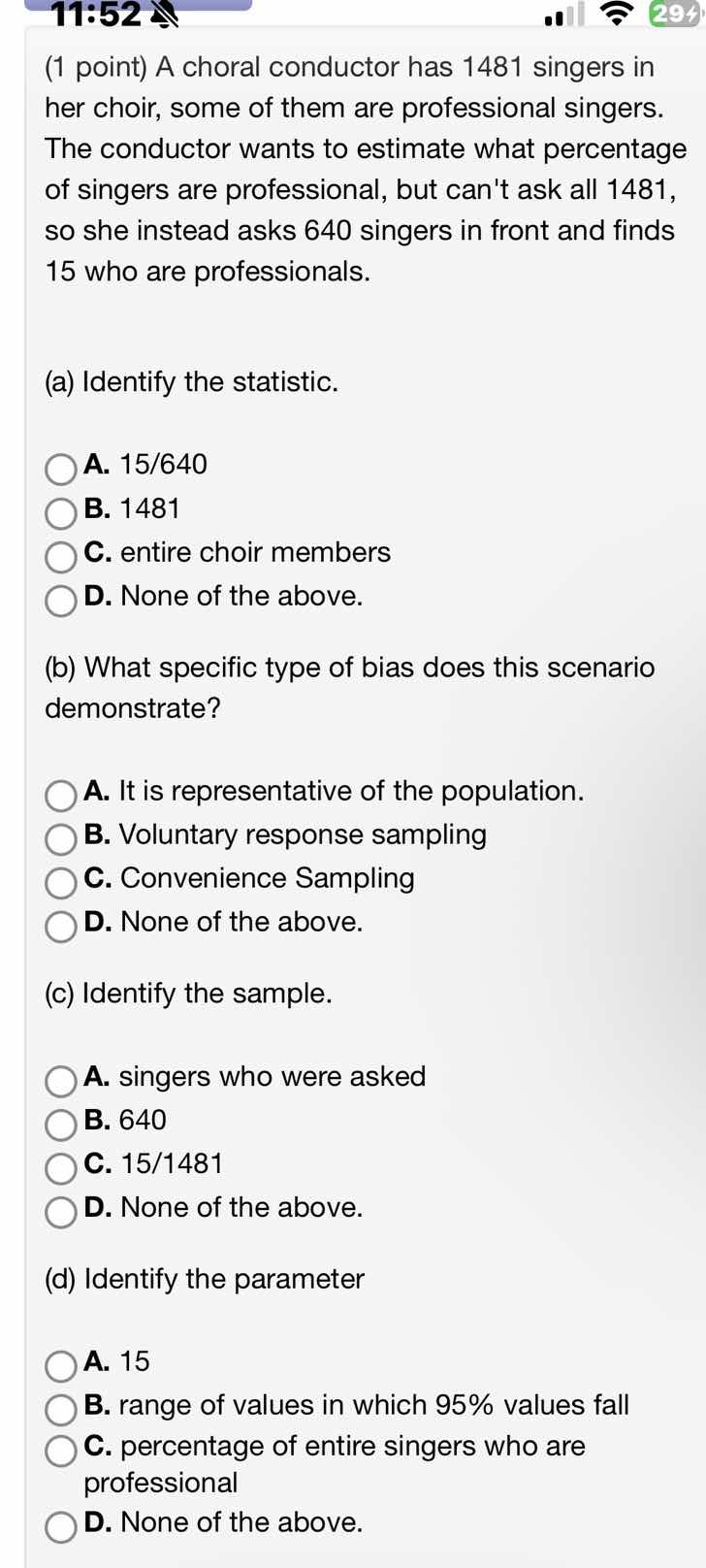
(1 point) a choral conductor has 1481 singers in her choir, some of them are professional singers. the conductor wants to estimate what percentage of singers are professional, but cant ask all 1481, so she instead asks 640 singers in front and finds 15 who are professionals.
(a) identify the statistic.
a. 15/640
b. 1481
c. entire choir members
d. none of the above.
(b) what specific type of bias does this scenario demonstrate?
a. it is representative of the population.
b. voluntary response sampling
c. convenience sampling
d. none of the above.
(c) identify the sample.
a. singers who were asked
b. 640
c. 15/1481
d. none of the above.
(d) identify the parameter
a. 15
b. range of values in which 95% values fall
c. percentage of entire singers who are professional
d. none of the above.
Part (a)
A statistic is a measure calculated from a sample. Here, the sample is 640 singers, and 15 are professional. So the statistic is the proportion of professionals in the sample, which is \( \frac{15}{640} \).
Convenience sampling is when a sample is taken from a group that is easy to reach (here, singers in front). Voluntary response is when people self - select, and this is not representative as it's a convenient group, not a random or representative one. So the bias is convenience sampling.
A sample is the subset of the population that is studied. Here, the 640 singers who were asked (the subset of the 1481 - member choir) are the sample. Option B is just the number of the sample, not the sample itself. Option C is a proportion related to the population.

Snap & solve any problem in the app
Get step-by-step solutions on Sovi AI
Photo-based solutions with guided steps
Explore more problems and detailed explanations
A. 15/640