QUESTION IMAGE
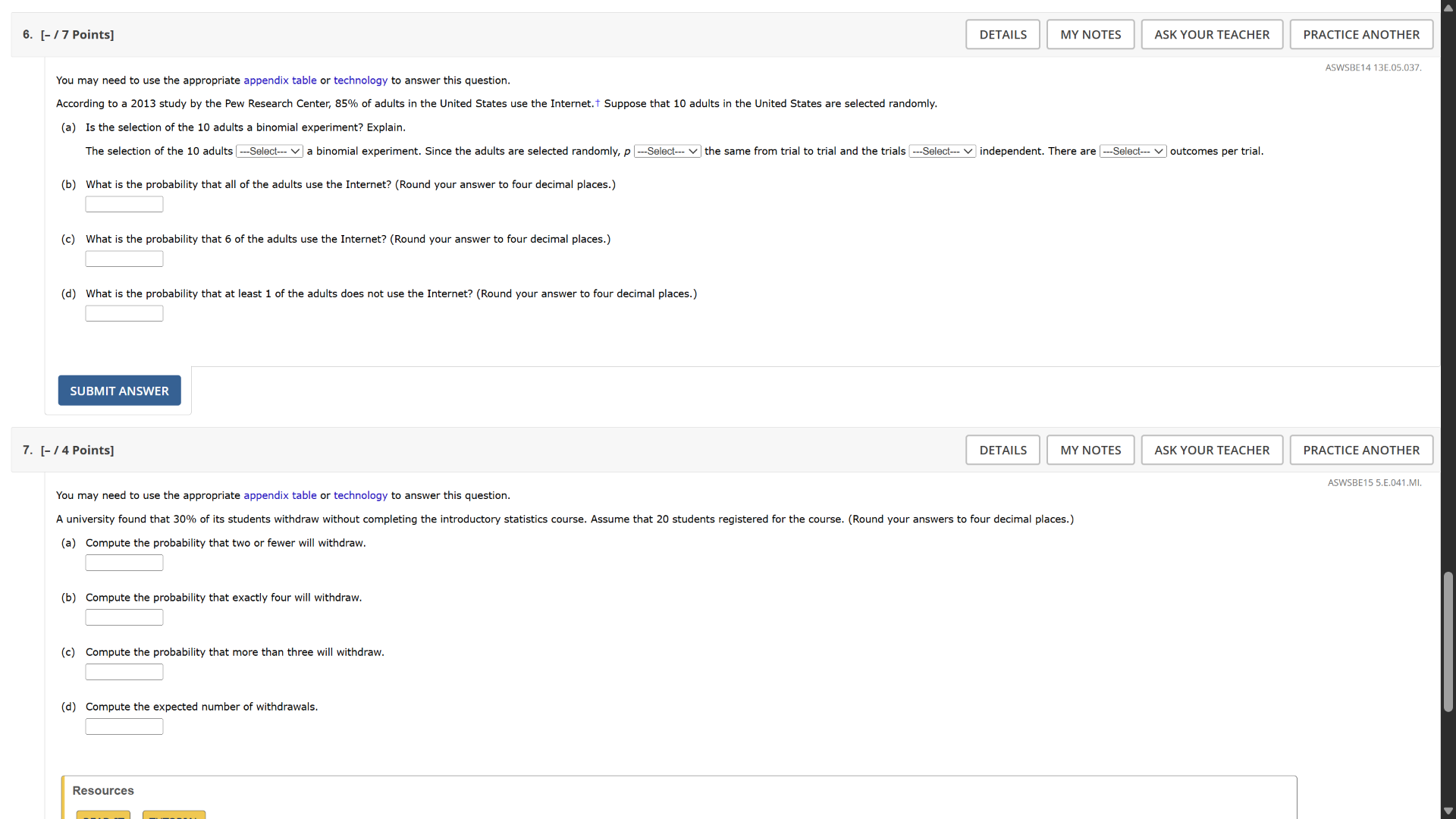
Question
- - / 7 points
you may need to use the appropriate appendix table or technology to answer this question.
according to a 2013 study by the pew research center, 85% of adults in the united states use the internet. suppose that 10 adults in the united states are selected randomly.
(a) is the selection of the 10 adults a binomial experiment? explain.
the selection of the 10 adults select a binomial experiment. since the adults are selected randomly, p select the same from trial to trial and the trials select independent. there are select outcomes per trial.
(b) what is the probability that all of the adults use the internet? (round your answer to four decimal places.)
(c) what is the probability that 6 of the adults use the internet? (round your answer to four decimal places.)
(d) what is the probability that at least 1 of the adults does not use the internet? (round your answer to four decimal places.)
- - / 4 points
you may need to use the appropriate appendix table or technology to answer this question.
a university found that 30% of its students withdraw without completing the introductory statistics course. assume that 20 students registered for the course. (round your answers to four decimal places.)
(a) compute the probability that two or fewer will withdraw.
(b) compute the probability that exactly four will withdraw.
(c) compute the probability that more than three will withdraw.
(d) compute the expected number of withdrawals.
Question 6
Part (a)
A binomial experiment has four conditions: fixed number of trials, independent trials, two outcomes per trial, and constant probability of success. Here, 10 trials (adults), independent (random selection), \( p = 0.85 \) (constant), two outcomes (use or not use Internet). So the selection is a binomial experiment. \( p \) is "is", trials are "are", outcomes per trial are "two".
Step1: Identify binomial parameters
We have a binomial experiment with \( n = 10 \), \( p = 0.85 \), and we want \( P(X = 10) \). The binomial probability formula is \( P(X = k) = \binom{n}{k} p^k (1 - p)^{n - k} \).
Step2: Calculate the combination and probability
For \( k = 10 \), \(\binom{10}{10} = 1\), \( p^{10} = 0.85^{10} \), \( (1 - p)^{0} = 1 \). So \( P(X = 10) = 1 \times 0.85^{10} \times 1 \). Calculate \( 0.85^{10} \approx 0.196874 \).
Step1: Identify binomial parameters
\( n = 10 \), \( p = 0.85 \), \( k = 6 \). Use the binomial formula \( P(X = k) = \binom{n}{k} p^k (1 - p)^{n - k} \).
Step2: Calculate the combination
\(\binom{10}{6} = \frac{10!}{6!(10 - 6)!} = \frac{10 \times 9 \times 8 \times 7}{4 \times 3 \times 2 \times 1} = 210 \).
Step3: Calculate the probability
\( p^6 = 0.85^6 \approx 0.377149 \), \( (1 - p)^4 = 0.15^4 = 0.00050625 \). Multiply: \( 210 \times 0.377149 \times 0.00050625 \approx 0.0401 \).

Snap & solve any problem in the app
Get step-by-step solutions on Sovi AI
Photo-based solutions with guided steps
Explore more problems and detailed explanations
The selection of the 10 adults \(\boldsymbol{\text{is}}\) a binomial experiment. Since the adults are selected randomly, \( p \boldsymbol{\text{is}} \) the same from trial to trial and the trials \(\boldsymbol{\text{are}}\) independent. There are \(\boldsymbol{\text{two}}\) outcomes per trial.