QUESTION IMAGE
Question
posttest
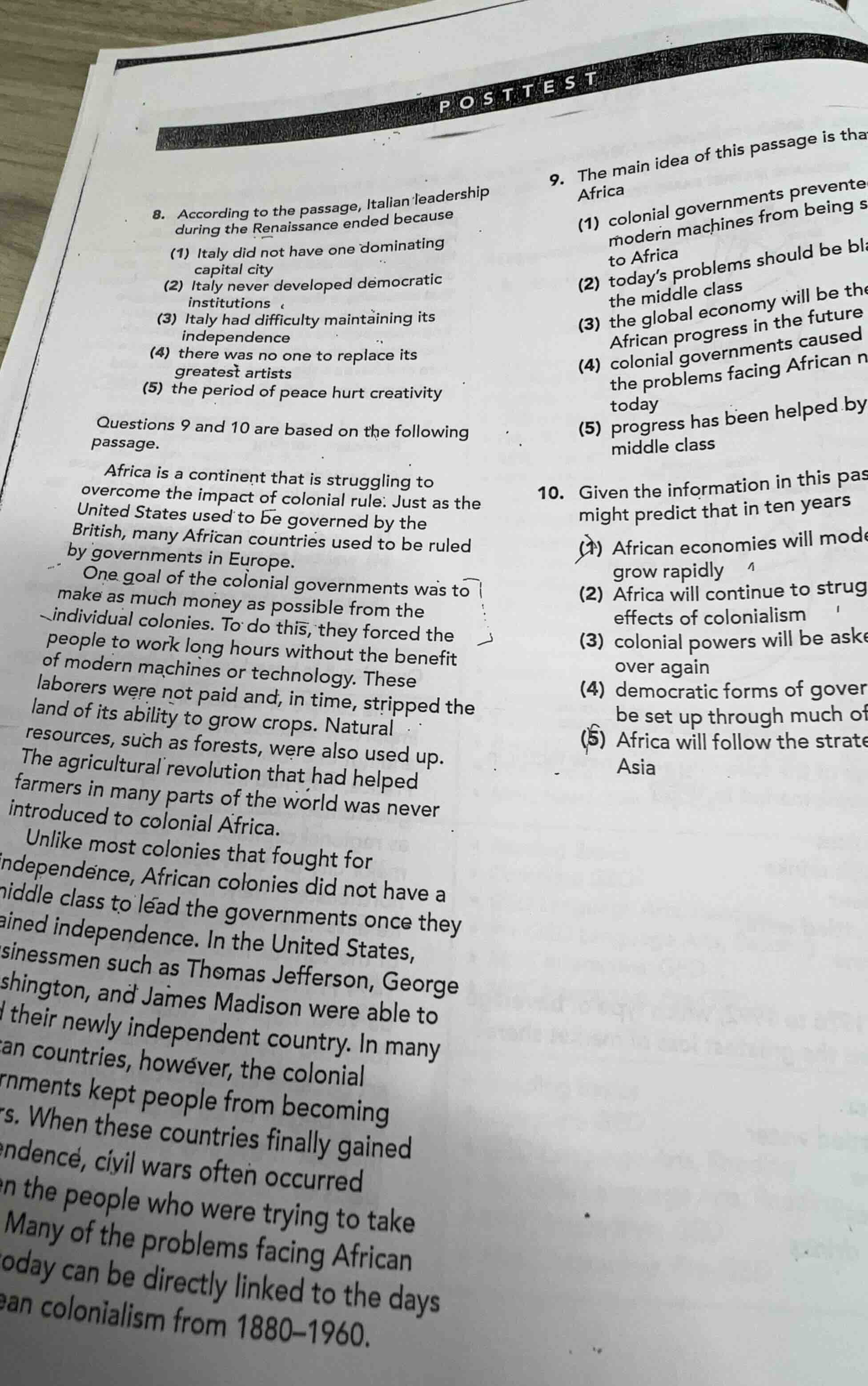
- according to the passage, italian leadership during the renaissance ended because
(1) italy did not have one dominating capital city
(2) italy never developed democratic institutions
(3) italy had difficulty maintaining its independence
(4) there was no one to replace its greatest artists
(5) the period of peace hurt creativity
questions 9 and 10 are based on the following passage.
africa is a continent that is struggling to overcome the impact of colonial rule. just as the united states used to be governed by the british, many african countries used to be ruled by governments in europe.
one goal of the colonial governments was to make as much money as possible from the individual colonies. to do this, they forced the people to work long hours without the benefit of modern machines or technology. these laborers were not paid and, in time, stripped the land of its ability to grow crops. natural resources, such as forests, were also used up. the agricultural revolution that had helped farmers in many parts of the world was never introduced to colonial africa.
unlike most colonies that fought for independence, african colonies did not have a middle class to lead the governments once they gained independence. in the united states, businessmen such as thomas jefferson, george washington, and james madison were able to lead their newly independent country. in many african countries, however, the colonial governments kept people from becoming leaders. when these countries finally gained independence, civil wars often occurred between the people who were trying to take over. many of the problems facing african countries today can be directly linked to the days of european colonialism from 1880–1960.
- the main idea of this passage is that africa
(1) colonial governments prevented modern machines from being sent to africa
(2) todays problems should be blamed on the middle class
(3) the global economy will be the key to african progress in the future
(4) colonial governments caused the problems facing african nations today
(5) progress has been helped by the middle class
- given the information in this passage, one might predict that in ten years
(1) african economies will modernize and grow rapidly
(2) africa will continue to struggle with the effects of colonialism
(3) colonial powers will be asked to rule over again
(4) democratic forms of government will be set up through much of africa
(5) africa will follow the strategies of asia
For Question 8:
The passage related to this question is not provided, so a definitive answer cannot be determined. However, common historical context notes that Italy's Renaissance leadership declined in part due to external pressures that threatened its independence, making option (3) a historically plausible choice.
For Question 9:
The passage centers on how colonial exploitation (extracting resources, preventing technological advancement, suppressing a middle class) created lasting issues that African nations face today. Option (4) directly matches this core focus.
For Question 10:
The passage emphasizes that colonialism left deep, lasting harm to Africa's land, economy, and governance structures. There is no indication of rapid recovery or outside intervention, so the most logical prediction is that Africa will continue to struggle with colonialism's aftereffects, which matches option (2).

Snap & solve any problem in the app
Get step-by-step solutions on Sovi AI
Photo-based solutions with guided steps
Explore more problems and detailed explanations
- (3) Italy had difficulty maintaining its independence
- (4) colonial governments caused the problems facing African nations today
- (2) Africa will continue to struggle with the effects of colonialism