QUESTION IMAGE
Question
practical math semester test, part 2
answer the questions. when you have finished, submit this assignment to your teacher by the due date for full
credit.
total score: ____ of 50 points
(score for question 1: ____ of 15 points)
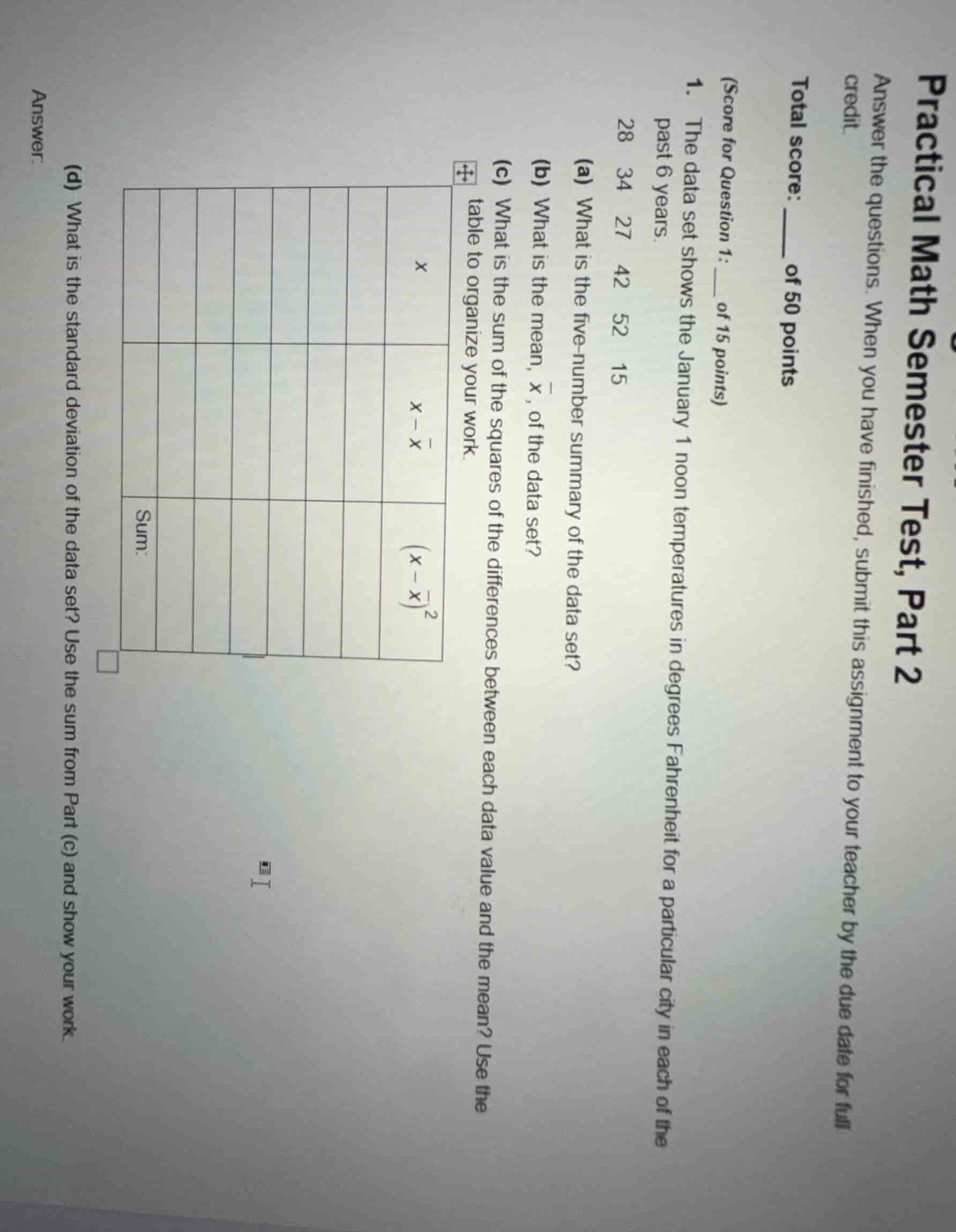
- the data set shows the january 1 noon temperatures in degrees fahrenheit for a particular city in each of the
past 6 years.
28 34 27 42 52 15
(a) what is the five - number summary of the data set?
(b) what is the mean, (overline{x}), of the data set?
(c) what is the sum of the squares of the differences between each data value and the mean? use the
table to organize your work.
| (x) | (x - overline{x}) | (left(x - overline{x} |
ight)^2) |
| sum: |
(d) what is the standard deviation of the data set? use the sum from part (c) and show your work.
answer:
Part (a): Five - number summary
Step 1: Order the data
First, we order the data set \(15, 27, 28, 34, 42, 52\) from least to greatest.
Step 2: Find the minimum and maximum
The minimum value (smallest number) is \(15\), and the maximum value (largest number) is \(52\).
Step 3: Find the median (second quartile, \(Q_2\))
Since there are \(n = 6\) data points (an even number), the median is the average of the \(\frac{n}{2}=3\)rd and \(\frac{n}{2}+ 1=4\)th values. The 3rd value is \(28\) and the 4th value is \(34\). So the median \(Q_2=\frac{28 + 34}{2}=\frac{62}{2}=31\).
Step 4: Find the first quartile (\(Q_1\))
The first quartile is the median of the lower half of the data. The lower half of the data (values less than the median) is \(15, 27, 28\). Since there are \(3\) values (an odd number), the median of this subset is the middle value, which is \(27\). So \(Q_1 = 27\).
Step 5: Find the third quartile (\(Q_3\))
The third quartile is the median of the upper half of the data. The upper half of the data (values greater than the median) is \(34, 42, 52\). Since there are \(3\) values (an odd number), the median of this subset is the middle value, which is \(42\). So \(Q_3=42\).
The five - number summary is: Minimum \(= 15\), \(Q_1 = 27\), Median \(= 31\), \(Q_3 = 42\), Maximum \(= 52\)
Part (b): Mean of the data set
Step 1: Recall the formula for the mean
The formula for the mean \(\bar{x}=\frac{\sum_{i = 1}^{n}x_i}{n}\), where \(x_i\) are the data points and \(n\) is the number of data points.
Step 2: Calculate the sum of the data points
\(\sum_{i=1}^{6}x_i=15 + 27+28 + 34+42+52=198\)
Step 3: Calculate the mean
Since \(n = 6\), \(\bar{x}=\frac{198}{6}=33\)
Part (c): Sum of the squares of the differences from the mean
We first find \(x-\bar{x}\) and \((x - \bar{x})^2\) for each data point \(x\) with \(\bar{x}=33\):
| \(x\) | \(x-\bar{x}\) | \((x - \bar{x})^2\) |
|---|---|---|
| \(27\) | \(27 - 33=-6\) | \((-6)^2=36\) |
| \(28\) | \(28 - 33=-5\) | \((-5)^2 = 25\) |
| \(34\) | \(34 - 33 = 1\) | \((1)^2=1\) |
| \(42\) | \(42 - 33=9\) | \((9)^2 = 81\) |
| \(52\) | \(52 - 33 = 19\) | \((19)^2=361\) |
Step 1: Calculate the sum of \((x-\bar{x})^2\)
We sum up the values in the \((x - \bar{x})^2\) column: \(324+36 + 25+1+81+361=828\)
Part (d): Standard deviation

Snap & solve any problem in the app
Get step-by-step solutions on Sovi AI
Photo-based solutions with guided steps
Explore more problems and detailed explanations
Step 1: Recall the formula for the sample standard deviation (since this is a sample of past 6 years, we use sample standard deviation)
The formula for the sample standard deviation \(s=\sqrt{\frac{\sum_{i = 1}^{n}(x_i-\bar{x})^2}{n - 1}}\), where \(\sum_{i = 1}^{n}(x_i-\bar{x})^2\) is the sum of squared differences from the mean and \(n\) is the number of data points.
Step 2: Substitute the values
We know that \(\sum_{i = 1}^{n}(x_i-\bar{x})^2=828\) and \(n = 6\), so \(n-1=5\). Then \(\frac{\sum_{i = 1}^{n}(x_i-\bar{x})^2}{n - 1}=\frac{828}{5}=165.6\)
Step 3: Take the square root
\(s=\sqrt{165.6}\approx12.87\) (rounded to two decimal places) or if we consider population standard deviation (using \(n\) instead of \(n - 1\)), \(\sigma=\sqrt{\frac{828}{6}}=\sqrt{138}\approx11.75\) (but since it's a sample of 6 years, sample standard deviation is more appropriate)
Final Answers:
(a) Five - number summary: Minimum \(= 15\), \(Q_1 = 27\), Median \(= 31\), \(Q_3 = 42\), Maximum \(= 52\)
(b) Mean \(\bar{x}=\boldsymbol{33}\)
(c) Sum of squared differences \(=\boldsymbol{828}\)
(d) Sample standard deviation \(\approx\boldsymbol{12.87}\) (Population standard deviation \(\approx\boldsymbol{11.75}\))