QUESTION IMAGE
Question
practice: energy flow #2
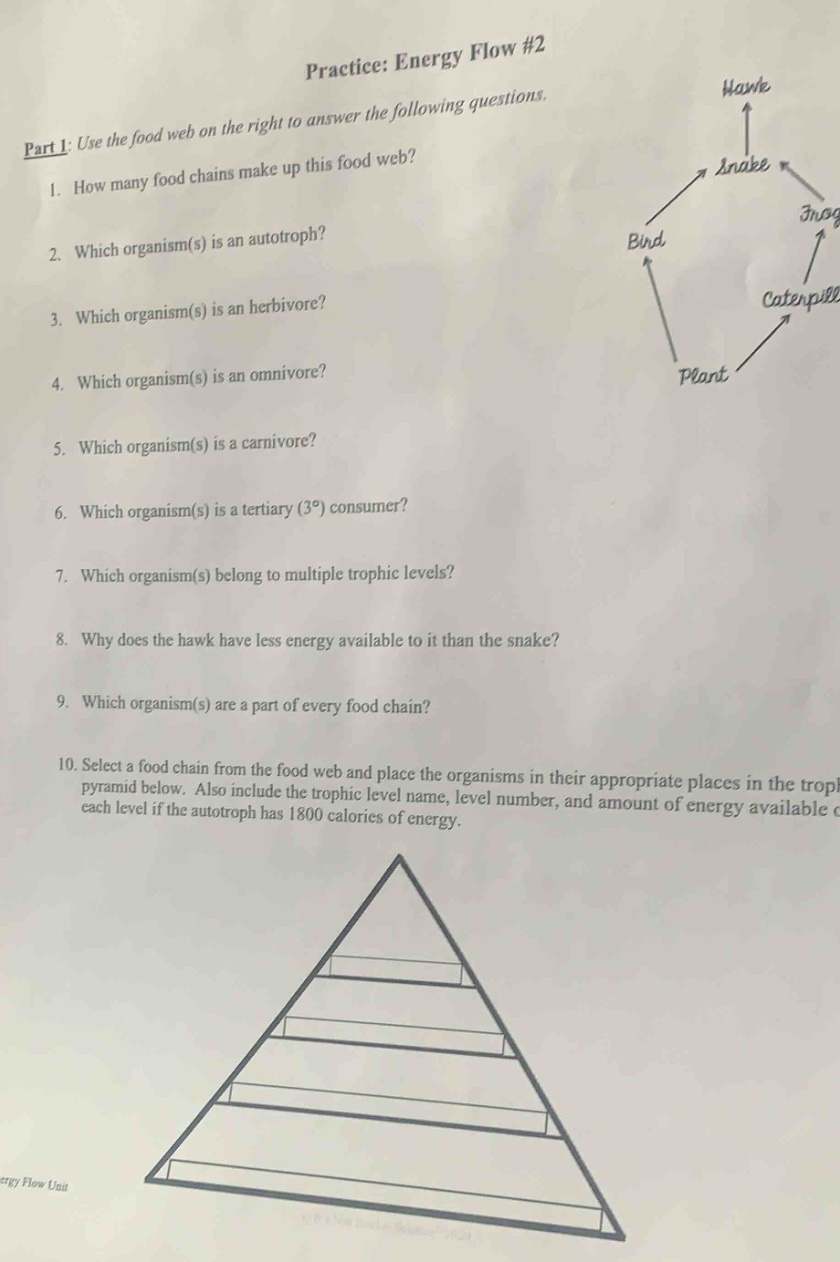
part i: use the food web on the right to answer the following questions.
- how many food chains make up this food web?
- which organism(s) is an autotroph?
- which organism(s) is an herbivore?
- which organism(s) is an omnivore?
- which organism(s) is a carnivore?
- which organism(s) is a tertiary (3°) consumer?
- which organism(s) belong to multiple trophic levels?
- why does the hawk have less energy available to it than the snake?
- which organism(s) are a part of every food chain?
- select a food chain from the food web and place the organisms in their appropriate places in the trophic pyramid below. also include the trophic level name, level number, and amount of energy available at each level if the autotroph has 1800 calories of energy.
Brief Explanations
- Count all linear feeding paths from plant to top predator:
- Plant → Bird → Snake → Hawk
- Plant → Caterpillar → Frog → Snake → Hawk
- Autotrophs produce their own food (plants, via photosynthesis).
- Herbivores only eat producers (autotrophs like plants).
- Omnivores eat both plants and animals; no organism here does this.
- Carnivores only eat other animals.
- Tertiary consumers are 4th trophic level, eat secondary consumers.
- Identify organisms that eat at multiple trophic levels: snake eats both bird (primary consumer) and frog (secondary consumer).
- 10% energy transfer rule: only ~10% of energy moves up each trophic level, so higher levels have less energy.
- Producers (autotrophs) form the base of every food chain.
- Using the chain Plant → Bird → Snake → Hawk: apply 10% energy transfer rule ($1800 \times 0.1$ for each level up), and label corresponding trophic levels.

Snap & solve any problem in the app
Get step-by-step solutions on Sovi AI
Photo-based solutions with guided steps
Explore more problems and detailed explanations
- 2
- Plant
- Bird, Caterpillar
- None
- Snake, Hawk, Frog
- Hawk
- Snake
- Only about 10% of energy is transferred from one trophic level to the next, so by the time energy reaches the hawk (one level above the snake), most energy has been lost as heat or used for organism functions.
- Plant
- (From bottom of pyramid to top):
- Trophic Level 1 (Producer): Plant, 1800 calories
- Trophic Level 2 (Primary Consumer): Bird, 180 calories
- Trophic Level 3 (Secondary Consumer): Snake, 18 calories
- Trophic Level 4 (Tertiary Consumer): Hawk, 1.8 calories