QUESTION IMAGE
Question
practice: haploid v. diploid
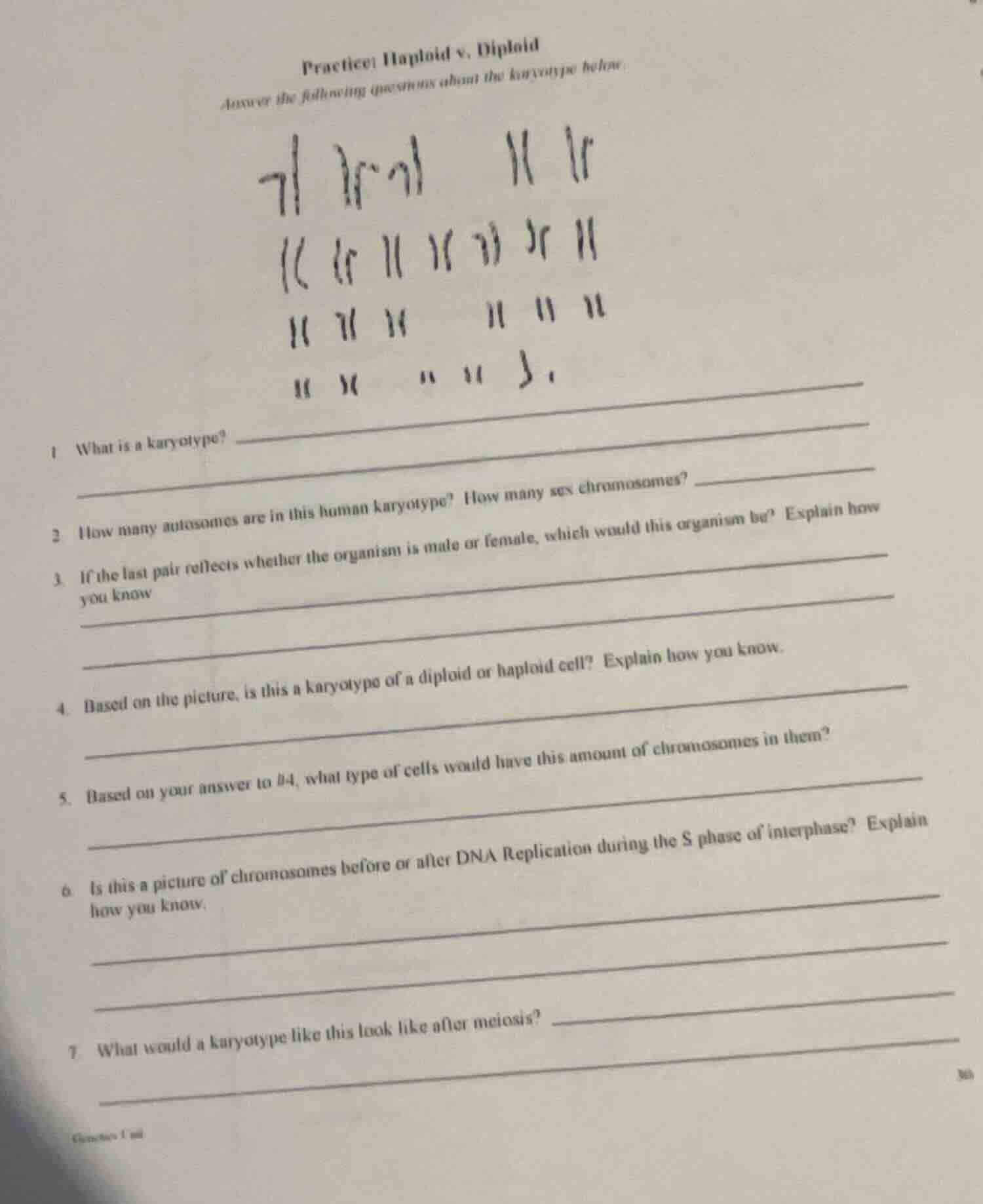
answer the following questions about the karyotype below:
- what is a karyotype?
- how many autosomes are in this human karyotype? how many sex chromosomes?
- if the last pair reflects whether the organism is male or female, which would this organism be? explain how you know
- based on the picture, is this a karyotype of a diploid or haploid cell? explain how you know.
- based on your answer to #4, what type of cells would have this amount of chromosomes in them?
- is this a picture of chromosomes before or after dna replication during the s phase of interphase? explain how you know.
- what would a karyotype like this look like after meiosis?
Brief Explanations
- A karyotype is a visual arrangement of an organism's chromosomes, organized by size, shape, and number, used to analyze chromosomal abnormalities and determine sex.
- In human karyotypes, autosomes are non-sex chromosomes. There are 22 pairs (44 total) of autosomes, and 2 sex chromosomes (1 pair).
- The last pair is the sex chromosomes. This karyotype has two X chromosomes (XX), which is the typical sex chromosome complement for a female human.
- A diploid cell has two sets of chromosomes (one from each parent). This karyotype shows pairs of each chromosome, so it is diploid.
- Diploid chromosome counts are found in somatic (body) cells of humans, such as skin, liver, and muscle cells.
- Each chromosome here consists of two sister chromatids, which is the state of chromosomes after DNA replication in the S phase of interphase (before cell division).
- Meiosis reduces the chromosome number by half, resulting in haploid cells. The post-meiosis karyotype would have only one copy of each chromosome (22 autosomes + 1 sex chromosome, for a total of 23 chromosomes, no pairs).

Snap & solve any problem in the app
Get step-by-step solutions on Sovi AI
Photo-based solutions with guided steps
Explore more problems and detailed explanations
- A visual arrangement of an organism's chromosomes, sorted by size, shape, and number, used for genetic analysis.
- 44 autosomes; 2 sex chromosomes
- Female. The last pair is XX, which is the sex chromosome combination for human females.
- Diploid. The karyotype shows two copies (a homologous pair) of each chromosome.
- Somatic (body) cells (e.g., skin, muscle, liver cells)
- After DNA replication. Each chromosome has two attached sister chromatids, which forms after DNA is copied in S phase.
- It would have 23 total chromosomes, with only one single copy (no homologous pairs) of each autosome and one sex chromosome (either X), resulting in a haploid set.