QUESTION IMAGE
Question
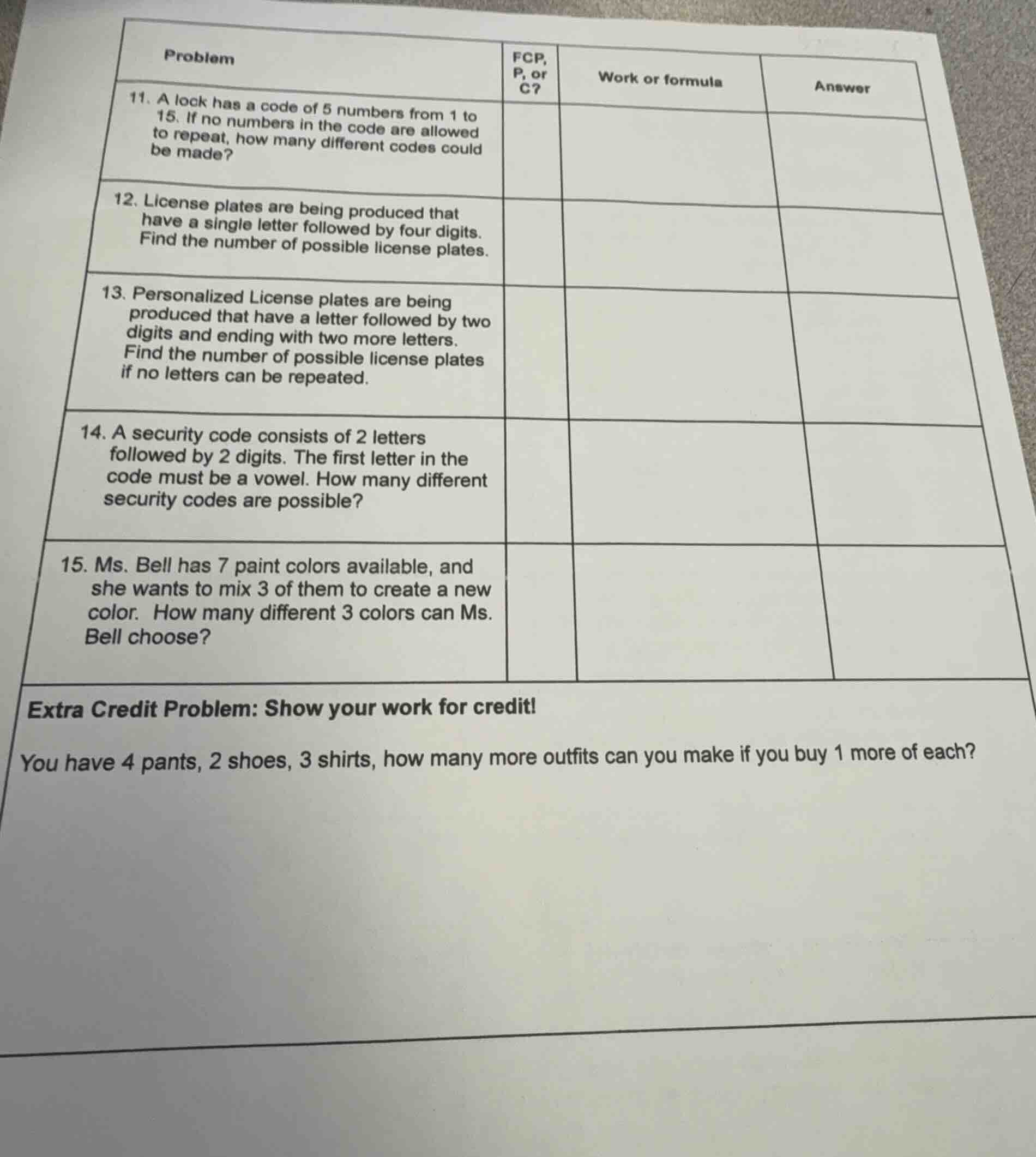
problem 11. a lock has a code of 5 numbers from 1 to 15. if no numbers in the code are allowed to repeat, how many different codes could be made? 12. license plates are being produced that have a single letter followed by four digits. find the number of possible license plates. 13. personalized license plates are being produced that have a letter followed by two digits and ending with two more letters. find the number of possible license plates if no letters can be repeated. 14. a security code consists of 2 letters followed by 2 digits. the first letter in the code must be a vowel. how many different security codes are possible? 15. ms. bell has 7 paint colors available, and she wants to mix 3 of them to create a new color. how many different 3 colors can ms. bell choose? extra credit problem: show your work for credit! you have 4 pants, 2 shoes, 3 shirts, how many more outfits can you make if you buy 1 more of each?
Problem 11
Step1: Identify permutation
We need to arrange 5 numbers from 15 without repetition, so use permutation formula \( P(n, r)=\frac{n!}{(n - r)!} \), where \( n = 15 \), \( r = 5 \).
Step2: Calculate permutation
\( P(15, 5)=\frac{15!}{(15 - 5)!}=\frac{15!}{10!}=15\times14\times13\times12\times11 \)
\( 15\times14 = 210 \), \( 210\times13 = 2730 \), \( 2730\times12 = 32760 \), \( 32760\times11 = 360360 \)
Step1: Use Fundamental Counting Principle (FCP)
1 letter (26 options) and 4 digits (each 0 - 9, 10 options). So total is \( 26\times10\times10\times10\times10 \).
Step2: Calculate product
\( 26\times10^4 = 26\times10000 = 260000 \)
Step1: Analyze positions
1st letter: 26, 2 digits: \( 10\times10 \), last 2 letters (no repeat): \( P(25, 2) \) (since 1 letter used). Wait, actually, first letter: 26, then two digits (10 each), then two letters with no repeat: \( 25\times24 \) (since first letter is used, 25 left, then 24). So total: \( 26\times10\times10\times25\times24 \). Wait, no: positions are letter, digit, digit, letter, letter. So first letter: 26, digits: 10 and 10, then two letters with no repetition: \( P(25, 2)=\frac{25!}{23!}=25\times24 \). So total: \( 26\times10\times10\times25\times24 \).
Step2: Calculate
\( 26\times100\times600 = 26\times60000 = 1560000 \)

Snap & solve any problem in the app
Get step-by-step solutions on Sovi AI
Photo-based solutions with guided steps
Explore more problems and detailed explanations
FCP, P, or C? : P
Work or formula : \( P(15, 5)=\frac{15!}{10!}=15\times14\times13\times12\times11 \)