QUESTION IMAGE
Question
problem 2
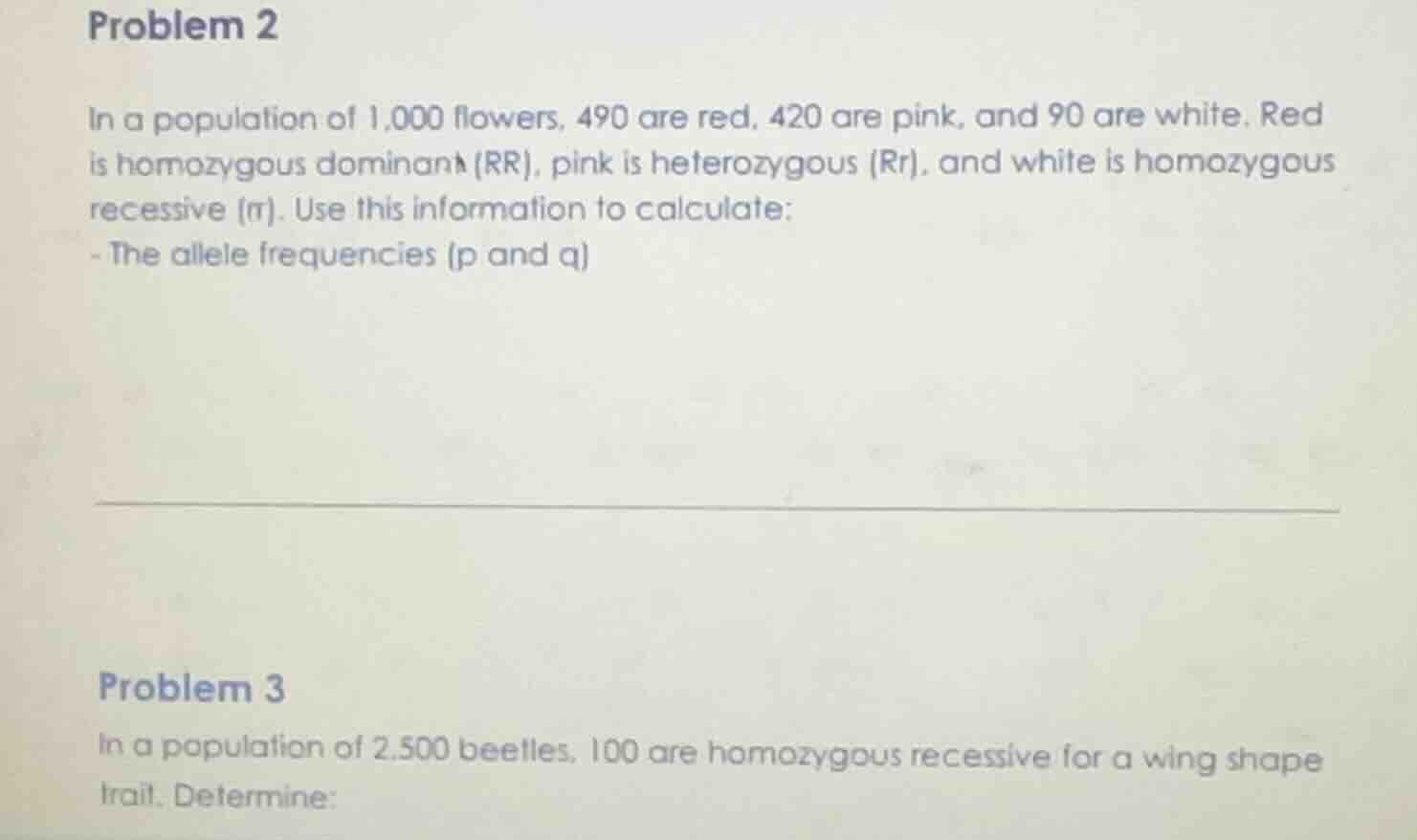
in a population of 1,000 flowers, 490 are red, 420 are pink, and 90 are white. red is homozygous dominant (rr), pink is heterozygous (rr), and white is homozygous recessive (rr). use this information to calculate:
- the allele frequencies (p and q)
problem 3
in a population of 2,500 beetles, 100 are homozygous recessive for a wing shape trait. determine:
Step1: Count total alleles
Total flowers = 1000, each has 2 alleles.
Total alleles = $1000 \times 2 = 2000$
Step2: Count R alleles
Red (RR): 490 flowers, each has 2 R alleles. Pink (Rr): 420 flowers, each has 1 R allele.
Number of R alleles = $(490 \times 2) + 420 = 980 + 420 = 1400$
Step3: Calculate p (R frequency)
$p = \frac{\text{Number of R alleles}}{\text{Total alleles}} = \frac{1400}{2000} = 0.7$
Step4: Count r alleles
White (rr): 90 flowers, each has 2 r alleles. Pink (Rr): 420 flowers, each has 1 r allele.
Number of r alleles = $(90 \times 2) + 420 = 180 + 420 = 600$
Step5: Calculate q (r frequency)
$q = \frac{\text{Number of r alleles}}{\text{Total alleles}} = \frac{600}{2000} = 0.3$

Snap & solve any problem in the app
Get step-by-step solutions on Sovi AI
Photo-based solutions with guided steps
Explore more problems and detailed explanations
$p = 0.7$, $q = 0.3$
---
For Problem 3, the question is incomplete (no specific calculation request, e.g., allele frequencies, genotype frequencies). Please provide more details or clarify the required calculation for Problem 3 so I can assist you better.