QUESTION IMAGE
Question
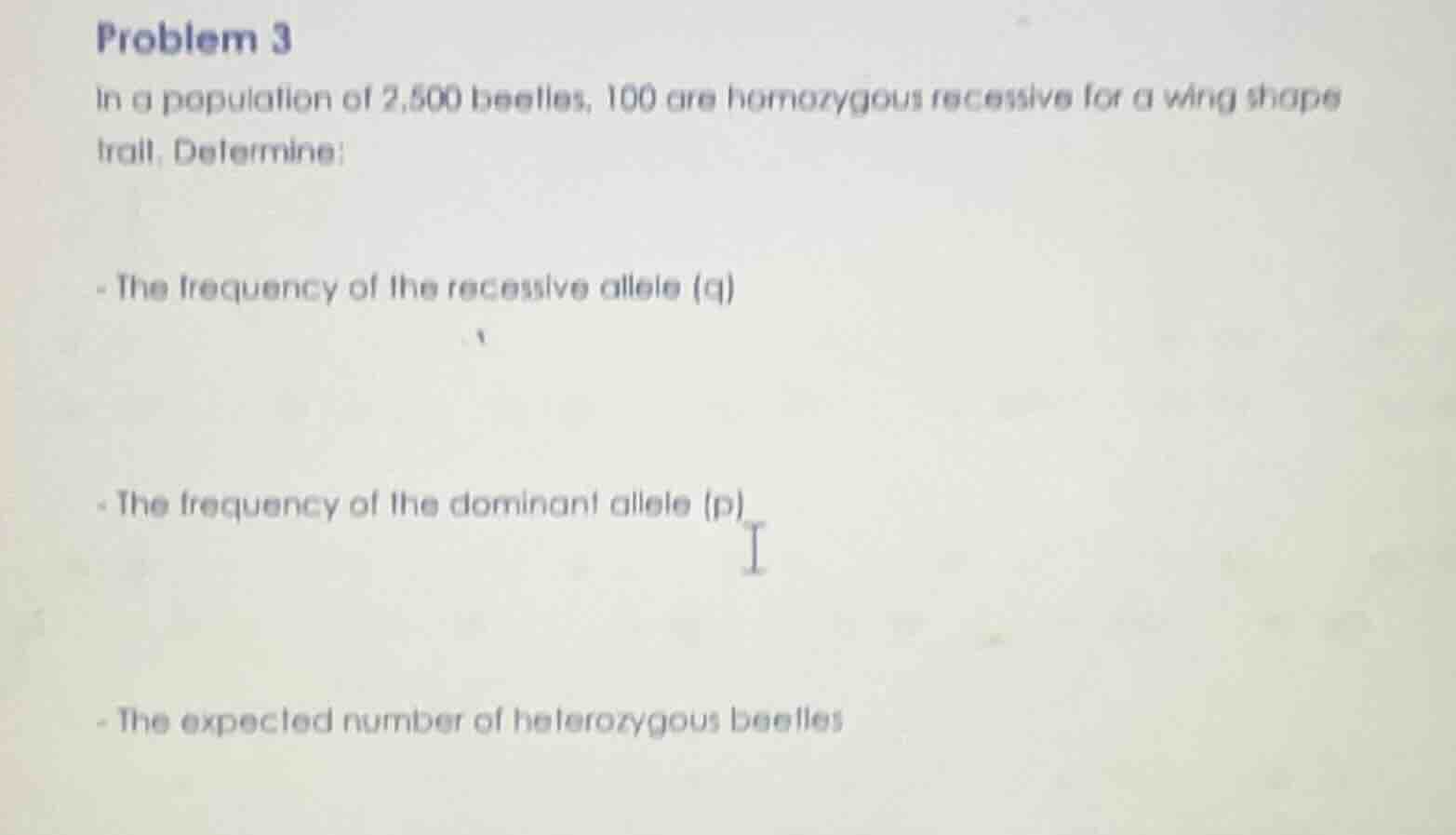
problem 3
in a population of 2,500 beetles, 100 are homozygous recessive for a wing shape
trait. determine:
- the frequency of the recessive allele (q)
- the frequency of the dominant allele (p)
- the expected number of heterozygous beetles
Step1: Calculate recessive genotype frequency
First, find the frequency of the homozygous recessive genotype ($q^2$) by dividing the number of homozygous recessive beetles by the total population.
$q^2 = \frac{100}{2500} = 0.04$
Step2: Find recessive allele frequency (q)
Take the square root of $q^2$ to get the frequency of the recessive allele.
$q = \sqrt{0.04} = 0.2$
Step3: Find dominant allele frequency (p)
Use the Hardy-Weinberg equilibrium equation $p + q = 1$ to solve for p.
$p = 1 - q = 1 - 0.2 = 0.8$
Step4: Calculate heterozygote frequency
Use the Hardy-Weinberg term for heterozygotes ($2pq$) to find their frequency, then multiply by the total population to get the number of heterozygous beetles.
$2pq = 2 \times 0.8 \times 0.2 = 0.32$
Number of heterozygous beetles = $0.32 \times 2500 = 800$

Snap & solve any problem in the app
Get step-by-step solutions on Sovi AI
Photo-based solutions with guided steps
Explore more problems and detailed explanations
- The frequency of the recessive allele (q): $0.2$
- The frequency of the dominant allele (p): $0.8$
- The expected number of heterozygous beetles: $800$