QUESTION IMAGE
Question
problem 8: spiral review
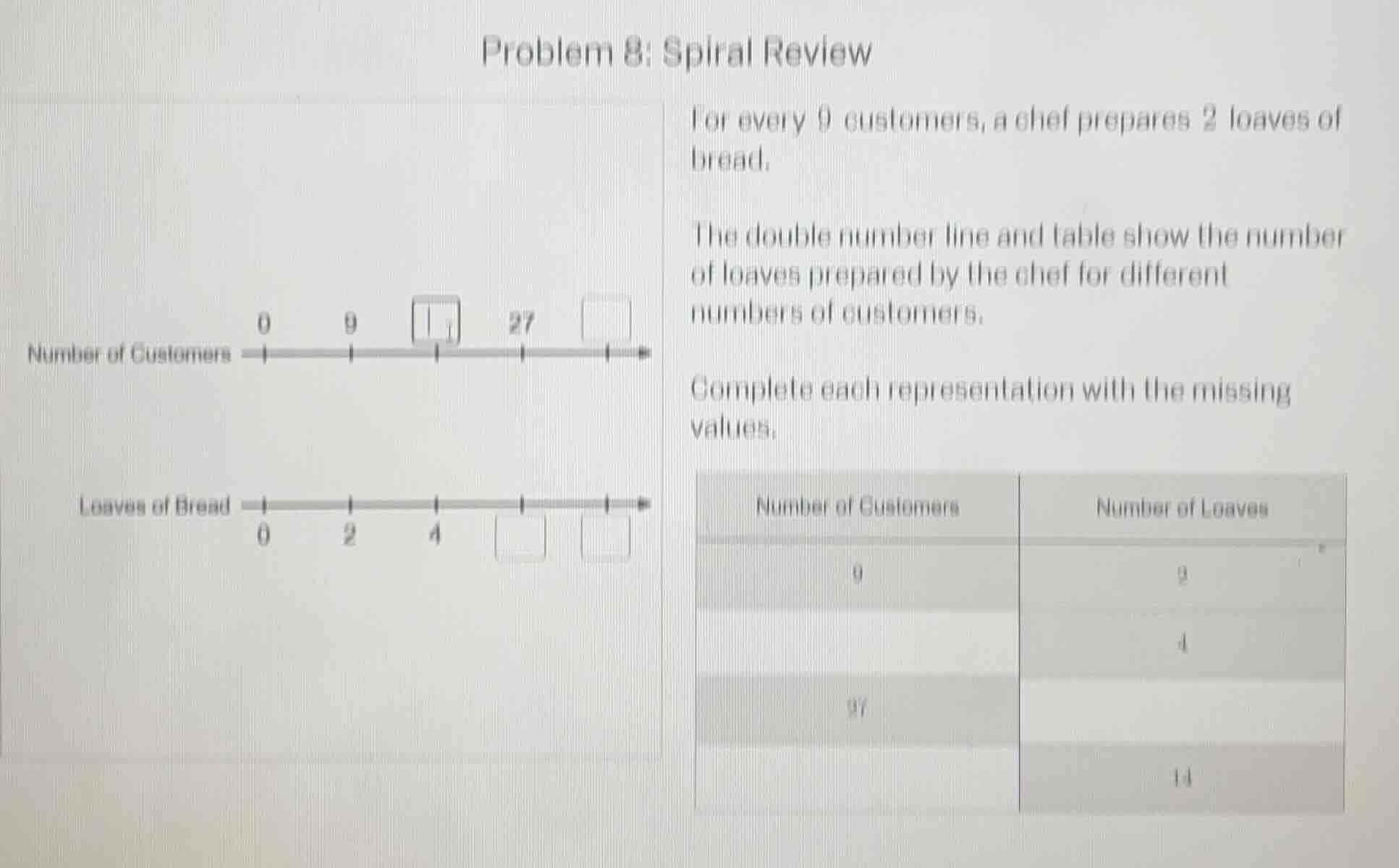
for every 9 customers, a chef prepares 2 loaves of bread.
the double number line and table show the number of loaves prepared by the chef for different numbers of customers.
complete each representation with the missing values.
number of customers: 0, 9, blank, 27, blank
loaves of bread: 0, 2, 4, blank, blank
table:
| number of customers | number of loaves |
|---|---|
| blank | 4 |
| 27 | blank |
| blank | 14 |
Step1: Analyze the ratio
The ratio of customers to loaves is \( 9:2 \), meaning for every 9 customers, 2 loaves are prepared. So the unit rate is \( \frac{9}{2} \) customers per loaf or \( \frac{2}{9} \) loaves per customer.
Step2: Find missing customers for 4 loaves
If there are 4 loaves, since 2 loaves correspond to 9 customers, 4 loaves is \( 4\div2 = 2 \) times 2 loaves. So customers \( = 9\times2 = 18 \).
Step3: Find loaves for 27 customers
27 customers is \( 27\div9 = 3 \) times 9 customers. So loaves \( = 2\times3 = 6 \).
Step4: Find customers for 14 loaves
14 loaves is \( 14\div2 = 7 \) times 2 loaves. So customers \( = 9\times7 = 63 \).
Step5: Find loaves for (next after 27) customers
Let the next customers be \( 9\times4 = 36 \) (since each segment is 9). Loaves \( = 2\times4 = 8 \)? Wait, no, wait. Wait the double number line: customers are 0,9,?,27,?. Let's see the intervals. From 0 to 9 is 9, 9 to? should be 9, so? is 18 (as in step2). Then 18 to 27 is 9, then 27 to? is 9, so? is 36. Loaves: 0,2,4,?,?. 0 to 2 is 2, 2 to 4 is 2, so next is 6 (for 27 customers, step3), then next is 8 (for 36 customers, since 36/9=4, 4*2=8).
Now the table:
- For 9 customers, 2 loaves (given).
- For? customers, 4 loaves: we found 18 (step2).
- For 27 customers, loaves: 6 (step3).
- For? customers, 14 loaves: 63 (step4).

Snap & solve any problem in the app
Get step-by-step solutions on Sovi AI
Photo-based solutions with guided steps
Explore more problems and detailed explanations
Double Number Line (Number of Customers): 18, 36
Double Number Line (Loaves of Bread): 6, 8
Table:
- Number of Customers: 18 (for 4 loaves), 63 (for 14 loaves)
- Number of Loaves: 6 (for 27 customers)
(Note: Filling the table cells:
- Row with 4 loaves: Number of Customers = 18
- Row with 27 customers: Number of Loaves = 6
- Row with 14 loaves: Number of Customers = 63
- The last loaves (after 6) would be 8 for 36 customers, but in the table, maybe the last row is 14 loaves corresponding to 63 customers.)
So summarizing the missing values:
- Customers line: 18, 36
- Loaves line: 6, 8
- Table:
- 4 loaves → 18 customers
- 27 customers → 6 loaves
- 14 loaves → 63 customers