QUESTION IMAGE
Question
problems
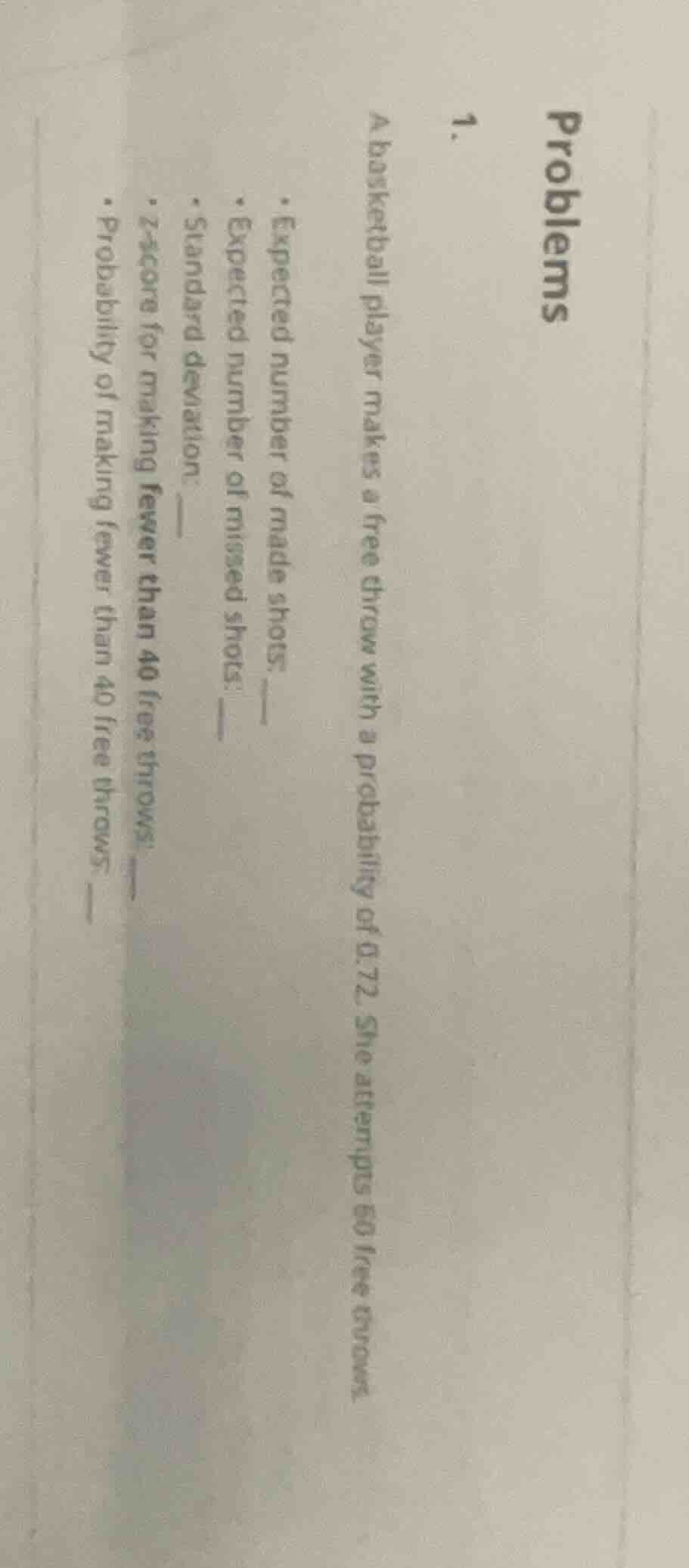
- a basketball player makes a free throw with a probability of 0.72. she attempts 50 free throws.
- expected number of made shots:
- expected number of missed shots:
- standard deviation:
- z - score for making fewer than 40 free throws:
- probability of making fewer than 40 free throws:
To solve the problem about the basketball player's free throws, we recognize this is a binomial distribution problem with \( n = 50 \) (number of trials), \( p = 0.72 \) (probability of success, making a free throw), and \( q = 1 - p = 0.28 \) (probability of failure, missing a free throw).
1. Expected number of made shots
For a binomial distribution, the expected value (mean) of the number of successes (\( \mu \)) is given by \( \mu = np \).
Step 1: Identify \( n \) and \( p \)
\( n = 50 \), \( p = 0.72 \)
Step 2: Calculate the expected value
\( \mu_{\text{made}} = np = 50 \times 0.72 = 36 \)
2. Expected number of missed shots
The expected value of the number of failures (\( \mu_{\text{missed}} \)) is \( \mu = nq \) (or \( n - np \)).
Step 1: Identify \( n \) and \( q \)
\( n = 50 \), \( q = 0.28 \)
Step 2: Calculate the expected value
\( \mu_{\text{missed}} = nq = 50 \times 0.28 = 14 \) (or \( 50 - 36 = 14 \))
3. Standard deviation
For a binomial distribution, the standard deviation (\( \sigma \)) is \( \sigma = \sqrt{npq} \).
Step 1: Identify \( n \), \( p \), and \( q \)
\( n = 50 \), \( p = 0.72 \), \( q = 0.28 \)
Step 2: Calculate \( npq \)
\( npq = 50 \times 0.72 \times 0.28 = 50 \times 0.2016 = 10.08 \)
Step 3: Take the square root
\( \sigma = \sqrt{10.08} \approx 3.175 \)
4. \( z \)-score for making fewer than 40 free throws
To find the \( z \)-score, we use the normal approximation to the binomial distribution (since \( np = 36 \) and \( nq = 14 \) are both \( \geq 5 \), the approximation is valid). For a discrete distribution, we apply the continuity correction: "fewer than 40" means \( X < 40 \), so we use \( X = 39.5 \) (continuity correction).
The \( z \)-score formula is \( z = \frac{X - \mu}{\sigma} \), where \( X = 39.5 \), \( \mu = 36 \), and \( \sigma \approx 3.175 \).
Step 1: Apply continuity correction
\( X = 39.5 \) (for \( X < 40 \))
Step 2: Calculate the \( z \)-score
\( z = \frac{39.5 - 36}{3.175} = \frac{3.5}{3.175} \approx 1.10 \)
5. Probability of making fewer than 40 free throws
Using the \( z \)-score \( z \approx 1.10 \), we find the area to the left of \( z = 1.10 \) in the standard normal distribution.
From the standard normal table, \( P(Z < 1.10) \approx 0.8643 \).
Final Answers:
- Expected number of made shots: \( \boldsymbol{36} \)
- Expected number of missed shots: \( \boldsymbol{14} \)
- Standard deviation: \( \boldsymbol{\approx 3.18} \) (rounded to two decimal places)
- \( z \)-score for fewer than 40: \( \boldsymbol{\approx 1.10} \)
- Probability of fewer than 40: \( \boldsymbol{\approx 0.8643} \) (or 86.43%)

Snap & solve any problem in the app
Get step-by-step solutions on Sovi AI
Photo-based solutions with guided steps
Explore more problems and detailed explanations
To solve the problem about the basketball player's free throws, we recognize this is a binomial distribution problem with \( n = 50 \) (number of trials), \( p = 0.72 \) (probability of success, making a free throw), and \( q = 1 - p = 0.28 \) (probability of failure, missing a free throw).
1. Expected number of made shots
For a binomial distribution, the expected value (mean) of the number of successes (\( \mu \)) is given by \( \mu = np \).
Step 1: Identify \( n \) and \( p \)
\( n = 50 \), \( p = 0.72 \)
Step 2: Calculate the expected value
\( \mu_{\text{made}} = np = 50 \times 0.72 = 36 \)
2. Expected number of missed shots
The expected value of the number of failures (\( \mu_{\text{missed}} \)) is \( \mu = nq \) (or \( n - np \)).
Step 1: Identify \( n \) and \( q \)
\( n = 50 \), \( q = 0.28 \)
Step 2: Calculate the expected value
\( \mu_{\text{missed}} = nq = 50 \times 0.28 = 14 \) (or \( 50 - 36 = 14 \))
3. Standard deviation
For a binomial distribution, the standard deviation (\( \sigma \)) is \( \sigma = \sqrt{npq} \).
Step 1: Identify \( n \), \( p \), and \( q \)
\( n = 50 \), \( p = 0.72 \), \( q = 0.28 \)
Step 2: Calculate \( npq \)
\( npq = 50 \times 0.72 \times 0.28 = 50 \times 0.2016 = 10.08 \)
Step 3: Take the square root
\( \sigma = \sqrt{10.08} \approx 3.175 \)
4. \( z \)-score for making fewer than 40 free throws
To find the \( z \)-score, we use the normal approximation to the binomial distribution (since \( np = 36 \) and \( nq = 14 \) are both \( \geq 5 \), the approximation is valid). For a discrete distribution, we apply the continuity correction: "fewer than 40" means \( X < 40 \), so we use \( X = 39.5 \) (continuity correction).
The \( z \)-score formula is \( z = \frac{X - \mu}{\sigma} \), where \( X = 39.5 \), \( \mu = 36 \), and \( \sigma \approx 3.175 \).
Step 1: Apply continuity correction
\( X = 39.5 \) (for \( X < 40 \))
Step 2: Calculate the \( z \)-score
\( z = \frac{39.5 - 36}{3.175} = \frac{3.5}{3.175} \approx 1.10 \)
5. Probability of making fewer than 40 free throws
Using the \( z \)-score \( z \approx 1.10 \), we find the area to the left of \( z = 1.10 \) in the standard normal distribution.
From the standard normal table, \( P(Z < 1.10) \approx 0.8643 \).
Final Answers:
- Expected number of made shots: \( \boldsymbol{36} \)
- Expected number of missed shots: \( \boldsymbol{14} \)
- Standard deviation: \( \boldsymbol{\approx 3.18} \) (rounded to two decimal places)
- \( z \)-score for fewer than 40: \( \boldsymbol{\approx 1.10} \)
- Probability of fewer than 40: \( \boldsymbol{\approx 0.8643} \) (or 86.43%)