QUESTION IMAGE
Question
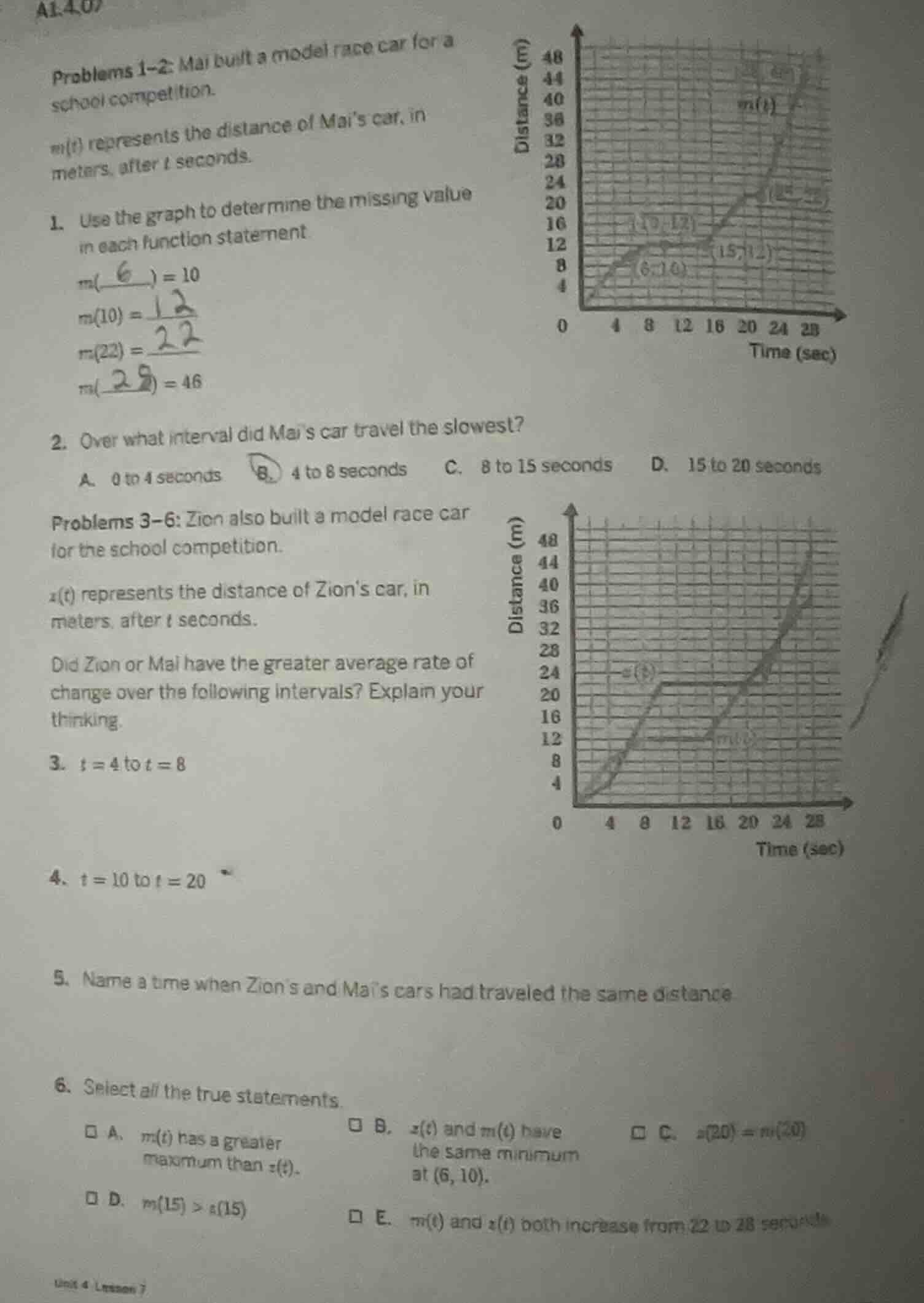
problems 1–2: mai built a model race car for a school competition.
m(t) represents the distance of mai’s car, in meters, after t seconds.
- use the graph to determine the missing value in each function statement
m(\underline{\quad}) = 10
m(10) = \underline{\quad}
m(22) = \underline{\quad}
m(\underline{\quad}) = 46
- over what interval did mai’s car travel the slowest?
a. 0 to 4 seconds
b. 4 to 8 seconds
c. 8 to 15 seconds
d. 15 to 20 seconds
problems 3–6: zion also built a model race car for the school competition.
z(t) represents the distance of zion’s car, in meters, after t seconds.
did zion or mai have the greater average rate of change over the following intervals? explain your thinking.
- t = 4 to t = 8
- t = 10 to t = 20
- name a time when zion’s and mai’s cars had traveled the same distance
- select all the true statements.
□ a. m(t) has a greater maximum than z(t).
□ b. z(t) and m(t) have the same minimum at (6, 10).
□ c. z(20) = m(30)
□ d. m(15) > z(15)
□ e. m(t) and z(t) both increase from 22 to 28 seconds
Problem 1
Step1: Find \( m(?) = 10 \)
From the graph, the point \((6, 10)\) means when \( t = 6 \), \( m(t)=10 \), so the missing value is \( 6 \).
Step2: Find \( m(10) \)
Looking at the graph, at \( t = 10 \), the \( y \)-value (distance) is \( 12 \), so \( m(10)=12 \).
Step3: Find \( m(22) \)
From the graph, at \( t = 22 \), the distance is \( 22 \) (assuming the point \((22, 22)\) is on the graph), so \( m(22)=22 \).
Step4: Find \( m(?) = 46 \)
From the graph, when the distance is \( 46 \), the time \( t \) is \( 28 \) (looking at the graph's trend), so the missing value is \( 28 \).
To find when the car traveled slowest, we look at the slope of the graph (slope = rate of change = distance/time). The flattest slope (least steep) means the slowest speed. The interval 8 to 15 seconds has a horizontal line (slope = 0, or very small), which is slower than other intervals. Option A: 0 - 4 has a steeper slope. Option B: 4 - 8 has a slope. Option D: 15 - 20 has a positive slope. So the slowest is 8 - 15 seconds (Option C).
Step1: Recall average rate of change formula
The average rate of change (speed) is \( \frac{\text{Change in distance}}{\text{Change in time}}=\frac{m(8)-m(4)}{8 - 4} \) for Mai and \( \frac{z(8)-z(4)}{8 - 4} \) for Zion.
Step2: Find values from graph
For Mai: At \( t = 4 \), assume \( m(4) \) (from graph, maybe around 8? Wait, looking at Mai's graph: at \( t = 6 \), \( m(6)=10 \), at \( t = 8 \), \( m(8)=12 \)? Wait, no, earlier Mai's graph: from \( t = 6 \) to \( t = 8 \), maybe? Wait, the first graph for Mai: points (6,10), (8,12)? Wait, no, the first graph has (6,10), (15,12)? Wait, maybe I misread. Wait, the problem says "Mai's car" graph: let's re - examine. For \( t = 4 \) to \( t = 8 \):
For Mai: Let's say at \( t = 4 \), \( m(4) \) is, from the graph, maybe 8? At \( t = 8 \), \( m(8)=12 \). So change in distance for Mai: \( 12 - 8 = 4 \), time change: \( 8 - 4 = 4 \), so rate: \( \frac{4}{4}=1 \) m/s.
For Zion: From Zion's graph, at \( t = 4 \), \( z(4) \) is, say, 8? At \( t = 8 \), \( z(8)=20 \) (from the second graph: the point at \( t = 8 \) for Zion is higher). Change in distance: \( 20 - 8 = 12 \), time change: \( 8 - 4 = 4 \), rate: \( \frac{12}{4}=3 \) m/s. Wait, no, maybe my initial values are wrong. Wait, the second graph for Zion: at \( t = 8 \), the distance is 20 (from the graph's grid). For Mai, at \( t = 8 \), the distance is 12 (from first graph: (8,12)? Wait, the first graph has (6,10), (8,12)? Maybe. So Mai's rate: \( \frac{12 - m(4)}{4} \). If \( m(4) \) is 8 (from graph: at \( t = 4 \), distance is 8), then \( \frac{12 - 8}{4}=\frac{4}{4}=1 \). Zion's rate: \( \frac{20 - z(4)}{4} \). If \( z(4) \) is 8 (same start), then \( \frac{20 - 8}{4}=\frac{12}{4}=3 \). So Zion has a greater average rate of change (faster speed) than Mai.

Snap & solve any problem in the app
Get step-by-step solutions on Sovi AI
Photo-based solutions with guided steps
Explore more problems and detailed explanations
\( m(\boldsymbol{6}) = 10 \), \( m(10)=\boldsymbol{12} \), \( m(22)=\boldsymbol{22} \), \( m(\boldsymbol{28}) = 46 \)