QUESTION IMAGE
Question
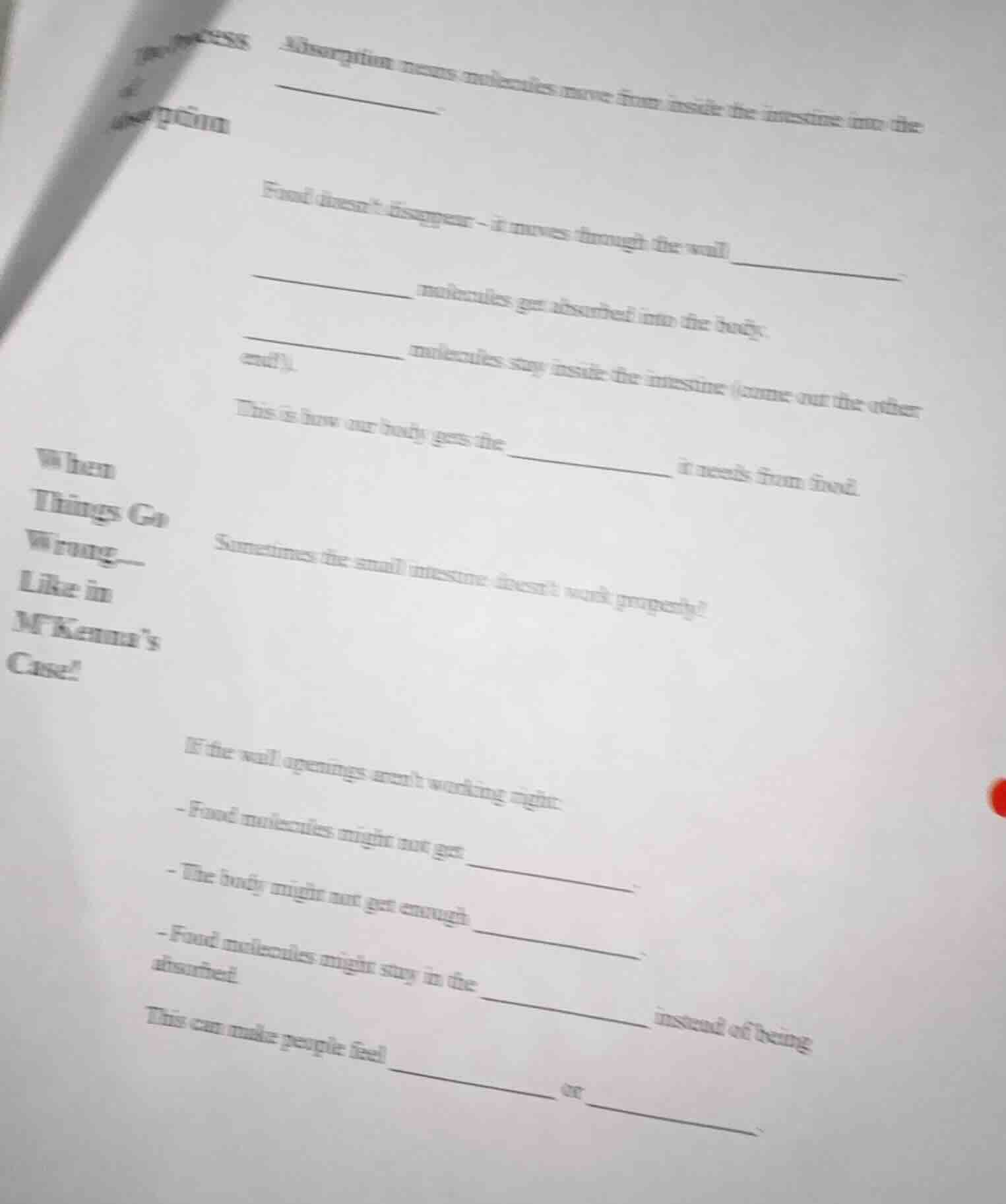
process of absorption
absorption means molecules move from inside the intestine into the ______.
food doesnt disappear - it moves through the wall ______.
______ molecules get absorbed into the body;
______ molecules stay inside the intestine (come out the other end!).
this is how our body gets the ______ it needs from food.
when things go wrong---
like in mckenna’s case!
sometimes the small intestine doesnt work properly!
if the wall openings arent working right:
- food molecules might not get ______.
- the body might not get enough ______.
- food molecules might stay in the ______ instead of being absorbed.
this can make people feel ____ or ____.
Filling the Blanks (Based on Digestive System and Absorption Knowledge)
- Absorption means molecules move from inside the intestine into the \_\_\_\_\_\_\_\_.
The correct term here is "bloodstream" (or "body" in a broader sense, but "bloodstream" is more precise for nutrient absorption). Nutrients are absorbed into the bloodstream to be transported to cells.
- Food doesn’t disappear - it moves through the wall \_\_\_\_\_\_\_\_.
The intestine wall has tiny openings (villi and microvilli) for absorption, so "of the intestine" fits here (to clarify the wall belongs to the intestine).
- \_\_\_\_\_\_\_\_ molecules get absorbed into the body; \_\_\_\_\_\_\_\_ molecules stay inside the intestine (come out the other end!).
This is a contrast: "Useful" (nutrient) molecules are absorbed, "Waste" (or "Undigested") molecules remain to be excreted.
- This is how our body gets the \_\_\_\_\_\_\_\_ it needs from food.
The body needs "nutrients" (like vitamins, minerals, glucose, amino acids) from food, so "nutrients" is the answer.
- **If the wall openings aren’t working right:
- Food molecules might not get \_\_\_\_\_\_\_\_.**
If absorption is impaired, molecules don’t get "absorbed" (into the body).
- The body might not get enough \_\_\_\_\_\_\_\_.
Without absorption, the body lacks "nutrients" (energy, building blocks).
- Food molecules might stay in the \_\_\_\_\_\_\_\_ instead of being absorbed.
Molecules stay in the "intestine" (specifically, the small intestine where absorption occurs).
- This can make people feel \_\_\_\_\_\_\_\_ or \_\_\_\_\_\_\_\_.
Malabsorption causes symptoms like "tired" (from nutrient deficiency) or "sick" (nausea, discomfort), or "weak", "bloated", etc.
Final Answers (Filled Blanks):
- Absorption means molecules move from inside the intestine into the $\boldsymbol{\text{bloodstream}}$ (or "body").
- Food doesn’t disappear - it moves through the wall $\boldsymbol{\text{of the intestine}}$.
- $\boldsymbol{\text{Useful}}$ molecules get absorbed into the body; $\boldsymbol{\text{Waste}}$ molecules stay inside the intestine (come out the other end!).
- This is how our body gets the $\boldsymbol{\text{nutrients}}$ it needs from food.
- If the wall openings aren’t working right:
- Food molecules might not get $\boldsymbol{\text{absorbed}}$.
- The body might not get enough $\boldsymbol{\text{nutrients}}$.
- Food molecules might stay in the $\boldsymbol{\text{intestine}}$ instead of being absorbed.
- This can make people feel $\boldsymbol{\text{tired}}$ or $\boldsymbol{\text{sick}}$ (or other relevant symptoms like "weak", "bloated").
(Note: Answers are based on human physiology, specifically the digestive system’s absorption process. Key concepts include nutrient absorption, intestinal structure, and consequences of malabsorption.)

Snap & solve any problem in the app
Get step-by-step solutions on Sovi AI
Photo-based solutions with guided steps
Explore more problems and detailed explanations
Filling the Blanks (Based on Digestive System and Absorption Knowledge)
- Absorption means molecules move from inside the intestine into the \_\_\_\_\_\_\_\_.
The correct term here is "bloodstream" (or "body" in a broader sense, but "bloodstream" is more precise for nutrient absorption). Nutrients are absorbed into the bloodstream to be transported to cells.
- Food doesn’t disappear - it moves through the wall \_\_\_\_\_\_\_\_.
The intestine wall has tiny openings (villi and microvilli) for absorption, so "of the intestine" fits here (to clarify the wall belongs to the intestine).
- \_\_\_\_\_\_\_\_ molecules get absorbed into the body; \_\_\_\_\_\_\_\_ molecules stay inside the intestine (come out the other end!).
This is a contrast: "Useful" (nutrient) molecules are absorbed, "Waste" (or "Undigested") molecules remain to be excreted.
- This is how our body gets the \_\_\_\_\_\_\_\_ it needs from food.
The body needs "nutrients" (like vitamins, minerals, glucose, amino acids) from food, so "nutrients" is the answer.
- **If the wall openings aren’t working right:
- Food molecules might not get \_\_\_\_\_\_\_\_.**
If absorption is impaired, molecules don’t get "absorbed" (into the body).
- The body might not get enough \_\_\_\_\_\_\_\_.
Without absorption, the body lacks "nutrients" (energy, building blocks).
- Food molecules might stay in the \_\_\_\_\_\_\_\_ instead of being absorbed.
Molecules stay in the "intestine" (specifically, the small intestine where absorption occurs).
- This can make people feel \_\_\_\_\_\_\_\_ or \_\_\_\_\_\_\_\_.
Malabsorption causes symptoms like "tired" (from nutrient deficiency) or "sick" (nausea, discomfort), or "weak", "bloated", etc.
Final Answers (Filled Blanks):
- Absorption means molecules move from inside the intestine into the $\boldsymbol{\text{bloodstream}}$ (or "body").
- Food doesn’t disappear - it moves through the wall $\boldsymbol{\text{of the intestine}}$.
- $\boldsymbol{\text{Useful}}$ molecules get absorbed into the body; $\boldsymbol{\text{Waste}}$ molecules stay inside the intestine (come out the other end!).
- This is how our body gets the $\boldsymbol{\text{nutrients}}$ it needs from food.
- If the wall openings aren’t working right:
- Food molecules might not get $\boldsymbol{\text{absorbed}}$.
- The body might not get enough $\boldsymbol{\text{nutrients}}$.
- Food molecules might stay in the $\boldsymbol{\text{intestine}}$ instead of being absorbed.
- This can make people feel $\boldsymbol{\text{tired}}$ or $\boldsymbol{\text{sick}}$ (or other relevant symptoms like "weak", "bloated").
(Note: Answers are based on human physiology, specifically the digestive system’s absorption process. Key concepts include nutrient absorption, intestinal structure, and consequences of malabsorption.)