QUESTION IMAGE
Question
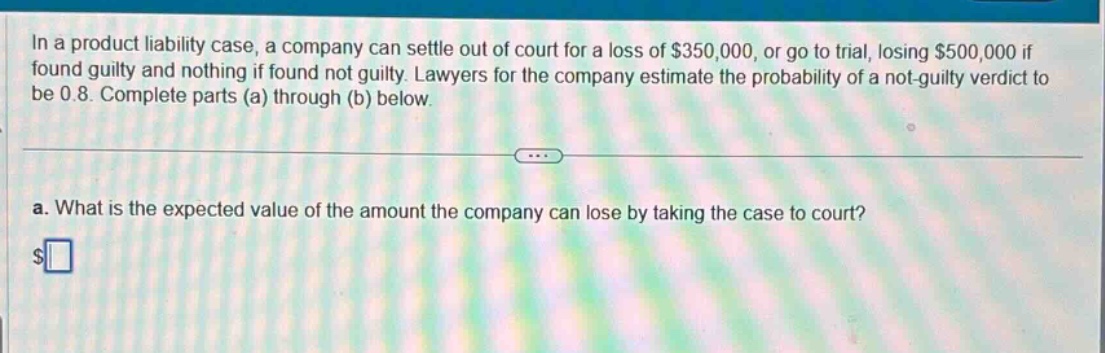
in a product liability case, a company can settle out of court for a loss of $350,000, or go to trial, losing $500,000 if found guilty and nothing if found not guilty. lawyers for the company estimate the probability of a not - guilty verdict to be 0.8. complete parts (a) through (b) below.
a. what is the expected value of the amount the company can lose by taking the case to court?
$
Step1: Identify possible outcomes and probabilities
The two possible outcomes when going to trial are:
- Not - guilty: Probability \(P(\text{not guilty}) = 0.8\), Loss \(L_{\text{not guilty}}=\$0\)
- Guilty: Probability \(P(\text{guilty})=1 - 0.8 = 0.2\), Loss \(L_{\text{guilty}}=\$500000\)
Step2: Use the formula for expected value
The formula for the expected value \(E\) of a discrete random variable is \(E=\sum_{i}x_{i}P(x_{i})\), where \(x_{i}\) are the possible values and \(P(x_{i})\) are their corresponding probabilities.
For the loss in the trial:
\(E = L_{\text{not guilty}}\times P(\text{not guilty})+L_{\text{guilty}}\times P(\text{guilty})\)
Substitute the values:
\(E=0\times0.8 + 500000\times0.2\)
Step3: Calculate the expected value
First, calculate \(500000\times0.2\):
\(500000\times0.2 = 100000\)
And \(0\times0.8 = 0\)
So, \(E = 0+100000=\$100000\)

Snap & solve any problem in the app
Get step-by-step solutions on Sovi AI
Photo-based solutions with guided steps
Explore more problems and detailed explanations
\(100000\)