QUESTION IMAGE
Question
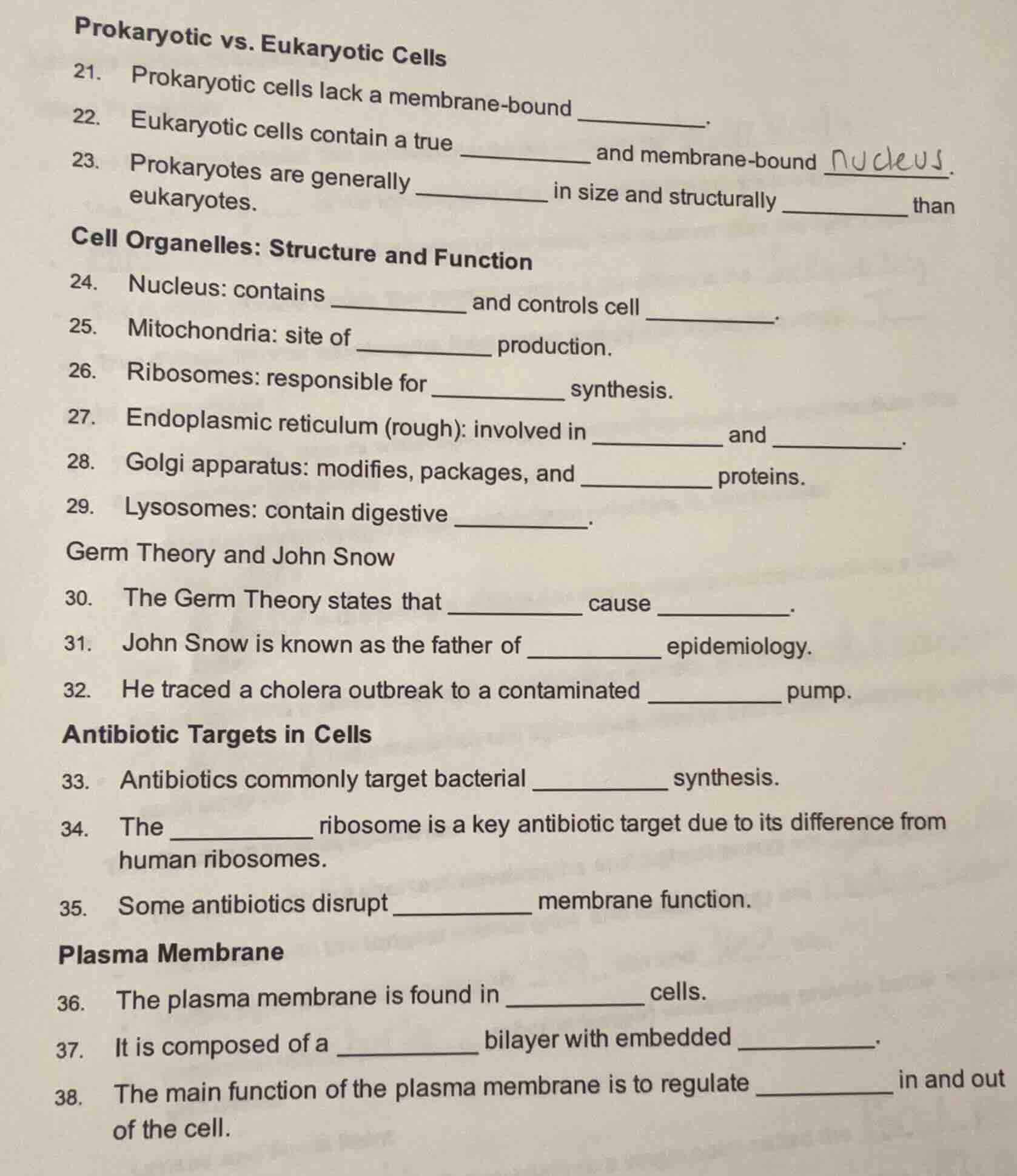
prokaryotic vs. eukaryotic cells
- prokaryotic cells lack a membrane - bound ______.
- eukaryotic cells contain a true ______ and membrane - bound nucleus.
- prokaryotes are generally ____ in size and structurally ____ than eukaryotes.
cell organelles: structure and function
- nucleus: contains ____ and controls cell ____.
- mitochondria: site of ______ production.
- ribosomes: responsible for ______ synthesis.
- endoplasmic reticulum (rough): involved in ____ and ____.
- golgi apparatus: modifies, packages, and ______ proteins.
- lysosomes: contain digestive ______.
germ theory and john snow
- the germ theory states that ____ cause ____.
- john snow is known as the father of ______ epidemiology.
- he traced a cholera outbreak to a contaminated ______ pump.
antibiotic targets in cells
- antibiotics commonly target bacterial ______ synthesis.
- the ______ ribosome is a key antibiotic target due to its difference from human ribosomes.
- some antibiotics disrupt ______ membrane function.
plasma membrane
- the plasma membrane is found in ______ cells.
- it is composed of a ____ bilayer with embedded ____.
- the main function of the plasma membrane is to regulate ______ in and out of the cell.
Brief Explanations
These are fill-in-the-blank questions covering core cell biology, microbiology, and cell membrane concepts. Each answer is based on standard biological definitions and established scientific facts.

Snap & solve any problem in the app
Get step-by-step solutions on Sovi AI
Photo-based solutions with guided steps
Explore more problems and detailed explanations
- nucleus
- nucleus; organelles
- smaller; simpler
- genetic material; activities
- ATP (energy)
- protein
- protein synthesis; protein folding
- transports
- enzymes
- microorganisms (germs); infectious diseases
- modern
- water
- cell wall
- bacterial (prokaryotic)
- bacterial (cell)
- all (prokaryotic and eukaryotic)
- phospholipid; proteins
- substances