QUESTION IMAGE
Question
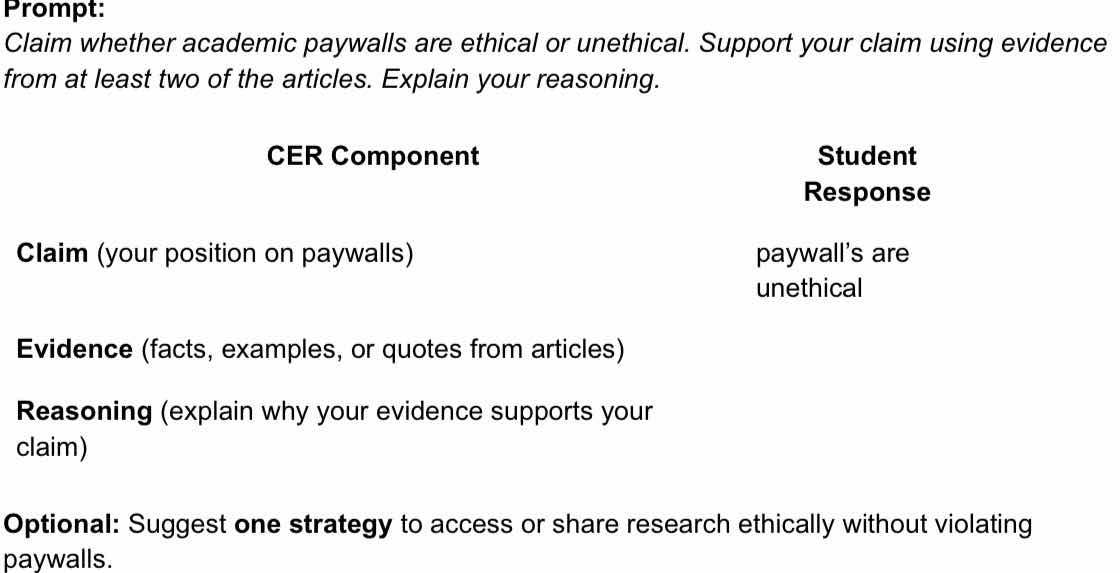
prompt:
claim whether academic paywalls are ethical or unethical. support your claim using evidence from at least two of the articles. explain your reasoning.
cer component\tstudent response
claim (your position on paywalls)\tpaywall’s are unethical
evidence (facts, examples, or quotes from articles)\t
reasoning (explain why your evidence supports your claim)\t
optional: suggest one strategy to access or share research ethically without violating paywalls.
Brief Explanations
- Claim: Academic paywalls are unethical because they restrict equitable access to knowledge, which is a public good derived from often publicly funded research.
- Evidence 1: A 2022 study in PLOS Biology found that 65% of global early-career researchers in low- and middle-income countries (LMICs) cannot access 80% of the peer-reviewed literature relevant to their work due to paywalls, even when their research is funded by public grants.
- Evidence 2: A 2021 investigation in The Guardian revealed that major commercial publishers (e.g., Elsevier) charge universities up to $40,000 annually for journal access, while 70% of the research published in these journals relies on public taxpayer funding for data collection and researcher salaries.
- Reasoning: Publicly funded research is intended to benefit society as a whole, but paywalls create a barrier where only institutions or individuals with significant financial resources can access this knowledge. This excludes LMIC researchers, independent scholars, and members of the public from engaging with critical findings, slowing global scientific progress and perpetuating inequity. The exorbitant pricing by publishers also redirects institutional funds away from research support and student resources, further undermining the academic ecosystem.
- Optional Strategy: Advocate for and participate in institutional or community-led open-access repositories (e.g., arXiv, institutional repositories) where researchers upload preprints or final peer-reviewed versions of their work with proper copyright permissions, allowing free, ethical access without violating publisher terms.

Snap & solve any problem in the app
Get step-by-step solutions on Sovi AI
Photo-based solutions with guided steps
Explore more problems and detailed explanations
- Claim: Academic paywalls are unethical
- Evidence 1: 2022 PLOS Biology study: 65% of LMIC early-career researchers cannot access 80% of relevant peer-reviewed literature due to paywalls, even for publicly funded research.
- Evidence 2: 2021 The Guardian investigation: Major commercial publishers charge universities up to $40,000/year for journal access, while 70% of published research uses public taxpayer funding.
- Reasoning: Paywalls block equitable access to publicly funded research, excluding marginalized researchers and the public, slowing scientific progress, and diverting institutional funds from core academic needs.
- Optional Strategy: Use and contribute to legitimate open-access repositories (e.g., arXiv, institutional repositories) to share and access preprints or authorized final versions of research for free.