QUESTION IMAGE
Question
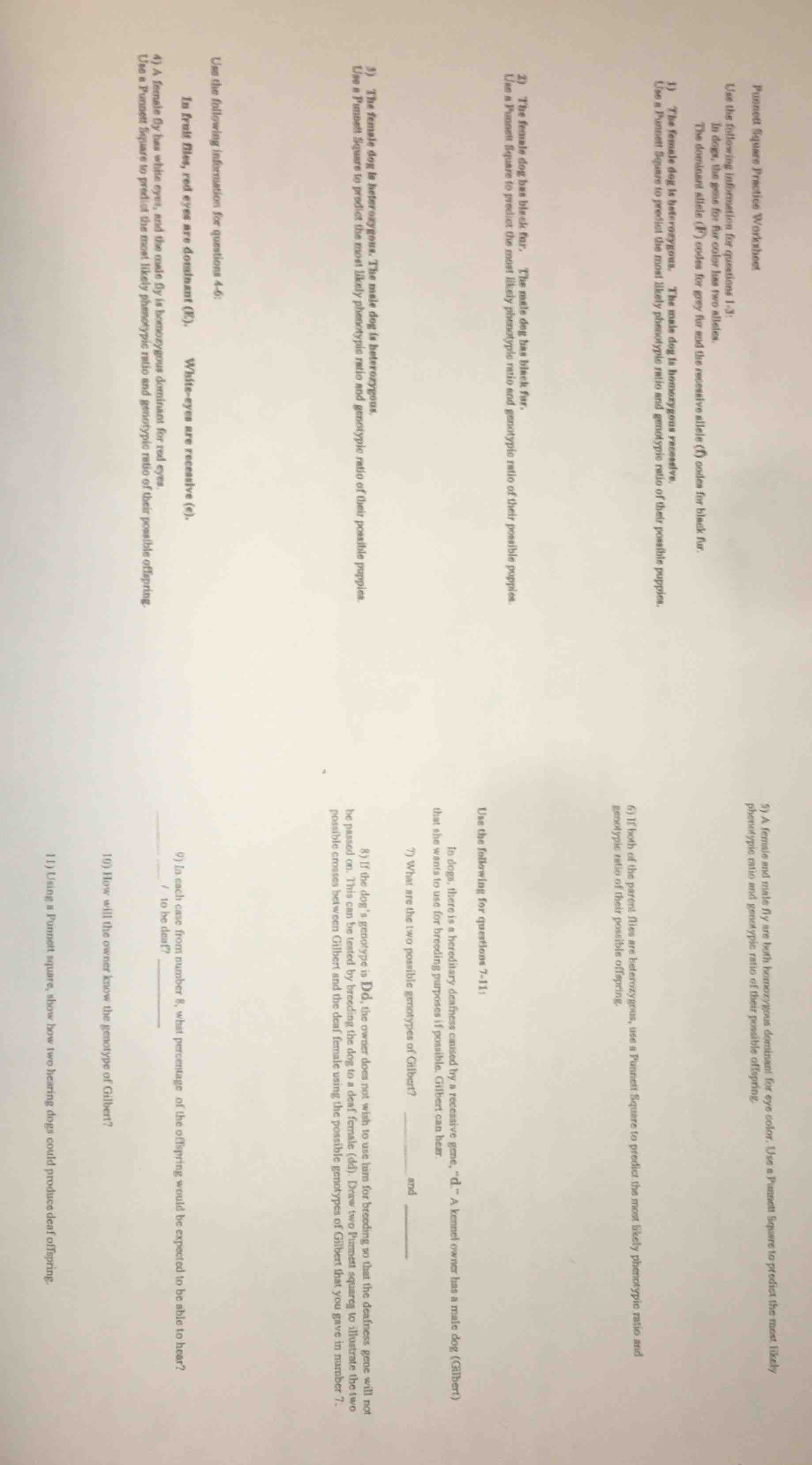
punnett square practice worksheet
use the following information for questions 1 - 3:
in dogs, the gene for fur color has two alleles.
the dominant allele (f) codes for grey fur and the recessive allele (f) codes for black fur.
- the female dog is heterozygous. the male dog is homozygous recessive.
(use a punnett square to predict the most likely phenotypic ratio and genotypic ratio of their possible puppies.
- the female dog has black fur. the male dog has black fur.
(use a punnett square to predict the most likely phenotypic ratio and genotypic ratio of their possible puppies.
- the female dog is heterozygous. the male dog is heterozygous.
(use a punnett square to predict the most likely phenotypic ratio and genotypic ratio of their possible puppies.
use the following information for questions 4 - 6:
in fruit flies, red eyes are dominant (e). white - eyes are recessive (e).
- a female fly has white eyes, and the male fly is homozygous dominant for red eyes.
(use a punnett square to predict the most likely phenotypic ratio and genotypic ratio of their possible offspring.
use the following for questions 7 - 11:
in dogs, there is a hereditary deafness caused by a recessive gene, “d.” a kennel owner has a male dog (gilbert) that she wants to use for breeding purposes if possible. gilbert can hear.
- what are the two possible genotypes of gilbert?
- if the dog’s genotype is dd, the owner does not wish to use him for breeding so that the deafness gene will not be passed on. this can be tested by breeding the dog to a deaf female (dd). draw two punnett squares to illustrate the two possible crosses between gilbert and the deaf female using the possible genotypes of gilbert that you gave in number 7.
- in each case from number 8, what percentage of the offspring would be expected to be able to hear? / to be deaf?
- how will the owner know the genotype of gilbert?
- using a punnett square, show how two hearing dogs could produce deaf offspring.
- a female and male fly are both homozygous dominant for eye color. use a punnett square to predict the most likely phenotypic ratio and genotypic ratio of their possible offspring.
- if both of the parent flies are heterozygous, use a punnett square to predict the most likely phenotypic ratio and genotypic ratio of their possible offspring.
To solve these Punnett Square problems, we'll address each question one by one. Let's start with question 1:
Question 1: Dog Fur Color
Given:
- Female dog: Heterozygous (\( Ff \))
- Male dog: Homozygous recessive (\( ff \))
- \( F \) (dominant) = black fur; \( f \) (recessive) = grey fur
Step 1: Set up the Punnett Square
The female’s gametes: \( F \) or \( f \) (since \( Ff \) → 50% \( F \), 50% \( f \))
The male’s gametes: \( f \) or \( f \) (since \( ff \) → 100% \( f \))
| \( F \) | \( f \) | |
|---|---|---|
| \( f \) | \( Ff \) | \( ff \) |
Step 2: Analyze Genotypes and Phenotypes
- Genotypes:
- \( Ff \): 2/4 = 50%
- \( ff \): 2/4 = 50%
- Genotypic ratio: \( 1:1 \) (\( Ff : ff \))
- Phenotypes:
- \( Ff \): Black fur (dominant allele \( F \))
- \( ff \): Grey fur (recessive allele \( f \))
- Phenotypic ratio: \( 1:1 \) (black : grey)
Question 2: Dog Fur Color (Both Black Fur)
Given:
- Female dog: Black fur (genotype? Assume \( Ff \) if heterozygous, but wait—wait, the problem says “female dog has black fur” and “male dog has black fur.” Wait, maybe the female is \( Ff \) (heterozygous) and male is \( Ff \)? Wait, no—the original problem says: “The female dog has black fur. The male dog has black fur.” Wait, maybe I misread. Wait, let’s check again.
Wait, the first problem (1) has female \( Ff \), male \( ff \). For question 2, maybe female is \( Ff \) (black) and male is \( Ff \) (black)? Wait, no—the problem says: “The female dog has black fur. The male dog has black fur.” Let’s assume both are heterozygous (\( Ff \)) (since black is dominant, so \( F \_ \) could be \( FF \) or \( Ff \), but to get variation, likely \( Ff \times Ff \)).
Step 1: Punnett Square for \( Ff \times Ff \)
Gametes: Female (\( F, f \)); Male (\( F, f \))
| \( F \) | \( f \) | |
|---|---|---|
| \( f \) | \( Ff \) | \( ff \) |
Step 2: Genotypes and Phenotypes
- Genotypes:
- \( FF \): 1/4
- \( Ff \): 2/4
- \( ff \): 1/4
- Genotypic ratio: \( 1:2:1 \) (\( FF : Ff : ff \))
- Phenotypes:
- \( FF, Ff \): Black fur (dominant \( F \))
- \( ff \): Grey fur (recessive \( f \))
- Phenotypic ratio: \( 3:1 \) (black : grey)
Question 3: Dog Fur Color (Heterozygous Female, Heterozygous Male)
Wait, no—question 3: “The female dog is heterozygous. The male dog is heterozygous.” Wait, for fur color? So same as question 2, \( Ff \times Ff \), leading to \( 3:1 \) phenotypic, \( 1:2:1 \) genotypic.
Question 4: Fruit Fly Eye Color
Given:
- Female fly: White eyes (recessive? Wait, no—“In fruit flies, red eyes are dominant (\( E \)). White eyes are recessive (\( e \)). A female fly has white eyes, and the male fly is homozygous dominant for red eyes.”
So:
- Female: White eyes → Genotype \( ee \) (recessive)
- Male: Homozygous dominant → Genotype \( EE \) (red eyes)
Step 1: Punnett Square
Female gametes: \( e, e \) (since \( ee \))
Male gametes: \( E, E \) (since \( EE \))
| \( E \) | \( E \) | |
|---|---|---|
| \( e \) | \( Ee \) | \( Ee \) |
Step 2: Genotypes and Phenotypes
- Genotypes: All \( Ee \) (heterozygous)
- Genotypic ratio: \( 1:0 \) (all \( Ee \))
- Phenotypes: All red eyes (dominant \( E \) in \( Ee \))
- Phenotypic ratio: \( 1:0 \) (all red)
Question 5: Fruit Fly Eye Color (Both Homozygous Dominant)
Given:
- Female and male: Homozygous dominant for eye color (so \…

Snap & solve any problem in the app
Get step-by-step solutions on Sovi AI
Photo-based solutions with guided steps
Explore more problems and detailed explanations
To solve these Punnett Square problems, we'll address each question one by one. Let's start with question 1:
Question 1: Dog Fur Color
Given:
- Female dog: Heterozygous (\( Ff \))
- Male dog: Homozygous recessive (\( ff \))
- \( F \) (dominant) = black fur; \( f \) (recessive) = grey fur
Step 1: Set up the Punnett Square
The female’s gametes: \( F \) or \( f \) (since \( Ff \) → 50% \( F \), 50% \( f \))
The male’s gametes: \( f \) or \( f \) (since \( ff \) → 100% \( f \))
| \( F \) | \( f \) | |
|---|---|---|
| \( f \) | \( Ff \) | \( ff \) |
Step 2: Analyze Genotypes and Phenotypes
- Genotypes:
- \( Ff \): 2/4 = 50%
- \( ff \): 2/4 = 50%
- Genotypic ratio: \( 1:1 \) (\( Ff : ff \))
- Phenotypes:
- \( Ff \): Black fur (dominant allele \( F \))
- \( ff \): Grey fur (recessive allele \( f \))
- Phenotypic ratio: \( 1:1 \) (black : grey)
Question 2: Dog Fur Color (Both Black Fur)
Given:
- Female dog: Black fur (genotype? Assume \( Ff \) if heterozygous, but wait—wait, the problem says “female dog has black fur” and “male dog has black fur.” Wait, maybe the female is \( Ff \) (heterozygous) and male is \( Ff \)? Wait, no—the original problem says: “The female dog has black fur. The male dog has black fur.” Wait, maybe I misread. Wait, let’s check again.
Wait, the first problem (1) has female \( Ff \), male \( ff \). For question 2, maybe female is \( Ff \) (black) and male is \( Ff \) (black)? Wait, no—the problem says: “The female dog has black fur. The male dog has black fur.” Let’s assume both are heterozygous (\( Ff \)) (since black is dominant, so \( F \_ \) could be \( FF \) or \( Ff \), but to get variation, likely \( Ff \times Ff \)).
Step 1: Punnett Square for \( Ff \times Ff \)
Gametes: Female (\( F, f \)); Male (\( F, f \))
| \( F \) | \( f \) | |
|---|---|---|
| \( f \) | \( Ff \) | \( ff \) |
Step 2: Genotypes and Phenotypes
- Genotypes:
- \( FF \): 1/4
- \( Ff \): 2/4
- \( ff \): 1/4
- Genotypic ratio: \( 1:2:1 \) (\( FF : Ff : ff \))
- Phenotypes:
- \( FF, Ff \): Black fur (dominant \( F \))
- \( ff \): Grey fur (recessive \( f \))
- Phenotypic ratio: \( 3:1 \) (black : grey)
Question 3: Dog Fur Color (Heterozygous Female, Heterozygous Male)
Wait, no—question 3: “The female dog is heterozygous. The male dog is heterozygous.” Wait, for fur color? So same as question 2, \( Ff \times Ff \), leading to \( 3:1 \) phenotypic, \( 1:2:1 \) genotypic.
Question 4: Fruit Fly Eye Color
Given:
- Female fly: White eyes (recessive? Wait, no—“In fruit flies, red eyes are dominant (\( E \)). White eyes are recessive (\( e \)). A female fly has white eyes, and the male fly is homozygous dominant for red eyes.”
So:
- Female: White eyes → Genotype \( ee \) (recessive)
- Male: Homozygous dominant → Genotype \( EE \) (red eyes)
Step 1: Punnett Square
Female gametes: \( e, e \) (since \( ee \))
Male gametes: \( E, E \) (since \( EE \))
| \( E \) | \( E \) | |
|---|---|---|
| \( e \) | \( Ee \) | \( Ee \) |
Step 2: Genotypes and Phenotypes
- Genotypes: All \( Ee \) (heterozygous)
- Genotypic ratio: \( 1:0 \) (all \( Ee \))
- Phenotypes: All red eyes (dominant \( E \) in \( Ee \))
- Phenotypic ratio: \( 1:0 \) (all red)
Question 5: Fruit Fly Eye Color (Both Homozygous Dominant)
Given:
- Female and male: Homozygous dominant for eye color (so \( EE \times EE \))
Step 1: Punnett Square
Gametes: All \( E \) (female \( E \), male \( E \))
| \( E \) |
|---|
Step 2: Genotypes and Phenotypes
- Genotypes: All \( EE \)
- Phenotypes: All red eyes
- Ratios: \( 1:0 \) (genotypic and phenotypic)
Question 6: Fruit Fly Eye Color (Both Heterozygous)
Given:
- Both heterozygous (so \( Ee \times Ee \))
Step 1: Punnett Square
Gametes: Female \( E, e \); Male \( E, e \)
| \( E \) | \( e \) | |
|---|---|---|
| \( e \) | \( Ee \) | \( ee \) |
Step 2: Ratios
- Genotypic: \( 1:2:1 \) (\( EE : Ee : ee \))
- Phenotypic: \( 3:1 \) (red : white) (since \( EE, Ee \) = red; \( ee \) = white)
Question 7: Dog Deafness (Genotype of Gilbert)
Given:
- Deafness is recessive (\( d \)); hearing is dominant (\( D \))
- Dog’s genotype: \( Dd \) (hearing, since \( D \) is dominant)
- Owner wants to breed to avoid deafness (genotype \( dd \))
So Gilbert is a male dog. The owner wants to know Gilbert’s genotype. To test, breed with a deaf female (\( dd \)):
- If Gilbert is \( DD \):
Gametes: \( D, D \)
Cross \( DD \times dd \): All offspring \( Dd \) (hearing)
- If Gilbert is \( Dd \):
Gametes: \( D, d \)
Cross \( Dd \times dd \): Offspring \( Dd \) (hearing) and \( dd \) (deaf)
Question 8: Probability of Deafness (Gilbert \( Dd \) × Deaf Female \( dd \))
Given:
- Gilbert: \( Dd \)
- Deaf female: \( dd \)
Step 1: Punnett Square
Gilbert’s gametes: \( D, d \)
Deaf female’s gametes: \( d, d \)
| \( D \) | \( d \) | |
|---|---|---|
| \( d \) | \( Dd \) | \( dd \) |
Step 2: Genotypes
- \( Dd \): 2/4 = 50% (hearing)
- \( dd \): 2/4 = 50% (deaf)
- Probability of deaf (\( dd \)): 50% (1/2)
Question 9: Percentage of Hearing/Deaf Offspring (Number 8)
From question 8, the ratio of hearing (\( Dd \)) to deaf (\( dd \)) is \( 1:1 \). So:
- Percentage of hearing: 50%
- Percentage of deaf: 50%
Question 10: How to Know Gilbert’s Genotype
Breed Gilbert with a deaf female (\( dd \)):
- If all offspring can hear (no deaf puppies), Gilbert is \( DD \) (homozygous dominant).
- If some offspring are deaf (50% chance), Gilbert is \( Dd \) (heterozygous).
Question 11: Two Hearing Dogs Produce Deaf Offspring
Given:
- Both hearing dogs (genotype? Must be \( Dd \), since deaf offspring (\( dd \)) need two recessive alleles, one from each parent).
Step 1: Punnett Square for \( Dd \times Dd \)
Gametes: \( D, d \) (both parents)
| \( D \) | \( d \) | |
|---|---|---|
| \( d \) | \( Dd \) | \( dd \) |
Step 2: Genotypes/Phenotypes
- \( dd \): Deaf (25% chance)
- So two hearing dogs (\( Dd \)) can produce a deaf puppy (\( dd \)) because each parent can pass the recessive \( d \) allele.
Final Answers (Key Ratios for Each Question)
- Phenotypic Ratio: \( 1:1 \) (black : grey); Genotypic Ratio: \( 1:1 \) (\( Ff : ff \))
- Phenotypic Ratio: \( 3:1 \) (black : grey); Genotypic Ratio: \( 1:2:1 \) (\( FF : Ff : ff \))
- (Same as Q2 if both heterozygous)
- Phenotypic Ratio: \( 1:0 \) (all red); Genotypic Ratio: \( 1:0 \) (all \( Ee \))
- Phenotypic Ratio: \( 1:0 \) (all red); Genotypic Ratio: \( 1:0 \) (all \( EE \))
- Phenotypic Ratio: \( 3:1 \) (red : white); Genotypic Ratio: \( 1:2:1 \) (\( EE : Ee : ee \))
- Gilbert’s possible genotypes: \( DD \) or \( Dd \); test by breeding with \( dd \).
- Probability of deaf offspring: \( 50\% \) (1/2)
- Percentage hearing: \( 50\% \); Percentage deaf: \( 50\% \)
- Breed with \( dd \); no deaf = \( DD \), some deaf = \( Dd \).
- Both parents \( Dd \) (hearing) can pass \( d \) → \( dd \) (deaf) offspring.
(Note: For specific questions, provide the ratio or probability as needed. For example, Q1: Phenotypic ratio \( 1:1 \), Genotypic ratio \( 1:1 \).)